
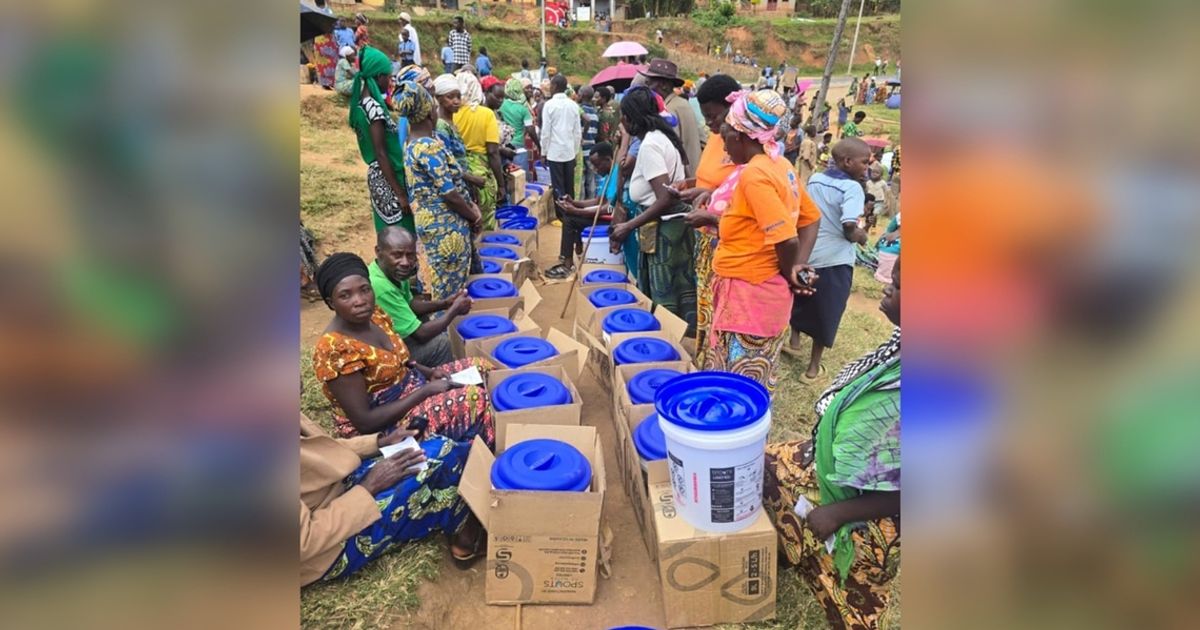
ANTALYA, Turkey — Carbon-tax liable firms in Singapore could soon buy carbon credits from a water purification project in Rwanda to shrink their tax bill.The National Environment Agency (NEA) said on Nov 14 that both countries have authorised the project by developer Climate Bridge International.The project entails the distribution of 300,000 water filters that will provide access to safe drinking water without having to boil it using firewood or charcoal.By reducing reliance on these fuels for water treatment, the project will also reduce emissions and indoor air pollution.The filters will provide safe drinking water to about 1.8 million people, and save around 780,000 tonnes of emissions from 2026 to 2030. This is equivalent to taking about 184,000 cars off the road for a year.Spending less time to collect firewood is also expected to give people more time for education, income-generating activities and community participation, said NEA.This is the first project that has been authorised under Singapore’s carbon credit framework.Under the framework, tax-liable companies here can buy eligible carbon credits to offset up to 5 per cent of their taxable emissions.The credits can come only from authorised projects in countries that Singapore has implementation agreements with.Rwanda is one of 12 countries that Singapore has such agreements with, and there are currently more than 20 projects undergoing assessment under the Singapore-Rwanda implementation agreement.An implementation agreement is a legally binding document that governs the international transfer of carbon credits between two countries.A key element of these agreements is to prevent double counting, which is where both the buyer and host country count the same emissions reductions or removals towards their own targets.A host country must agree to make a “corresponding adjustment” to add the sold emissions back to its national inventory.Of the 12 implementation agreements, six have been operationalised, which means that the applications for projects have been called.The six countries are: Ghana, Bhutan, Peru, Rwanda, Thailand and Mongolia.NEA made the announcement about the first authorisation from Rwanda alongside the ongoing UN climate summit COP31, which is being held in the Turkish city of Antalya.Representatives from nearly 200 countries are gathered there to discuss how to tackle climate change.One way to do this is through the carbon markets.Under the Paris Agreement, which aims to limit global warming to 1.5 deg C above pre-industrial levels, countries can buy credits generated elsewhere as long as the climate benefit is not double counted by host and buyer countries.One carbon credit represents one tonne of carbon dioxide that is either prevented from being released – by saving a forest from the axe, for example – or removed from the atmosphere, such as from a direct air capture plant.The carbon markets contribute to climate action, as it directs funds from carbon emitters to developing countries hosting these green projects.Under the Rwanda project, 300,000 ceramic water filters will be distributed to households and early childhood development centres across Rwanda, largely in the Western Province.The project will support Rwanda’s national climate targets, which include improving access to safe drinking water.An initial number of 10,000 water filters has been distributed in June 2026 with the remaining to be progressively deployed in 2027, said NEA.The implementation agreement between Singapore and Rwanda has three stages.At each stage, both countries assess applications against their own requirements.For Singapore, projects must meet Singapore’s eligibility criteria, for high-integrity carbon credits, where the climate benefit can be trusted and verified.At the second stage, both countries will issue letters of authorisation to approved projects. This signifies that the projects are approved under the implementation agreement to generate carbon credits under the Paris Agreement.The emission reductions will then be verified by an independent verification body and carbon credits will be issued by a carbon crediting programme.At the final stage, both countries authorise the transfer of carbon credits.Permanent Secretary for Sustainability and the Environment Melvyn Ong (left) and Bangladesh’s State Minister for Environment, Forest and Climate Change Shaikh Faridul Islam signing an MOU on Nov 14. PHOTO: COP31 SINGAPORE PAVILIONSeparately, Singapore and Bangladesh on Nov 14 inked an agreement at COP31’s Singapore Pavilion to explore carbon trading in the future.Both countries will now work towards an implementation agreement, which would help Singapore meet its climate targets while channelling finance to the South Asian nation.
S’pore authorises first carbon credit project in Rwanda
Full Article
Original Source
Read the full article at Straitstimes →KhanList aggregates and links to publicly available news content. We do not host full articles from third-party sources. Always verify important information with original sources.