
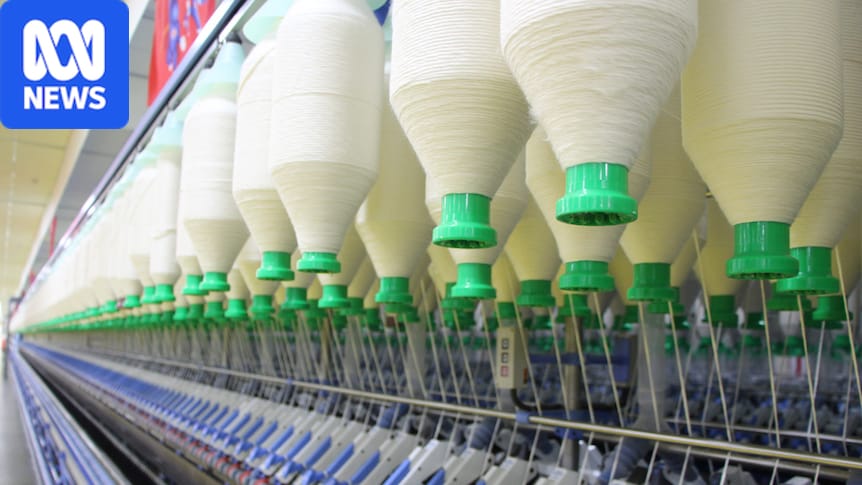
Australia's chief science agency has created a blueprint to re-establish spinning mills, a vital link in the country's clothing supply chain that disappeared in the 1980s. The CSIRO report looked at the feasibility of spinning mills, producing a template manufacturers can use to re-establish domestic production. While small parts of the textile and clothing sector have survived the offshoring trend of the past four decades, this critical link from farm to hanger is completely missing.As changes to global trade and technology make the return of spinning possible, the fashion industry is warning it will take significant investment to make it probable.To encourage it, they are calling on the nation's largest purchaser of uniforms to guarantee demand by committing to Australian-made.Raw fibre or synthetics can be spun into yarn to make textiles or thread. (Supplied: Stu Ross, Milk Video)Spinning yarnA spinning mill is a factory where raw cotton, wool or synthetic fibres like polyester are twisted together, or spun, to make yarn and thread that can be woven into textiles.Facing worker shortages, rising electricity costs and cheap garments made overseas, spinning mills have disappeared from Australia over the past 40 years.Australian Fashion Council (AFC) chief executive Sam Delgos said the industry saw value in producing the material and end garment solely in the country."Textile, clothing and footwear manufacturing contracted sharply in the 1980s after the import tariffs were removed," she said.Sam Delgos says the industry wants Australia to have capability at every stage of the manufacturing process. (Supplied: Australian Fashion Council)Earlier this year, AFC released its own national manufacturing strategy to bring it back."The industry is very clear they want the capability to be able to take our Australian-grown cotton and wool all the way from farm to finished garment here," Ms Delgos said."Every stage of that process that we're not doing in Australia is values, jobs and of course traceability of our supply chain that we're handing over to another country."Australia sends raw cotton overseas to countries like China to be spun into yarn and thread. (ABC News: Brett Worthington)Template for returnThe CSIRO study was funded by the cotton industry and the federal government through Cotton Research and Development Corporation (CRDC).The study's author, senior principal research scientist Stuart Gordon, said the work could be used by companies exploring establishing a mill as a blueprint and scaled to their specific needs."It provides a reasonably objective template for people to run a more focused business case," Dr Gordon said.Stuart Gordon says the blueprint can be scaled to a company's needs. (Supplied: CSIRO)The study considered challenges like the cost of electricity and workforce skill shortages, as well as where mills could be built. It identified Toowoomba and Brisbane in Queensland, Narrabri, Dubbo and Sydney in New South Wales and Melbourne in Victoria as potential locations.Dr Gordon said it allowed companies to compare being closer to the inputs, like cotton or wool growing regions, or closer to textile manufacturers and ports where the yarn will be exported."If we have it in Toowoomba, the cost to the mill there is quite low, but the cost of the goods out of the mill, to the local manufacturers at least, is quite high," he said.'A unique capability'The study specifically looked at the feasibility of short-staple spinning, a technique primarily used for cotton.Peak industry body Cotton Australia chief executive Adam Kay said advances in technology had mitigated some of the issues that had led production to move overseas."Spinning mills, they're all automated, there's very little labour [now]," he said."The key thing is apparently the energy costs to run the mill."If energy costs can come down, that will make it attractive to have spinning back in Australia [which is] certainly, something we'd love to see."This shows the different fibre lengths of wool and cotton. (Supplied: Eqwools)The short-staple spinning system can also take other fibres like synthetics, recycled fibres, hemp and even a special type of wool.Wool is traditionally spun in a long-staple mill, but Australian company Michell Wool has figured out how to spin the shorter part of the wool clip in the system.General manager Gaynor Scott said the company had no choice but to send the shorter wool overseas to be spun.She wanted to see spinning return to Australia."That would give us a really unique capability," she said.Alongside being able to supply the domestic industry, Ms Scott said it would open up opportunities to export yarn to international textile manufacturers."It would also be really important to have that manufacturing capability from a providence standpoint," she said.Wool and cotton spinning is the only step of textile manufacturing that is not available in Australia. (Supplied: Eqwools)Guaranteed demandWhile the AFC welcomed the feasibility study, Ms Delgos said manufacturers needed confidence in ongoing demand before they invested.That could be achieved by getting the largest purchasers of clothing and textiles in the country to buy Australian-made."The government procurement of uniforms, defence apparel, would be one of the few levers that can create certainty at scale," she said."At the moment, we actually don't have any verifiable information about what percentage of contracts were actually landing with Australian manufacturers."Each department in the federal government runs its own procurement, but the policy they adhere to sits under the finance department.A spokesperson for the department said there was a range of measures to promote domestic economic growth through procurement.It said that included targets to source from small to medium enterprises and requirements to first consider Australian businesses and the benefit to the economy."The government continues to engage with industry and stakeholders to ensure the commonwealth procurement framework supports competitive Australian businesses while maintaining value for money and open, transparent procurement processes," they said.
Spinning mill blueprint could provide path to manufacturing revival
Full Article
Original Source
Read the full article at Abc →KhanList aggregates and links to publicly available news content. We do not host full articles from third-party sources. Always verify important information with original sources.