
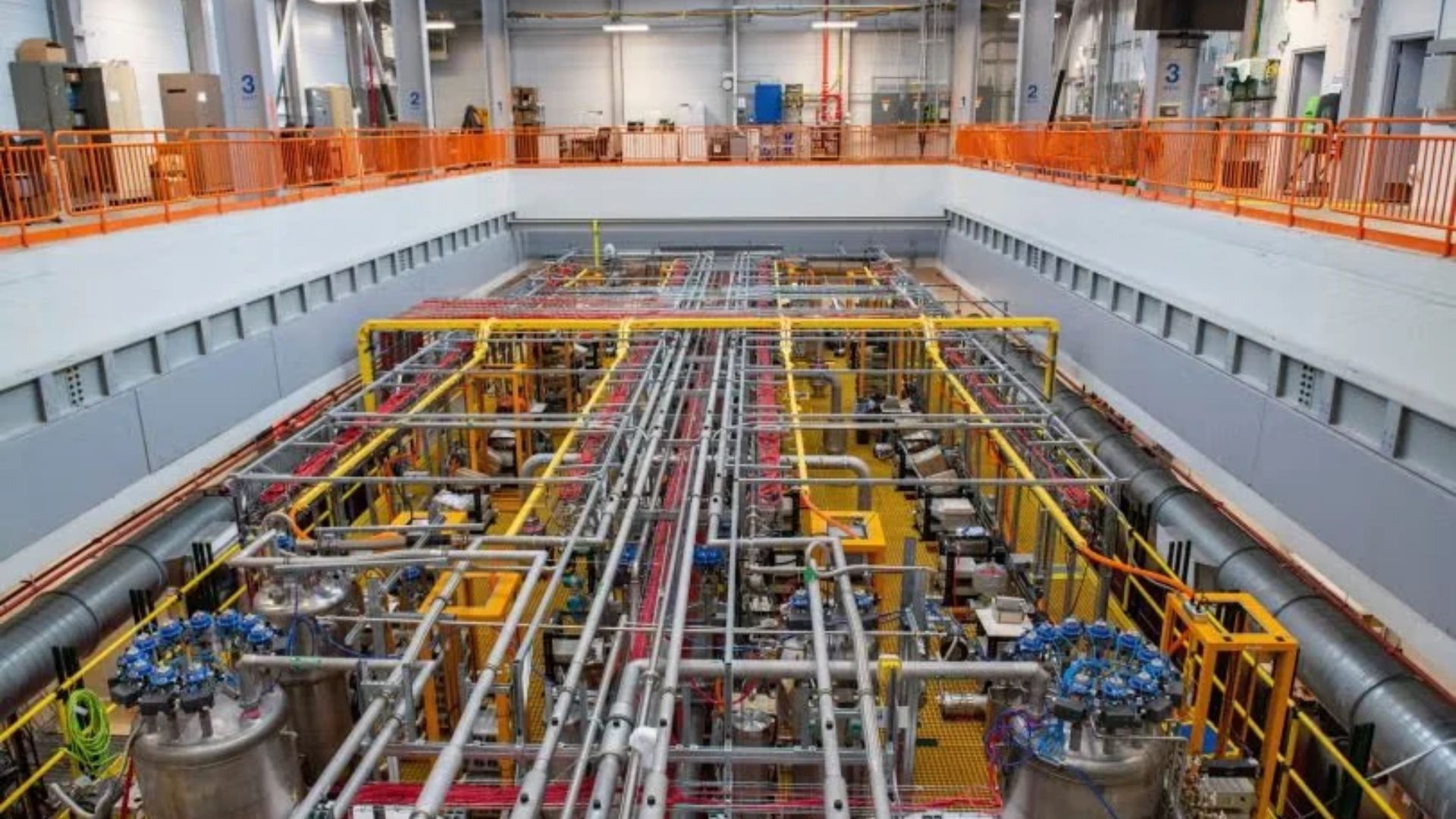
Key TakeawaysNeutrinos are ghostly particles that are abundant but difficult to detect.Neutrino detectors generate complex images of their interactions that need to be processed efficiently to understand the physics.SPINE uses machine learning to process data in parallel than in series to prevent accumulation of errors.US researchers at the SLAC National Accelerator Laboratory have developed the Scalable Particle Imaging with Neural Embeddings (SPINE). It is a machine learning tool to analyze data from experiments designed to find neutrinos, the elusive ghost particle. The tool recently analyzed its first set of data from a real-world experiment and is prepared to tackle data from more ambitious projects in the future. Neutrinos are extremely abundant particles in our universe but are the most elusive. These nearly massless particles are released by stars and and radioactive elements alike but rarely interact with matter. Despite their abundance, these have been very difficult to detect. So, scientists have built large particle accelerators and complex detectors to catch these ghostly particles. A typical neutrino detector holds hundreds of tons of liquid argon cooled to temperatures of -300 degrees Fahrenheit (-184 degrees Celsius). When a neutrino strikes an argon atom, it sends several particles traveling through the liquid and leaves a trail of electrons that are picked up by collection wires to create a three-dimensional image of the event. Reconstructing the event with SPINE Capturing the image is only the beginning, since scientists must reconstruct the event from a complex picture generated by data from the collection wires, overlapping signals, and background activity, which can include multiple neutrino interactions at the same time. Conventionally, scientists have done this using special algorithms that chain events together one step at a time. Each algorithm performs a narrow task and passes it to the next. However, this carries a significant risk: an error at any step can carry forward through the rest of the computation. To address this, researcher François Drielsma, a scientist at SLAC, used a different approach in which multiple machine-learning models work together to reconstruct the event. Different models perform different tasks such as spotting basic features in the image, identifying individual particles, and then piecing together the complete interaction. The work began as a postdoctoral position at SLAC in 2015-16 and has been expanded into a program that will eventually be deployed on eight different detectors in the future. The first test Much of SPINE’s work so far consisted of simulations to test whether the approach works. More recently, the team got their hands on real-world data from ICARUS, the largest detector in the Short-Baseline Neutrino program at the Fermi National Accelerator Laboratory in Illinois. Neutrinos are known to oscillate between the three flavors as they travel, but physicists wonder whether if sterile neutrino produces some oscillations that the three flavors cannot explain. Even though the first analysis did not make a major scientific breakthrough, the researchers found that SPINE recovered 60 percent more neutrino interactions that were usable when compared to conventional approaches. With more experiments underway in the Short-Baseline program, SPINE will have more data to analyze later this year and in 2027, but the team has already set its sights on results from the Deep Underground Neutrino Experiment (DUNE), which will begin operations by 2030. Under construction, DUNE will send a neutrino beam from Fermilab in Illinois to detectors 800 miles away in South Dakota. The experiment’s near detector is expected to see over 1,000 interactions per 10 seconds as it searches for answers to the matter-antimatter asymmetry. SPINE is already trained to handle data from DUNE detectors. Get the latest in engineering, tech, space & science - delivered daily to your inbox.Ameya is a science writer based in Hyderabad, India. A Molecular Biologist at heart, he traded the micropipette to write about science during the pandemic and does not want to go back. He likes to write about genetics, microbes, technology, and public policy.
SPINE: US-developed ‘super intelligence’ tool to decode elusive neutrino data
Full Article
Original Source
Read the full article at Interestingengineering →KhanList aggregates and links to publicly available news content. We do not host full articles from third-party sources. Always verify important information with original sources.