
In 2026, Germany is spending a record €125 billion on defense, second only to the United States among NATO allies, and its core defense budget is set to reach €170 billion by 2029. Its military strategy promises Europe’s strongest conventional army by 2039 with a technologically superior and innovative Bundeswehr, Germany’s armed forces.German startups and “neo-primes” — venture-backed defense companies built to compete with established primes — demonstrate, most visibly in Ukraine, that money can become capability quickly and cheaply. Much of that proof is paid for by Berlin: Germany is Ukraine’s second-largest bilateral donor and finances the drones that German startups deliver there. Yet the Bundeswehr itself has rarely followed this approach for its own forces (although the loitering munitions contracts are a bright spot). The Kiel Institute’s tracker of publicly announced orders shows that the share of German procurement going to novel capabilities such as drones and artificial intelligence has fallen from 22 percent in 2020 to 9 percent today. To understand why the Bundeswehr does not yet benefit in the same way Ukraine does, we conducted 125 interviews with politicians, military personnel, founders, and investors across Germany’s defense innovation ecosystem for a forthcoming study.Before sharing our lessons, readers should know where we sit. One of us chairs the NATO Innovation Fund, which invests in defense, security, and resilience startups of the kind this article urges Germany to engage. The other works in corporate strategy at HENSOLDT, a German defense prime with a direct stake in how procurement priorities and processes are set. These interests pull in different directions. Consequently, our conclusions favor no single company and no class of supplier.We identified three interdependent levels that Germany should fix: The first is strategy, defining what it needs, with what priority, and what it is willing to pay for. The second is budget oversight, the way the Bundestag turns priorities into money. The third is the procurement process that turns those priorities into equipment. For Germany’s reforms to succeed, we propose what has to change at each level and close with the incentives that will decide whether any of these reforms take hold.Sign Up for Our NewsletterPriorities FirstVolumes have been written about German procurement reform with expert commissions in 2000 and 2010, a 2014 review of the Bundeswehr’s major programs, and the 2025 report from Germany’s federal auditors. All of them address the procurement process, calling for involving industry early, buying what the market offers (instead of gold-plated specs), and placing engineers from the procurement office on the contractor’s floor. None emphasizes the level above, the strategy that says which capabilities Germany needs.Germany has strategy papers in abundance (national security strategy, defense industry strategy, even the military strategy cited above). All of them describe what Germany should consider and coordinate, but none defines the end state or a theory of victory, and without either, what to buy first is difficult to say.The Bundeswehr has a capability profile derived from NATO’s targets, but both are classified, and the profile reportedly lacks prioritization. One interviewee described the central prioritization instrument: a single chart on which the chief of defense, Germany’s most senior officer, assigns all capabilities to one of two priority tiers, high and highest. The planning office and the service branches then break these capabilities down into individual projects. Unfortunately, they flag every project as urgent and important, making it difficult for the procurement office to sequence projects or shift staff.Outside the Bundeswehr, neither the Bundestag’s defense committee nor the private sector can read what it intends to buy, so the market has no signal to plan against. A step in the right direction is NATO’s pledge at its July 2026 Ankara summit to invest roughly €35 billion in counter-drone capabilities over five years, but it has yet to be translated into German priorities.To provide the missing ranking inside the Bundeswehr and the missing signal outside, German leaders should do the hard work of distilling a short, ranked list of priorities that tells the private sector what Germany will buy first. The chief of defense would draw up the ranking with an emphasis on capabilities, not on “kit” (i.e. what effects should be purchased, not what products), to allow room for innovation. The state secretary responsible for armaments and innovation would settle the ranking with the chief of defense, and the minister would sign it off. Today’s “single chart” carries no consequences. The priority list would, since each entry becomes a program with a budget and a delivery date.The planning office and the service branches would still file their projects, but no longer grade them as unilaterally urgent, since a project’s priority would follow from its capability’s rank. The list would be updated regularly and shared as openly as security allows.Naming capabilities rather than products or suppliers also limits the risk that such a list weakens the Bundeswehr’s hand in negotiations. It might even attract more bidders per entry. German procurement lacks competition today, which drove the price increases of recent years, as the Bundestag’s budget rapporteurs point out.There is precedent for such an approach. Estonia’s central procurement agency publishes such a list, with amounts and years, and updates it continuously. Canada’s new Defence Investment Agency concentrates on the largest, most strategic programs, and the United States gives its Defense Innovation Unit a mandate to accelerate the adoption of commercial technology in regularly updated priority areas.Budget Oversight Without SteeringBetween a priority and the program that delivers against it sits the budget. In Germany, the Bundestag releases funds contract by contract. Every contract above €25 million requires a submission to its budget committee, a threshold dating from 1981. A former senior defense ministry official told us that this threshold catches virtually everything the Bundeswehr buys.Each submission is a lot of work. The procurement office negotiates the full contract with the supplier, its lawyers clear it, the defense ministry releases the budget, and the finance ministry confirms the money is there, all before the budget committee sees it. A former project leader in the procurement office told us this can take a year, and the rule applies even where the Bundestag has already decided. He recalled a €1 billion framework contract for information technology, approved by the Bundestag, from which every call-off above €25 million still needed its own submission.The Bundestag micromanages each contract but has no say in the strategic choices behind it. In December 2025, the committee approved around 30 proposals totaling €52 billion, and one rapporteur complained that nobody had time to read them all. Nonetheless, its members defend the process as their only lever over defense spending. Raising the threshold would change little: At €100 million, we were told, only six of the roughly 100 submissions of 2025 would have disappeared.To give the Bundestag a say in strategy rather than contracts, we propose moving its decision to the start of a program and tying it to the priority list. For each entry, the planning and procurement offices and the future users explore what the market can deliver and settle in a short, binding document: which strategic gap the program is aimed at, what performance it should deliver, what it may cost, and when it should be fielded. A body, elected by the Bundestag and drawn from the budget and defense committees and sitting with the defense and finance ministries and the procurement office, should then confirm that document, replacing today’s contract-by-contract submissions.Scrutiny should scale with the stakes. For example, a new air defense system warrants a closer look than a routine ammunition order. The program would report back on budget, schedule, and delivered performance. Parliament, having co-decided at the beginning, could afford to let go at the end.Fixing the Procurement ProcessThe program document proposes three elements today’s process lacks or brings in too late: the users’ voice, market knowledge before requirements are written, and a procurement path that fits the program.Today, the planning office writes requirements over long cycles, at arm’s length from the soldiers who will use the equipment. Only then does it hand finished specifications to the separate procurement office, which meets the market for the first time at the tender. One drone maker told us of a specification demanding his system function from minus 48 to plus 80 degrees Celsius, extreme temperatures that do not exist in Germany.Meanwhile, German defense tech startups are seeking to understand these priorities, having raised €3.1 billion from venture capital in 2026, 56 percent of Europe’s total, and developing products at their own risk. Founders told us the process needs a visible door for solutions that the market offers unasked. Germany opened one in Feb. 2026 with the Bundeswehr innovation center in Erding, which founders praise, but we were told the contract forms it needs to work with startups are still being set up. Across all groups, interviewees want requirements written only after the priority is set and the market has been explored, with future users at the table.Programs differ in how much is at stake and how many suppliers can deliver them — both should determine the procurement approach. Germany’s process makes no such distinction, and none of its variants considers how competitive the supply market is. So beyond its simplified track for small purchases, a drone follows the same steps as a frigate. The United States, by contrast, assigns every program to one of six pathways in its Adaptive Acquisition Framework.We therefore propose what industrial buyers have done for decades: categorize purchases by strategic importance and supply-market risk, and treat them differently. A high-importance program in a thin market, such as air defense, would get a team that supervises the manufacturer on site (rather than relying on penalty clauses alone) and a contract that pays for delivered performance. One interviewee recalled a German yard building a yacht for a Russian oligarch, who kept 25 engineers in the dock for five years, while the naval dock next door contained no one from the procurement office. No surprise, the warship arrived years late and over budget. A routine purchase in a competitive market would focus on price and speed.Supervising a manufacturer on site, or understanding whether fiber-optic drones for GPS-denied environments should change the priority list, takes skills the procurement office does not have today. The procurement office has 7,900 staff, nearly 13,000 including its test centers. One interviewee familiar with the office told us its engineers are mostly weapons engineers and it lacks manufacturing and supply-chain engineers who can tell whether a supplier’s production promises are realistic. With around 1,800 positions unfilled, the office has room to hire them.Changing the YardstickPrevious reforms have failed. Several interviewees doubted today’s will fare better, since the same people are asked to produce different outcomes. Our interviews suggest the reason is not a lack of will but what the system is measured on: money spent.A former leader in the procurement office told us that in three decades he had seen defense ministers questioned in the Bundestag for money left unspent, never for a missing capability. Four years into the war in Ukraine, we were told, a ministry workshop asked the procurement office when the Bundeswehr would reach NATO’s goal of a 30-day stock of 155 mm artillery shells in case of a crisis. The project manager could not say, since counting the shells bunker by bunker would take 14 days. The office, our interviewee concluded, was not tracking its progress toward that target.Inside the procurement office, money not spent by year-end lapses, hence the December rush to sign contracts. Price discipline suffers for the same reason. One example we were given: the Bundeswehr bought 191,000 headsets for which the office paid €19 extra per set for a printed user manual. This cost the government €3.6 million for booklets alone. Others include AA batteries at €10 apiece that cost well under €1 in the shop, a practice Germany’s federal auditors have criticized, and the list goes on. And if the measure is money out the door, one contract with a prime moves the same sum as a dozen contracts with startups at a fraction of the work, even if the startups’ offers are more innovative, cheaper over their lifetime and more useful to the frontline.In April 2023 the defense minister made time the top priority of procurement, and the state secretary responsible for armaments issued a decree allowing staff to deviate from internal rules whenever that speeds up a purchase. Since then, one interviewee told us, the decree has never been applied, because the yardstick is still money spent and nobody is rewarded for taking risk.The yardstick has to become capability delivered, measured against the ranked list and the program document. Some call for a new coordinator in the chancellery. But the state secretary already oversees both the planning and procurement offices. The problem is that the two are separate stovepipes. We believe the fixes above would bridge them.Like many NATO member states, Germany wants to turn money into capability and drive its capital markets towards its national priorities. None of the fixes proposed costs additional money or requires a new office. Time is the scarce resource, since the discretionary share of the federal budget has fallen to 16 percent and could fall to 5 percent by 2029. Getting the machinery right decides whether the money of this decade becomes the deterrence of the next.Write for Cogs of WarDame Fiona Murray is the William Porter (1967) Professor of Entrepreneurship at the MIT Sloan School of Management. She chairs the NATO Innovation Fund and is a vice chair of the U.K. Ministry of Defence’s Defence Industry Joint Council.Ardit Gashi works in corporate strategy at HENSOLDT, a German defense electronics company, and is a visiting researcher at the MIT Sloan School of Management. The views expressed are the authors’ own and do not represent those of their organizations.Image: Bundeswehr/Marco Dorow via Flickr.
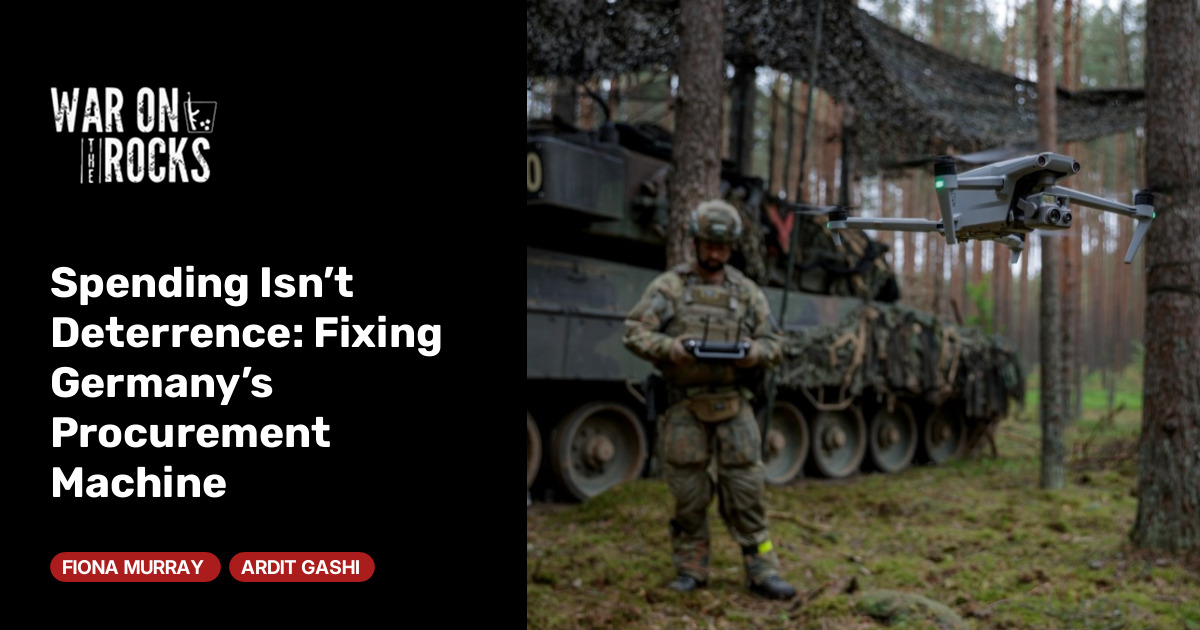
Spending Isn’t Deterrence: Fixing Germany’s Procurement Machine
Full Article
Original Source
Read the full article at Warontherocks →KhanList aggregates and links to publicly available news content. We do not host full articles from third-party sources. Always verify important information with original sources.