
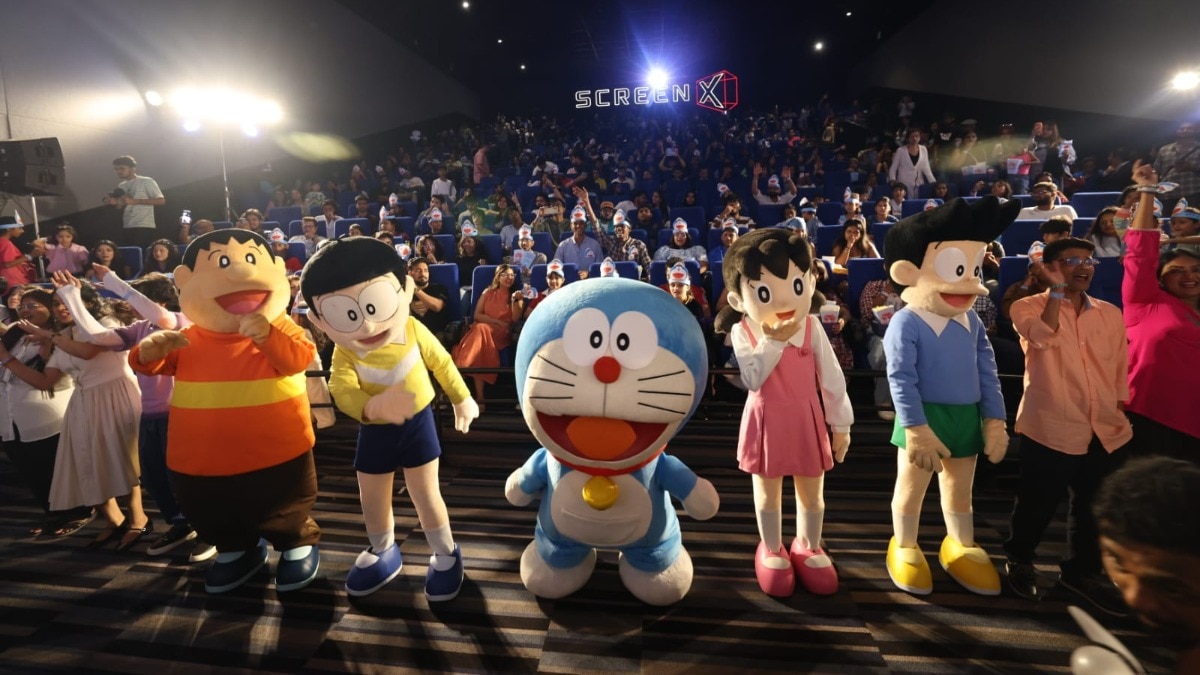
Doraemon may have been born in Japan, but somewhere along the way, India adopted the blue robot cat as its own. More than 20 years after the Japanese manga character first found his way into the Indian market, Doraemon is no longer just a childhood favourite. He is a multi-generational habit. The kids who once watched Nobita get bullied by Gian are now parents watching their own children grow up with the same characters. And that longevity has not gone unnoticed by the people behind the franchise.The makers of Doraemon were in India recently to promote Doraemon: New Nobita and the Castle of the Undersea Devil. In a conversation with India Today, Maiko Sumida, Head of Animation and Global Business Development at TV Asahi; Mr Nakajima of Shin-Ei Animation, the animation studio behind the film; and Mr Yoshida of Fujiko Pro, the office of Doraemon's original authors, spoke about the franchise's enduring popularity, its legacy and its future."Doraemon has been in India for over 20 years now. It has been passed on from someone who has been watching it as a kid to the parents and now to their kids. And to Doraemon, of course, India is a very special market in that sense for that longevity," they told in an exclusive chat with India Today.It is quite the journey for a character who was originally created for Japanese children. Doraemon began as a manga in 1970 before making the leap to television and, eventually, the big screen. Today, the franchise is appreciated across around 70 countries and regions. But India has given the character something particularly valuable: staying power. And the makers admit that they were surprised by just how deeply Doraemon resonated here. That cross-generational love may also explain why Doraemon has managed to stay relevant while so much of children's entertainment has changed around it. The trick, according to the makers, is not necessarily to reinvent the characters, but to put them in new situations. And while Doraemon's television series is rooted in the everyday lives of its characters, the films take them far beyond that familiar neighbourhood, into oceans, fantastical worlds and extraordinary adventures.But Doraemon's journey is now playing out against a very different entertainment landscape. Children have streaming platforms, YouTube, short-form videos and social media competing for their attention. Even parents are increasingly conscious of how much screen time their children consume. The makers know the game has changed. But they are not convinced everything needs to become digital. In fact, they believe that old-school, shared experience may be more important than ever. That belief is particularly interesting in India, where Doraemon's relationship with its audience has always extended beyond simply watching an episode. For many, the character is tied to childhood memories, school holidays and afternoons spent in front of the television. Now, the franchise wants that experience to continue in theatres, with families creating a new set of memories together. And despite all the changes in how children consume entertainment, India remains a key market.Asked whether competition, changing viewing habits and the rise of newer content had affected Doraemon's position in India, the makers were unequivocal. "Doraemon has been in this market for 20 years. And of course, everything has been changing. But it hasn't changed that it's our most important content that we distribute to India," they said, adding that commercial conditions may change but the core proposition remains the same: if the content connects, audiences will stay. There is, however, one very modern challenge that the Doraemon team cannot ignore: AI.At a time when animation can be generated with a few prompts, the franchise continues to rely heavily on traditional hand-drawn animation. And the makers are unapologetic about protecting that process. "The way we create animation is still by hand, hundreds of thousands of pieces, and we keep on drawing on paper," they said, adding that it is not simply the number of drawings involved; it's also the number of people and ideas that go into creating them."There are a lot of different departments, including the directors. Just by looking at the staff's credits, you can see that there are a lot of people involved. And each of those people's thoughts are very connected. We have to take care of the hand-drawn parts, and I think that will lead to the warmth of Doraemon in the future," the makers said, stating that human effort is what gives Doraemon its warmth, something they believe AI cannot replicate yet.Technology, however, is not entirely absent from the new film, Doraemon: New Nobita and the Castle of the Undersea Devil. The film is a remake of a 1983 film, but the makers have used newer animation technology and updated scientific knowledge to refresh the story for today's children. The underwater world depicted in the film, for instance, incorporates discoveries and information that were not available when the original was made in the 1980s. That attention to detail is rooted in the philosophy of Doraemon creator Fujiko F. Fujio, who believed in giving children the right information rather than simply telling them whatever made for a convenient story.So, what does the future hold for Doraemon? The makers' answer is simple: make him last, and take him further. They also hinted that they are working towards having a story with an Indian connection for fans in the country.- Ends
Special market: Doraemon makers on India's 20-year affair with the Japanese icon
Full Article
Original Source
Read the full article at Indiatoday →KhanList aggregates and links to publicly available news content. We do not host full articles from third-party sources. Always verify important information with original sources.