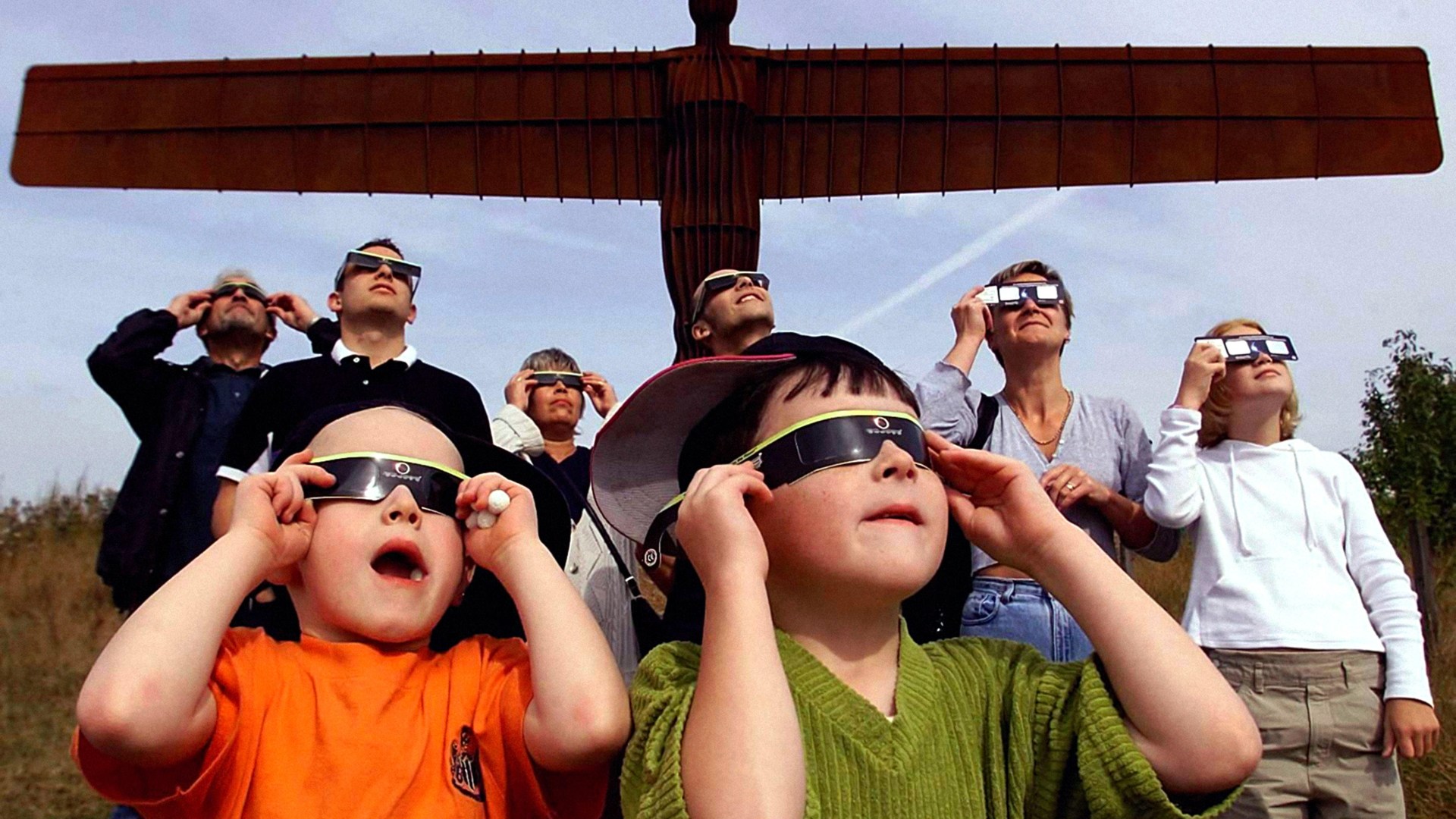
CROWDED on to rooftops, ships, hillsides and bridges, millions of us were awestruck as we witnessed 1999’s total solar eclipse. The date was August 11, and it was the first time this country had experienced the celestial spectacle for 72 years. Eyes to the heavens at the Angel of the North in Gateshead Credit: Alamy Kids from an aptly-named street look through safety specs at 1999 marvel in East London Credit: Alamy No one wanted to miss it. Like the audience at a 3D movie, they wore special glasses to protect their eyes so they could gaze to the heavens as the moon covered the sun. Factories closed, roads were clogged by traffic jams and trials at the Old Bailey in London were even briefly paused so that judges, lawyers, and jurors could watch day turn to night in the first full eclipse visible in the UK since June 29, 1927. Sign up for The Sun newsletter Thank you! Tomorrow, the nation will once again have the chance to witness this incredible phenomenon when 90 to 95 per cent of the sun is hidden from view in a dramatic partial eclipse. These cosmic coincidences happen because the sun is about 400 times larger than the moon, and about 400 times further away from Earth, making them appear almost the same size in our sky. This allows us to witness wonders such as a breathtaking total solar eclipse, where the moon can perfectly cover the sun. So be sure you do not miss out on tomorrow’s marvel because the next full one is not due until September 23, 2090. Dr Cyrielle Opitom, a member of the Royal Astronomical Society council, tells The Sun: “If the moon had been just a little bit further away from us there would never be a total eclipse.” The moon passes just above or below the sun every month. Most read in The Sun Passengers paid £1,500 to watch from the air on Concorde Credit: PA:Press Association Normally, when this happens, the moon is not visible because it is obscured by the solar glare. But during an eclipse, the moon passes directly between Earth and the sun. In another stroke of random good fortune, Cornwall should again be the best place to view the phenomena. In 1999, the “path of totality” — meaning the point at which there is a 100 per cent eclipse — passed between Penzance and Falmouth on the peninsula of England. This time, around 95 per cent of the sun will be blotted out above Cornwall just after 7pm tomorrow. Edinburgh and London will both see a 91 per cent eclipse, while it will be 93 per cent in Belfast and 92 per cent in Newcastle. Anyone wishing to enjoy a “totality” tomorrow needs to head elsewhere in Europe. The most western point of Iceland, a tiny part of Portugal and a large chunk of northern Spain are in its path. An awestruck crowd gazes towards the sky during event 27 years ago in Vauville, France Credit: Alamy A viewing hotspot, but these women look less than impressed in Paignton, Devon Credit: Guy Newman To celebrate, Bjork is headlining a rave near Iceland’s capital, Reykjavik, and there are seven festivals in Spain. Other fanatics will be out in the Atlantic on specially chartered ships to catch the historic moment. A solar eclipse does happen once every 18 months somewhere on Earth and there are obsessives who try to witness as many as possible, though not all are as dramatic as tomorrow’s. Dr Opitom, who saw a full one on the horizon from an observatory in Chile in 2019, says: “It is absolutely spectacular.” Back in 1999, two Concordes were sent up by British Airways so that 200 passengers paying £1,500 per seat had the best chance of getting a clear view of the event from the air. On the ground, a total eclipse lasts for around two minutes, but due to the supersonic craft travelling at twice the speed of sound, they got to enjoy it for some six minutes. The number of people on the tiny Channel island of Alderney swelled fivefold, from 2,000 to 10,000, because it was one of the best spots to see the incredible sight. Around 250,000 extra tourists headed for Devon and Cornwall 27 years ago, and there were traffic jams on the way to Land’s End, one of the first places in Europe to go fully dark at 11.11am. As the eclipse started, the birds went quiet and ducks tucked their heads in their wing feathers, believing it was night-time. Once it was over, the air was filled with a “dawn chorus” as they woke up again. The temperature also dropped, but the South West was largely cloudy so onlookers only caught glimpses of the total eclipse. There were some parts of the British Isles where the skies were clear enough to fully enjoy the eerie moment, particularly the North East of England. Pope John Paul II watches through a piece of special glass in Rome Credit: AP:Associated Press Skies darken as crowds gather for the big moment in Penzance, Cornwall Credit: News Group Newspapers Ltd Tomorrow, there is far more chance of the clouds parting as the heatwave continues. Most of Britain should be sunny until the moon begins to obscure the rays just after 6pm. Whether it is cloudy or not, one rule always applies — never look at the sun with the naked eye. Even with the moon covering most of the giant fireball, it can still blind onlookers. Wearing regular sunglasses is no protection at all and only eclipse glasses bearing the ISO 12312-2 safety standard should be used. Make sure they are bought from a trusted retailer because fake ones are being sold online. Despite repeated warnings about the risk in 1999, hospitals across the country received hundreds of calls from people complaining about eye problems in the aftermath of the eclipse. If you want to keep the party going this year, then there is a good reason to stay out beyond 6pm. Skies darken as crowds gather for the big moment Credit: Shutterstock Druid Dylan Ap Talban watching the last eclipse of the century in Marazion, Cornwall Credit: Getty That is because there is the added bonus of the Perseid meteor shower. With the moon in its new moon phase, and its light diminished, during the Perseid’s peak it should be much more visible over the UK. Keep your eyes peeled between midnight tomorrow and 5.30am on Thursday. The eclipse will also be a far more relaxing occasion this time around. In 1999, with the turn of the millennium just over four months away, there were a lot of predictions that the darkened skies heralded the end of the world. Verses from the 16th century French astrologer Nostradamus had been interpreted to predict “fire from heaven” in that year. Fashion designer Paco Rabanne had even warned that the MIR space station would plummet to Earth and that Paris would be destroyed. As with all the millennium scare stories, no disasters befell anyone. In fact, after the eclipse passed Britain on its way towards the Middle East and India, everyone returned to their desks to switch back on their computers and make themselves a cup of tea. The power surge was the biggest the UK had ever experienced. With a peak demand of 36,150 megawatts, it was even higher than when the nation tuned in to watch Prince Charles marry Lady Diana Spencer in 1981. And as the skies lightened there was one other lesson we learned from 1999. Nothing can ever truly eclipse The Sun. Comment now
Special Concorde flights, 500k flocking to Cornwall & biggest ever power surge… How UK stopped for 1999 total eclipse
Full Article
Original Source
Read the full article at Thesun →KhanList aggregates and links to publicly available news content. We do not host full articles from third-party sources. Always verify important information with original sources.