
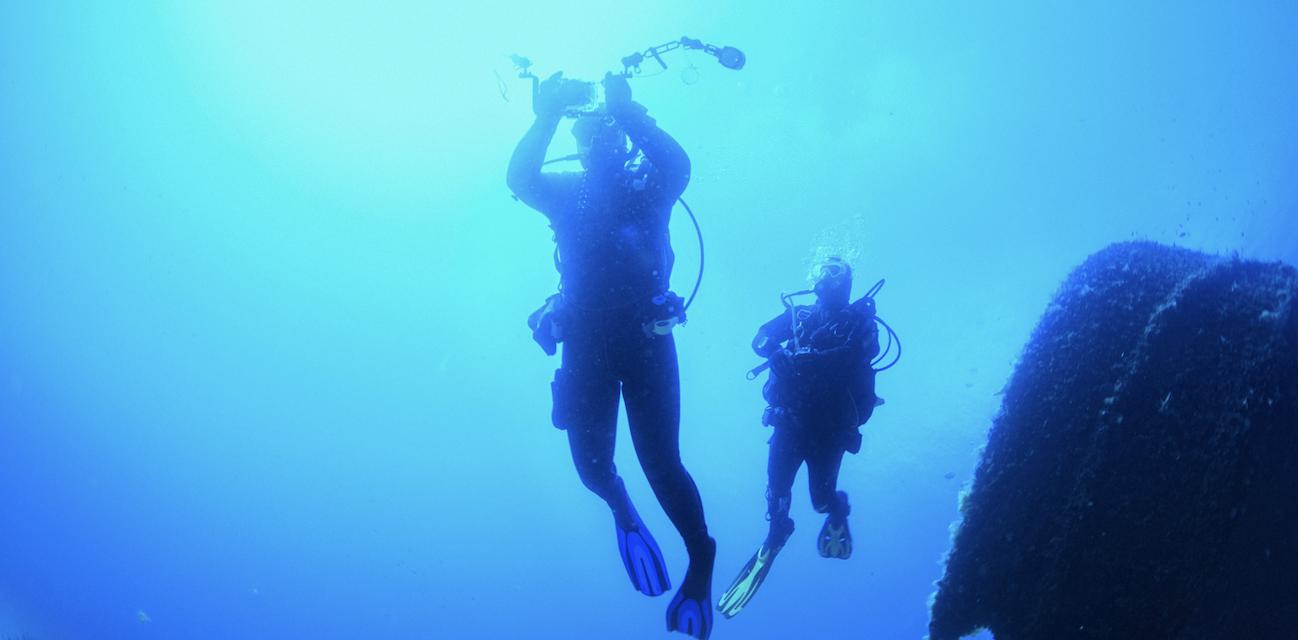
Giacomo De Mola (giacomodemola) was getting ready for a competition. In June 2026, the 46-year-old world-class spearfisher was off Mazara del Vallo on Sicily’s western coast with his friend Igor Bisulli. They were running sonar over the seabed, looking for a structure fish like to shelter under. Then something big came up on the scanner, three or four miles out. “I see a large dark mass and think: ‘The usual big rock,’” De Mola wrote on Instagram. He went down to look. As a former freediving champion, he managed a descent of about 150 feet on one breath with a mask and a GoPro. “Visibility wasn’t the best,” he wrote. “Below me was a vast expanse of amphorae.” It turns out he’d found a Roman merchant ship that sank sometime between the second and first centuries BC, with its cargo still stacked where it was loaded. Italian media put the hull at roughly 70 feet long and 20 feet wide, according to CBS News. The jars form a mound nearly six feet high, and there are at least 500 of them, possibly three times that. Most are Dressel 1A amphorae: tall, cylindrical, and the standard container for shipping wine at the time. Archaeologists care about the type because they can trace the clay and markings to specific production sites, turning a pile of pots into a map of who traded with whom. Lead anchor stocks are down there too, and De Mola has said some of the jars may be North African, including at least one Neo-Punic. He immediately reported the find to the Superintendent of the Sea for the Sicilian Region, and archaeologists confirmed what it was. The amphorae had likely been buried under silt for centuries and were uncovered by currents. “It’s hard to explain what it feels like to think that we’re among the first humans, after nearly 20 centuries, to see that place again,” De Mola said in a video posted to Facebook. Italian Culture Minister Alessandro Giuli called it one of the most significant underwater discoveries of recent years. “This shipwreck tells the story of the people, trade routes, and exchanges that made the Mediterranean a crossroads of civilizations,” he said on social media, according to NBC News. The wreck’s timing is also useful, since the ship sank before Rome became an empire. Lucy Blue, a maritime archaeologist at the University of Southampton who wasn’t involved in the find, told CNN that a wreck this intact “adds yet more knowledge to our understanding of trade and exchange prior to the Roman Empire.” And there may be more under the pots. Amphorae packed this tightly can shelter a ship’s wooden hull from the organisms that would otherwise have eaten it, which would make this one of the rarer finds in Mediterranean archaeology.
Spearfisherman scanning the seabed accidentally discovers 2,000-year-old Roman shipwreck
Full Article
Original Source
Read the full article at Upworthy →KhanList aggregates and links to publicly available news content. We do not host full articles from third-party sources. Always verify important information with original sources.