
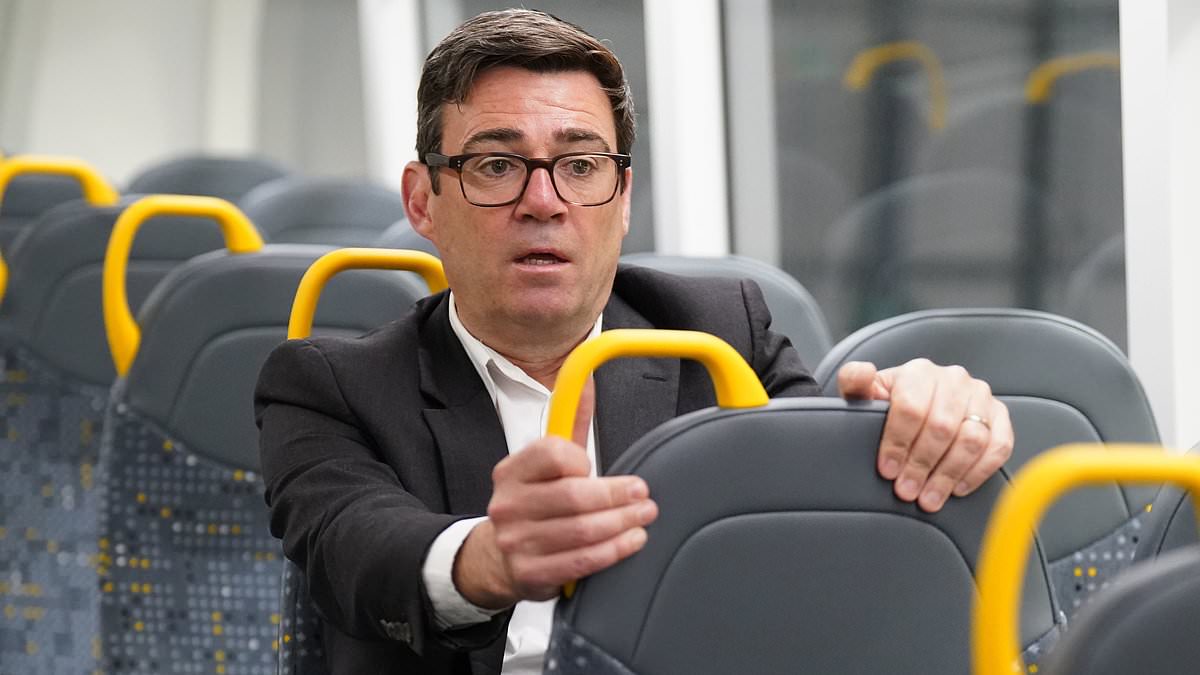
Andy Burnham's pledge this week to crack down on 'nuisance' passengers on public transport has already hit a major pothole – there'll be no dedicated resource to enforce the new rules. Labour announced yesterday that those travelling on buses, trains and trams who don't behave respectfully could face anti-social behaviour fines of up to £100. However, since unveiling the 'share the journey, not the noise' campaign, the Government hasn't clarified exactly how it will be policed, with science minister Chris McDonald suggesting self-enforcement might be relied upon. Discussing the fines, which could target passengers playing music without headphones, littering and vaping, Mr McDonald said: 'It will be enforced in the same way that any rule or law is enforced in the UK, it's no different to that. We're not going to create a special bus police.'The announcement was made as No10 said Mr Burnham is attempting to fix 'some of the everyday issues that make life a little more difficult' ahead of next week's Budget.Local authorities gained the power to set and enforce their own rules on their bus networks this year. Have bad manners become normal? As Andy Burnham threatens £100 fines on public transport - but admits there's no-one to enforce them - sociologists say it's too late, with 'speakerphone calls already part of modern life' However, British experts in sociology have suggested that some behaviours in public spaces that might once have been considered the height of bad manners are now just part of modern life.Those who find fellow passengers talking loudly on video calls or listening to music without headphones may just have to get used to them, with how old you are likely directly linked to how likely you are to be offended. Recent research certainly suggests the gulf between generations when it comes to certain social habits is sizeable.A survey last year for Transport for London found that 70 per cent of people living in Greater London found listening to someone else's phone call or loud music annoying, but other research suggests it doesn't grate quite so much on those in their teens.Ofcom's 2022 UK Media Habits report reported that 69 per cent of those aged 13 to 17 thought it was fine to make video calls in public, with 83 per cent admitting they wouldn't think twice about watching video without headphones.Dr Benjamin Abrams, Associate Professor of Sociology at University College London, tells the Daily Mail that societal habits generally evolve steadily over time, often spurred on by new technology. But he added that if you've spent decades of your life doing things a certain way, it can feel like an affront when younger generations start to do things differently.Dr Abrams uses the question of whether it's acceptable to have a video call or speakerphone conversation on public transport as an example: 'A younger person could argue that having a person on a video call is exactly the same as if they were having the same conversation with the person present and, logically, they probably have a good argument. Chris McDonald, the UK's Science Minister, suggested there might be 'self-enforcement' of the rules but added there would be no 'special bus police''If you're older though, it can feel like a violation. To understand why such scenarios can make people's blood absolutely boil, you need to look at the sociological wiring of the people at the heart of the debate.'The professor explains: 'For older people, say forties onwards, a phone call was once often a very private thing, on a handset tied to a landline or in a phone booth. 'With the rise of smartphones, your phone call is portable and you see new generations thinking "Maybe I'll use the speakerphone function" or "I don't want to hold a phone to my ear"... all of a sudden the experience of a phone call has gotten so far away from what it used to be.'Dr Abrams says the sociological concept of 'habitus', the dispositions and deeply ingrained habits we follow as individuals, are often shaped by factors such as age and social background – and play a crucial role in how we might respond to such scenarios. Join the discussionIs having a speakerphone conversation on public transport bad manners?What's your view?'These kinds of things become so embedded in us through our generational experience, maybe where we live, maybe even our social class or gender or race, that we kind of pick them up and they just become our expectations of how we would behave in a given situation.'Another example includes chatting on your phone while somebody serves you at a supermarket check-out. Has the relentless tide of self-checkouts left us forgetting our manners when we encounter an actual human at the tills?Dr Abrams adds: 'Rudeness is not a purely objective phenomenon but it's clear the increased presence of self-checkouts makes shopping something that is less and less human.'We see self-checkouts in coffee shops, fast food restaurants and other places and gradually, over time, the expectation that the interaction you have at a checkout is a social one fades and becomes something that many people will regard as more of a commercial one over time.'Eventually, we'll live in a world where the majority of people's interactions at a checkout, for example, are with a machine that doesn't demand the same sort of respect and attention as another human being.'Professor Jonathan Culpeper of Lancaster University says we're simply starting to shrug off politeness standards first established in a very different period of history – and not all of us may like it.He tells the Daily Mail: 'The politeness of British society was very much fixed in the Victorian period and particularly in the second half of the 19th century. For example, around respectfulness and privacy – you don't just barge in on someone; all of the traditional politeness we have today is based on that period.'However, over the last few decades and with increasing power, there's a new ideology on the block. Younger generations have a different kind of philosophy and it's all about expressing emotions. It's easy for older generations to dismiss the younger generation as entitled and horrible, but actually they're just working to different values.' Andy Burnham's pledge to tackle 'headphone dodgers' on buses is now at risk of falling apartThe Government's 'share the journey, not the noise' campaign also includes reminders of the rules already in place on the rail network.Train passengers playing music out loud can be fined up to £1,000 – or removed from the carriage at the next station – if they refuse to stop when asked by rail staff.Ministers said authorised officers, including transport safety officials and the police, would deal with incidents on buses as part of the crackdown.Unite general secretary Sharon Graham said that while the measures were 'well meaning' they were 'wholly inadequate' to deal with the 'avalanche of escalating abuse' faced by transport workers.She said: 'The proposed penalties are not going to deal with the issues facing workers.'Our members are demanding and deserve protections at work that these proposals do not address.'Conservative transport spokesman Richard Holden added: 'Labour are finally catching up with the Conservatives on issues passengers really care about.'After we led the charge against antisocial behaviour on public transport last summer, ministers have worked out that nobody wants to endure pounding techno or blaring hip hop on a packed train or bus.'But passengers and railway staff face far more serious problems. Assaults against rail staff have risen by 68 per cent, while prosecutions have slumped under Labour.'It's time for Andy Burnham to get serious about enforcement, tackling violence and protecting those who work on our railways.'Liberal Democrat transport spokesman Olly Glover said: 'Tough talk means nothing without enforcement.'Unless the Government funds transport safety officers on the ground, these new rules won't be worth the paper they're printed on.'
Speakerphone calls on public transport is just modern life - not bad manners, say sociologists, as Andy Burnham threatens £100 fines for 'nuisance' passengers
Full Article
Original Source
Read the full article at Dailymail →KhanList aggregates and links to publicly available news content. We do not host full articles from third-party sources. Always verify important information with original sources.