
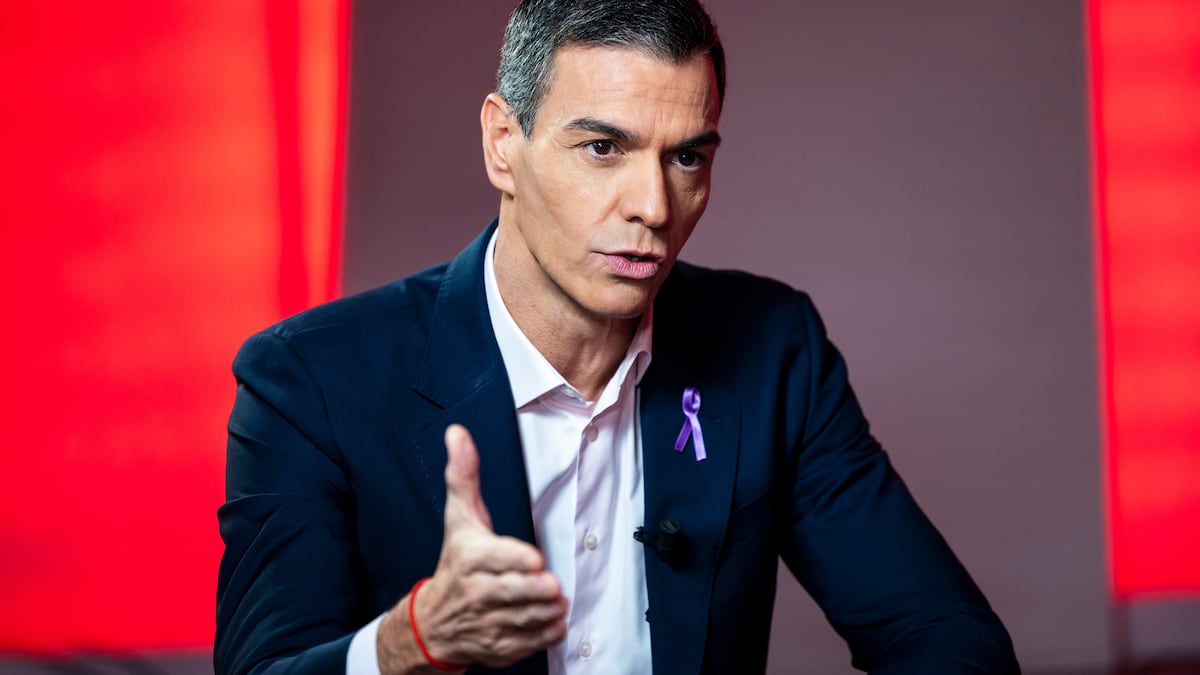
Pedro Sánchez arrives with a smile. He’s just come from an interview, and after his conversation with EL PAÍS, he’ll move on to another one. He seems swept up in the rhythm of the election campaign. Time and again, he insists that November 29 will bring a progressive majority, and whenever he can, he takes a jab at the right: “The last time the far right governed our country was during Franco’s dictatorship,” he recalls.The interview, focused on current election issues, takes place on the morning of November 25 at the Spanish Socialist Workers’ Party (PSOE) headquarters on Ferraz Street in Madrid. The 54-year-old prime minister and candidate is wearing a blue suit, a white shirt without a tie, and a purple ribbon on his lapel to mark International Day for the Elimination of Violence against Women. He doesn’t shy away from any questions or lose his composure when faced with follow-ups. After six election campaigns and eight years in office weathering all kinds of storms, he insists he isn’t tired: “I consider myself a deeply fortunate person. Being the prime minister of Spain — the best country in the world — is an honor. I’ll never have a better job in my life [...] There is still so much to be done in our country.”Question. In recent days, the government has approved a series of social measures. Why now and not sooner?Answer. For the past eight years, we have approved social reforms at every Cabinet meeting. What matters is not the timing, but the content. We’re extending bereavement, paternity, and maternity leave, and there are improvements for the self-employed… Of course, it’s a statement of intent.Q. What do you mean when you say it’s a statement of intent?A. It is a declaration of intent regarding what a progressive government wants to accomplish over the next four years. There is going to be an unprecedented mobilization in our country, and in response, the [main conservative opposition] PP and [far-right] Vox are casting doubt on the integrity of the electoral system. I am calling for a historic mobilization. We need the next progressive government to have more strength so it can go further in advancing social progress.Q. But isn’t it just a political ploy to pass so many measures just five days before the election?A. It would be if this were the first time we’d done it. But, I insist, every Cabinet meeting over the past eight years has resulted in progress. We’ve governed for the majority, regardless of ideological orientation.Q. Why didn’t you do this sooner? Was [Catalan pro-independence party] Junts standing in your way?A. In the case of paternity leave, Junts has been in agreement. However, the PP and Vox are going around saying they’re going to repeal many of these measures. The [Spanish Confederation of Employers’ Organizations] CEOE itself has claimed that we’re moving closer to the Bolivarian Republic of Venezuela. I’d add a nuance: we’re moving closer to the Bolivarian Republic of Belgium, where there’s also 10 days of bereavement leave. These are common-sense measures that, if there’s a PP-Vox majority, would be curtailed.Q. What’s left for you to do in the next legislative session if you win?A. We have a great deal left to do. For example, providing a more forceful response to the housing crisis and enshrining pensions and the right to abortion in the Constitution. The PP claims that the pension system is going to collapse; that’s a lie, because it’s in excellent shape.Q. But there’s growing criticism among young people about the generational divide, with the idea that retirees are better off than they are. How do you respond to that?A. I would say three things. First, during my administration, 900,000 jobs have been created for young people. Second, average wages for young people have increased by 30% during my administration. And third, what we need is precisely to strengthen the pension system, which is an expression of intergenerational solidarity. One sign that we’re doing things right is that in 2018 I inherited a pension fund of only €5 billion, and today it stands at nearly €20 billion. If this progressive government continues, our goal for 2030 will be to reach €50 billion. Raising wages, increasing the minimum wage by 75%, and regularizing the status of migrants so they can contribute to Social Security are key elements in sustaining and strengthening the public pension system. I see immigration as a great opportunity, not as a problem. It is clear that we must address the debate on integration, in which the autonomous regions and local governments also have a significant role to play. But the question is very simple: Do we want open — and therefore prosperous — societies, or closed — and therefore declining — societies? The PP and Vox favor the latter. They are pursuing approaches that, to me, seem contrary to the principles of the European Union, such as these deportation centers they want to establish in third countries.Q. Vox also blames immigration for the housing crisis.A. We have created 300,000 jobs in the construction sector over the past few years. The question that, I am convinced, many EL PAÍS readers share is: Who is going to work in construction to build the homes we need?Q. What does “anti-Sánchez sentiment” mean to you?A. The political, media, and economic right has embarked on a campaign of dehumanization. But they’re not just insulting me; they’re also insulting women, whom they call “charos” [a derogatory term for middle-aged progressives and feminists]; the unions, which they label the “mafia”; environmental groups; and even the media outlets whose editorial line they don’t like. This is common to the entire far-right international… And I think many media outlets will have to reflect on the extent to which they’ve used lies against the Spanish government. Can you disagree? Of course. Criticize? Sure, we live in a democratic society. But what you can’t do is use lies as a method.Q. Are these elections a referendum on you personally?A. No. They’re a choice between progress and regression. Let me give you an example. Ramón Sampedro died in 1998. It took 23 years to pass the law on the right to die with dignity. And now both the PP and Vox want to repeal it. It takes decades to win rights that can vanish in a single day. That’s why I’m calling for a historic mobilization of progressive Spain.Q. How much damage has the Ábalos case [involving former Socialist minister José Luis Ábalos, expelled from the party over corruption in the public purchase of facemasks during the Covid pandemic, and allegedly arranging meetings with sex workers] done to the female vote?A. The female vote continues to be largely in favor of progress and, in particular, the PSOE. And I am convinced that feminists will mobilize once again in these elections. Women know that, in addition to fighting the scourge of gender-based violence, we are strengthening public services such as education, public health, and long-term care. We are a government committed to the equal pay law and to ensuring equal representation... That said, obviously, the Ábalos case has done us a great deal of harm. But we have responded forcefully. You may criticize me for having mentioned it, but I can also say that we have expelled him, we have taken responsibility, and we have approved internal reforms to ensure that such cases do not happen again.Q. Virtually all the polls show a PP-Vox bloc as the winner. Are they all wrong?A. [PP leader Alberto Núñez] Feijóo and [Vox leader Santiago] Abascal are going to be defeated on November 29. And within the PP, a debate will begin about what kind of opposition they want to mount. It’s a serious matter for Vox to question our electoral system, but for the PP to do so so openly is extraordinarily serious... They’re engaging in a form of preemptive Trumpism; they’re saying that if the PSOE and the progressive parties win by a narrow margin, it will be a rigged election. That’s why I’m asking voters for a majority mandate — because if the victory is resounding and indisputable, they’ll have fewer excuses to cast doubt on the election results.Q. You don’t believe the polls, most of which show the combined total of the PP and Vox in the lead, but do you think it’s credible that the Center for Sociological Research (CIS) says you would beat the PP by nearly 10 points?A. The CIS was the only polling agency that, back in 2023, said something that seemed like blasphemy: that the PP and Vox wouldn’t add up. The same thing is going to happen this time: they won’t add up.Q. The PP says the first thing it will do is dismiss José Félix Tezanos. Was it a mistake to have kept the CIS president in his position all this time?A. The PP says it’s going to dismiss Tezanos and also appoint Eduardo Inda as news director at [Spanish state broadcaster] RTVE. Well, if this is the level of regression we’ve reached…Q. If your list receives the most votes, will you ask the PP to abstain during your investiture vote?A. We’re all adults. We know exactly what the Spanish political right is like… We have to focus on what’s possible: a progressive majority in parliament. We’re within touching distance. If we achieve a 75% or higher turnout, we could secure 176 progressive seats.Q. And would you ask Junts for their vote again?A. The PSOE has never questioned an election result. Never. When we’ve lost, we’ve accepted it. The PP and Vox aren’t on board with that, and that’s very serious. We’ve seen Mr. Feijóo express his concern about the cardboard ballot boxes at the consulates. But what worries Mr. Feijóo is what’s inside those cardboard ballot boxes, because what both the PP and Vox have done is curtail the right to political participation. I have my doubts that the PP and Vox, based on what they’re saying, will recognize the election results. And from there, in the resulting parliament, I’ll have to talk with the parliamentary groups that have been elected. What I hope is that we can secure 176 progressive seats.Q. Why is [Junts leader] Carles Puigdemont criticizing you so harshly? He said you had excessive ambition.A. I can’t answer that; he’ll have to answer it himself. In Catalonia, we have completed a process of normalizing coexistence [following the failed secession attempt led by Puigdemont] that we’ve been working on since 2017, and which has been appreciated, applauded, and supported by the vast majority of Catalan society.Q. Are Spanish democracy and its institutions prepared for a government that includes far-right elements?A. The last time the far right was in power in our country was during Franco’s dictatorship. I’ve heard Mr. Abascal say that he doesn’t want the current system of autonomías (devolved powers to the regions). Of course, pre-autonomous Spain is pre-democratic Spain. And when Abascal is asked about Franco, he says he has no position on the matter. But he calls me a dictator...Q. And why is the far right growing so much with that kind of rhetoric?A. First of all, it has the backing of the international far-right movement, which is beginning to show signs of exhaustion in Argentina, Brazil, and the U.S. The second reason is linked to the algorithm: there are tech oligarchs who prioritize hate speech. And finally, the political, media, and economic right has whitewashed Vox.Q. Doesn’t the left bear any responsibility for this rise of the far right?A. The right and the far right base their entire campaign on attacking me. And I talk about people’s problems and the solutions — about the social-democratic economic policies we’ve developed over the past eight years. Of course, we can debate housing; we have a lot of room for improvement. But what is indisputable is that today, as a result of labor reform, we have 22.6 million people working, with minimal rates of temporary employment. And while other countries in Europe aren’t growing, Spain is — and it’s reducing its public deficit and debt. The best response is more progressive policies.Q. Incidentally, do you think far-right leaders should be interviewed on public television?A. I am shocked by the disciplinary proceedings opened against a journalist [Silvia Intxaurrondo, of TVE]. Without journalism, there is no democracy. And journalism means asking questions and probing the issues on the table. With that in mind, I believe we must listen to all opinions. Among other reasons, because by listening to the far right, we can fully understand the risk of regression it poses. Without going any further, on this very November 25 — the International Day for the Elimination of Violence against Women — a Madrid City Council member, a woman from Vox, denied the existence of gender-based violence...Q. In the [televised] debate with Feijóo, you apologized several times and admitted to mistakes. What would you do differently if you were to win a majority again?A. I have appointed more than 55 ministers — both men and women — over the past eight years, and I have had one case of corruption involving a minister. [Former PP prime minister Mariano] Rajoy and [former PP prime minister José María] Aznar had 15 ministers charged with or convicted of corruption. I do not downplay the seriousness of our case. But we are light-years apart in terms of the number of cases, our standards, and our willingness to take responsibility.Q. And are you satisfied with the face-to-face strategy? Almost all the media portrayed you as the loser.A. It wasn’t a strategy; it’s a conviction. You don’t engage in debate with insults or lies. You defeat those who insult and lie at the polls, by voting for respect and the truth. Unfortunately, in our society — and also in some media outlets — the truth has been trivialized. And then there’s the matter of the tone, the insults, and the poor manners displayed by Mr. Feijóo, who, by the way, arrived in Madrid saying he wasn’t going to insult Sánchez... The PP will have to take a hard look at itself on November 29 when it sees the election results, because people are going to turn their backs on the rudeness we’re seeing in many PP leaders.Q. Will you change your strategy for the four-way debate?A. The format is different, but it’s going to be a three-way debate, because the PP and Vox are really running together: they represent the same regression.Q. The PP and Vox seem to have a non-aggression pact during the campaign; we saw that in the eight-way debate. Have you spoken with Ada Colau [the candidate of the progressive Broad Front coalition, successor to the Sumar alliance] to reach an agreement?A. These eight years of progressive coalition government attest to the understanding and civility among progressive parties. We’ve had disagreements, no doubt, but the PP and Vox only agree on cutting back on rights, while the PSOE and Sumar — now the Broad Front — agree on advancing rights and freedoms.Q. The Broad Front says you’re copying their platform to take votes away from them.A. Voters know a lot about the Spanish political system. There’s something called the D’Hondt method, which determines the distribution of seats. Voters know we have 52 districts. That means we have to optimize that vote. There are districts where proportional representation is more pronounced than in others where fewer seats are allocated. And, therefore, failing to optimize that vote could mean handing that seat over to the PP and Vox. We’re talking about being smart when it comes to achieving progress as a whole.Q. You’ve been in office for over eight years. You’ve weathered a pandemic, international conflicts, the Ceuta crisis, corruption scandals… Even your family has been caught up in legal troubles. Aren’t you tired? Don’t you feel like throwing in the towel and stepping out of the eye of the storm?A. No, I consider myself a deeply fortunate person. Being the prime minister of Spain — the best country in the world — is an honor. I’ll never have a better job in my life, and I’m 54 years old. There is still so much to be done in our country, and I’m just as eager as I was on the first day. Today I am a much more experienced politician, with far greater expertise. Moreover, at a dark time in the world, Spain has proven to be a model of dignity in defending international law and in advocating for an end to impunity for genocides such as the one in Gaza. It has also demonstrated consistency in defending the welfare state in the face of decisions like the 5% defense spending requirement, which was a demand made by Mr. Trump. In short, if Brazil could do it, if the United States could do it, and if Spain could do it in 2023, we must certainly be able to do it this coming November 29.Q. You’ve been at the helm of the PSOE for 12 years. Why haven’t you groomed a successor, as José Luis Rodríguez Zapatero did with Alfredo Pérez Rubalcaba, for example?A. What is very clear is that whoever replaces the current secretary-general — me — will not be decided by me, but by the PSOE members. And that is not only an example of internal democracy, but it also safeguards the autonomy of a political project against any pressures that may come from media groups or economic interests.Q. Zapatero is no longer in this campaign, [former transportation minister] Óscar Puente resigned, and [former deputy PM and finance minister] María Jesús Montero left [to focus on regional elections in Andalusia]. A good portion of your original inner circle is no longer with you. Aren’t you politically on your own, shouldering the entire burden of the campaign?A. Do you really think we’re showing in this campaign that I’m on my own?Q. We’re not talking about party members at rallies, but rather your inner circle, campaign support, and a more visible number two or number three.A. This is the sixth time I’ve run in a general election. I’ve never seen a mobilization like the one in this campaign. I have a very good feeling about it. All that experience gives you a certain intuition. There’s an undercurrent that goes beyond the PSOE. I’ve never experienced anything like it, and it moves me deeply. That said, my number two in the government is Carlos Cuerpo, and my number twos on the PSOE executive committee are María Jesús Montero and Rebeca Torró.Q. Puente resigned right in the middle of the pre-campaign. Has the tragic rail accident in Urda left its mark on this campaign?A. Obviously, it has affected it. By the way, when people analyze Vox’s decline in the polls, they often say it’s because they didn’t appear on Jordi Wild’s podcast [in which Sánchez and Feijóo participated]. Vox has been the only party that hasn’t observed a period of mourning following that accident. And that comes back to haunt them, because the public doesn’t understand why political parties wouldn’t respect the grief of the victims’ families. That accident touched the hearts and emotions of the Spanish public. All of our governments have faced tragedies. Mr. Rajoy did as well in Angrois [where a train derailed in 2013, resulting in 79 deaths]. We did not call for [former public works and transportation] Minister Ana Pastor’s resignation… Grief is something to be shared; it is not something to be exploited for political gain. The point here is to put solutions on the table and not to manipulate that grief, as Vox did.Q. You’ve referred to Zapatero as an asset. Why haven’t you made more of him?A. Zapatero himself has decided to keep a lower profile, which I obviously respect, but he’s helping me in this campaign.Q. [Former Socialist prime minister] Felipe González, who said he would cast a blank ballot, now adds that it’s better for him not to say what he knows because the PSOE would lose millions of votes. What do you think of those statements?A. Well, anyway… I respect them, but I don’t agree with them at all.Q. What do you mean? He says it could change the election…A. And millions of votes, too! I find that impressive (smiles).Q. Has Pedro Sánchez’s PSOE lost the political center?A. No. We are governing for the social majority of this country. When the PP or Vox say that the pension system is on the verge of collapse, when they cut funding for public healthcare, long-term care, and education… who are they governing for? When we transfer more than €300 billion to the regional governments so they can strengthen public services, when we improve the teacher-to-student ratio in elementary and secondary education, or when we safeguard the quality of vocational training in private schools — for whom are we governing? For the social majority of this country. I have governed for all Spanish citizens, regardless of how they vote. Or do all retirees vote for the PSOE? Or do all workers earning the minimum wage vote for the PSOE? Or the million students who have received scholarships?Q. What would you say to the remaining undecided voters?A. That we may have made mistakes, but that, on balance, Spain is today in one of its best moments in recent decades in terms of economic growth, job creation, rights and freedoms, and, of course, the reduction of inequality — which remains the primary task of any administration. If we don’t want a far-right international order for the world, how can we possibly want it for our own country?Sign up for our weekly newsletter to get more English-language news coverage from EL PAÍS USA Edition
Spanish PM Pedro Sánchez: ‘We’re within touching distance of securing a progressive majority; if we reach 75% turnout, we can make it happen’
Full Article
Original Source
Read the full article at English →KhanList aggregates and links to publicly available news content. We do not host full articles from third-party sources. Always verify important information with original sources.