
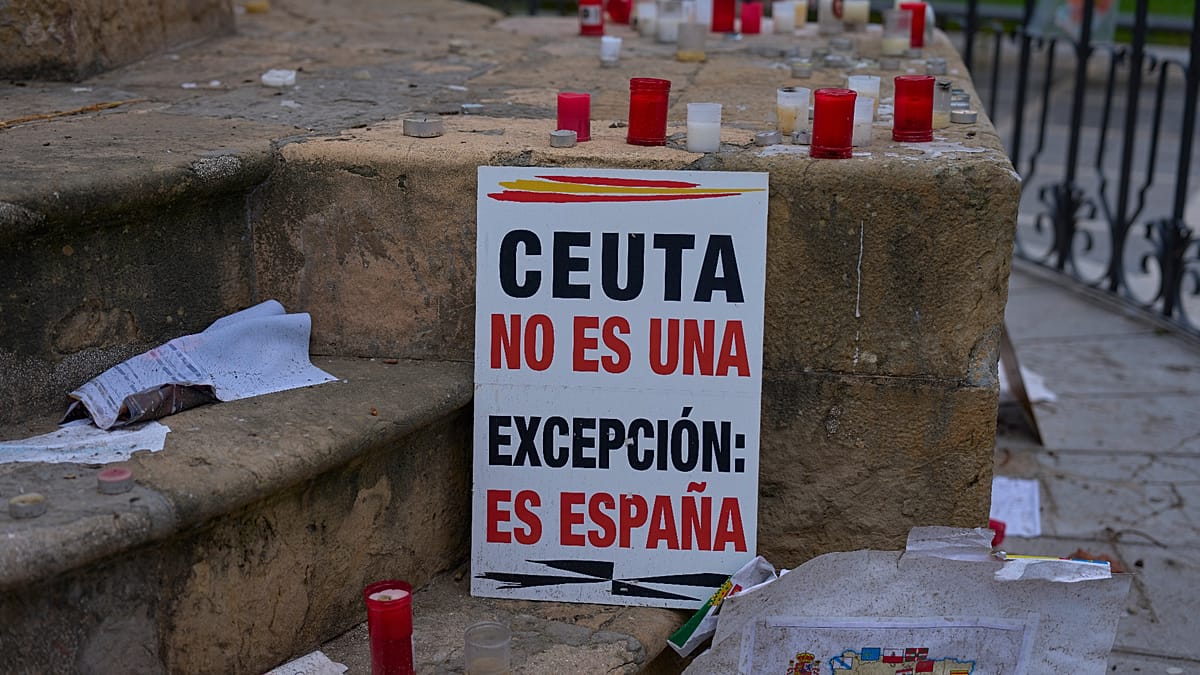
Felipe VI has taken 12 years on the throne to make it to Ceuta, and he is doing so in the same month, intriguingly, as his great-grandfather. The King and Queen Letizia will enter Ceuta's City Hall, in Plaza de África, launching a two-day trip that continues tomorrow in Melilla. It is the first time they have officially set foot in both cities as monarchs. ADVERTISEMENT ADVERTISEMENT The last royal visit was by Juan Carlos I and Queen Sofía, in November 2007, after an 80-year gap. This time the backdrop is very different: around 72,000 people crossed over illegally from Morocco to Ceuta on 30 and 31 July, into a city of just over 80,000 residents. What does Felipe VI's visit to Ceuta and Melilla involve? In Ceuta, the president of the Autonomous City, Juan Jesús Vivas, will present them with the keys to the city, a gesture also extended to Juan Carlos I and Sofía in 2007. Afterwards they will visit the Vicente Aleixandre school and end at the Muslim cemetery of Sidi Embarek, where an religious ceremony will be held in tribute to those who died trying to swim across the border. Dozens of them are buried there because Morocco refused to take back the bodies. The big difference compared with 2007 is that the King and Queen will spend the night in Ceuta. Juan Carlos and Sofía did not. Tomorrow it is Melilla's turn. The royals will arrive at 11:45am CET at the Assembly Palace; in the afternoon they will visit the Pintor Eduardo Morillas school and meet representatives of Melilla's civil society at the Melilla Puerto hotel. The Royal Household has mirrored the schedule in both cities, in order to give them equal weight even though Melilla did not experience anything comparable to Ceuta's influx. Pedro Sánchez will not travel with them. The prime minister's office, Moncloa, says the premier does not usually accompany the monarchs on their official trips. The minister on duty is likely to be Ángel Víctor Torres, head of Territorial Policy and in charge of the single command for the crisis. A migration surge still unresolved in Ceuta According to the Interior Ministry, more than 70,000 people entered Ceuta from Morocco between 30 and 31 July. Sánchez was in the city on the 31st and described it as an attack on Spain's territorial integrity. On 6 August, Felipe VI received Vivas at the Marivent palace, during his holidays in Mallorca, and the Ceuta leader emerged saying the King wanted to travel when the government considered it appropriate. At the end of August, Sánchez announced that the trip would go ahead once the right conditions were in place. On 29 September, at the gala dinner during France President Emmanuel Macron's state visit, the King called for greater solidarity from European countries and branded the situation in Ceuta "unacceptable". Since August, 11,026 people have returned to Morocco, according to Torres: 10,513 voluntarily and 513 expelled. Juan Carlos I in Ceuta and Melilla, November 2007 Juan Carlos I and Queen Sofía visited Ceuta on 5 November, 18 years ago, and Melilla the following day. They spent around five hours in Ceuta, where the King spoke of an "outstanding commitment" to the city. It was the first visit by a monarch in 80 years. Rabat reacted before the trip even began. It recalled its ambassador in Madrid for consultations and, according to AFP, Mohammed VI viewed the visit as an offence to the patriotic feelings of Moroccans. Hundreds of people protested in Tetouan and at the border, while in Ceuta thousands of residents cheered the King. Alfonso XIII in Ceuta in October 1927 Alfonso XIII, Felipe VI's great-grandfather, arrived in Ceuta on the morning of 5 October 1927 aboard the battleship Jaime I, accompanied by Queen Victoria Eugenia and General Primo de Rivera, then head of government. At the Puntilla quay he was received by the high commissioner, General Jose Sanjurjo, and Ceuta's commander-in-chief, General Agustin Gómez Morato. He inspected the troops and visited the Legion barracks in Dar Riffien, already in Protectorate territory, where the Queen presented a standard to the Tercio regiment. In the afternoon he watched a parade, attended a ceremony at Nuestra Señora de África and ended the day with a reception at the Municipal Palace, which the royal couple inaugurated. The following day they travelled to Tetouan, capital of the Protectorate, and left 1,000 pesetas (around 6 euros at the time, roughly 2,000 euros in today's money) for Ceuta's poor. The King had already visited Melilla in 1904, to lay the foundation stone of the port, and again in 1911 and 1926, according to El Faro de Melilla. The timing was significant. It had been six years since the disaster of Annual, near Melilla, where thousands of Spanish soldiers were killed, a blow to the monarchy. Alfonso XIII was accused of having encouraged the advance that ended in catastrophe. Then came Primo de Rivera's coup, which the King backed, and in 1925 the Alhucemas landing, which paved the way for the end of the Rif War. The Paramount newsreel preserved by the Ministry of Culture shows Spanish and Rifian troops, enemies until recently, marching together before the King. Four years after that trip, on 14 April 1931, his reign came to an end. Morocco's reaction Rabat has spent decades claiming sovereignty over the two cities, which have belonged to Spain since the 17th and 15th centuries respectively. So far it has not responded to enquiries about the trip, and successive Moroccan governments avoid mentioning Ceuta and Melilla in their official statements. Tomorrow, 14 October, a demonstration has been called in Castillejos to protest against the presence of the King and Queen of Spain in Ceuta and Melilla. On Saturday, in his opening speech to parliament, Mohammed VI insisted that Morocco's sovereignty does not tolerate pressure, threats or blackmail and described relations with Spain as a "sovereign choice", but he did not mention Ceuta at any point.
Spanish crown returns to Ceuta after 19 years amid lingering migration crisis
Full Article
Original Source
Read the full article at Euronews →KhanList aggregates and links to publicly available news content. We do not host full articles from third-party sources. Always verify important information with original sources.