
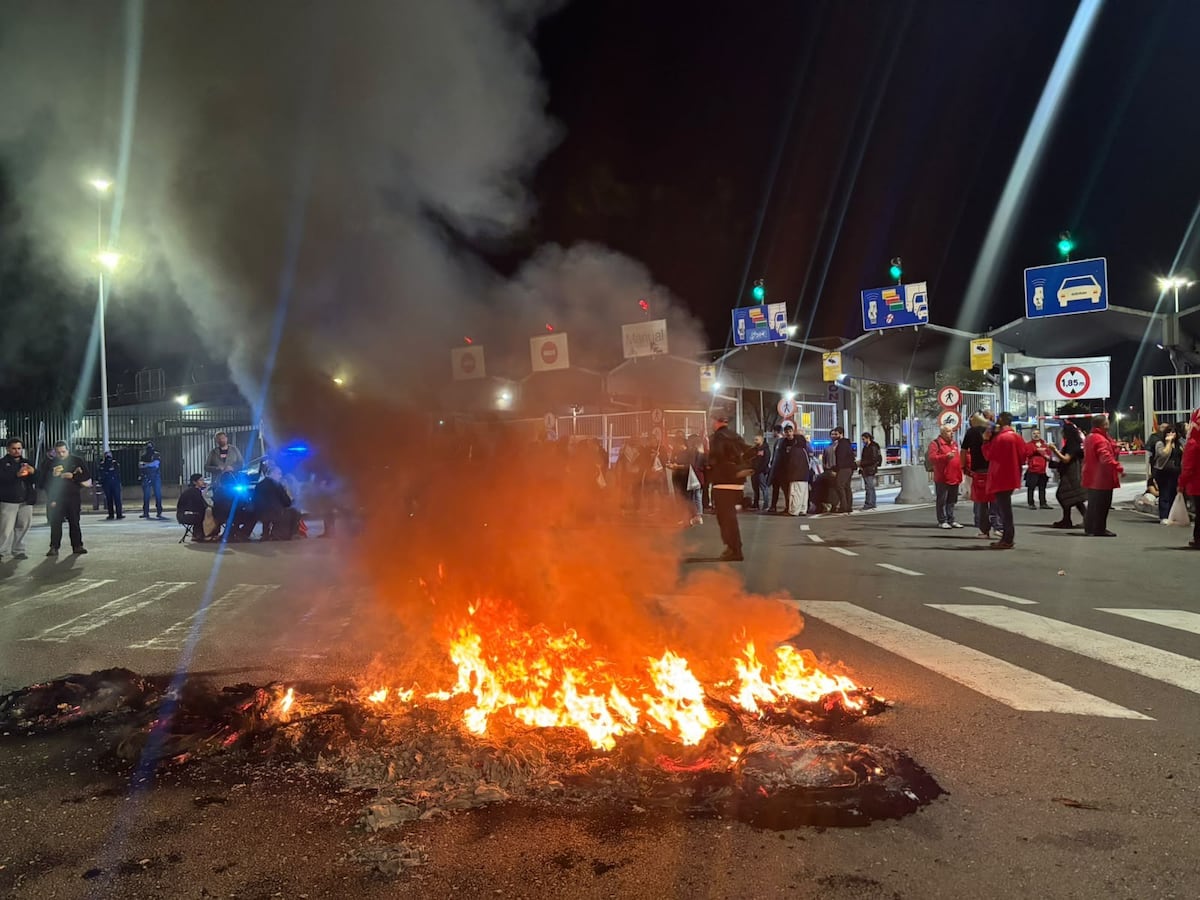
Wages, housing, prices. Under that slogan, Spain’s two largest unions, CC OO and UGT, are calling on workers to walk off the job this Wednesday in the first general strike they have called in 14 years. The unions themselves admit the call is “unorthodox,” for several reasons. It is not a response to a specific piece of legislation or to any single government body. It grew out of a wave of public outrage over an eviction and out of protests organized by a group that is not a labor union. It also falls 18 days before a general election, and it comes after a train accident that has brought about “a certain shift in the country’s mood,” according to Unai Sordo.That is why UGT and CC OO, while calling for “massive” support, expect turnout to be “uneven.” They predict less backing in regions less affected by the housing problem and are unsure about the ones that are hit hardest. According to a 40dB. survey for EL PAÍS and Cadena SER, 23% of employed respondents say they will strike, while 36.3% say they will not. Another 22.4% say they will not strike but support it, and 10.3% say they don’t know what they will do.The unions argue the strike is justified by the bite housing takes out of paychecks. Wages are rising more slowly than prices, they say, because the CEOE employers’ confederation refused to sign a national collective bargaining agreement. They also say the general strike didn’t come out of nowhere: it caps a surge in labor unrest over recent months, with the number of workdays lost to strikes tripling compared with last year. They are calling on workers to stop work and also to join the afternoon demonstrations, which are threatened by rain forecast for much of the country. At Madrid’s Puerta del Sol, which only days earlier was filled with tents in protest against the housing affordability crisis, the leaders of the two big unions urged workers on Tuesday night to join the general strike, which begins at midnight. “Housing is this country’s great fault line. Young people of Spain, this is your day. We have to fill the streets and demand ambitious policies that free this country from the scourge of rentierism,” said the head of CC OO. He called for a “flood of people” so that the authorities “take the hint,” and to “run the vulture funds out of town.”UGT’s secretary general, for his part, said that “no salary can keep up with the price of housing.” “This strike is directed at every level of government. We are going to make it clear to whoever governs after November 29 that they need to start listening,” said Pepe Álvarez. He also responded to the president of the Madrid region, Isabel Díaz Ayuso, who on Tuesday urged Alberto Núñez Feijóo to put an end to “the whole union caste.” “She can go to hell. Let the marquise of Puerta del Sol hear that,” the UGT leader said. After the speeches, hundreds of union members marched toward Cibeles chanting “strike, strike, general strike.”Alicia del Río, spokesperson for the Tenants’ Union (Sindicato de Inquilinas), told EL PAÍS on Tuesday that November 11 marks the start of “a new cycle of struggle that can finally win the major gains our country needs, such as the right to housing and better living conditions for the working class.”The strike began with a push from Del Río’s organization, the Tenants’ Union, the group that supported Maricarmen during her eviction. Public anger over what happened to the Madrid woman ran so high that the government responded by approving decrees with housing measures, which were later rejected by the right-wing majority in Congress. That vote on Friday, October 2, led to mass demonstrations the next day, Saturday, October 3, led by the Tenants’ Union under the main slogan “toward a general strike.”At that point the major unions had doubts, but some smaller ones, such as CGT, did not and promised to back the call in the workplace. The Tenants’ Union even said it would go ahead with the strike without CC OO and UGT, alongside smaller unions, if the two refused. On Monday, October 5, hours after Pedro Sánchez called the election, UGT and CC OO announced their support for the strike, raising it to a different level. Without their strength in workplaces, where they have 228,000 shop stewards (more than two-thirds of the total), the strike would have had little impact. That is what happened with the last general strike call, which CGT organized last year over the massacre in Gaza and which drew very little participation.The past month has been a whirlwind for the unions, which have put their organizers to work to pull together a general strike in under a month. Sources at the major unions stress that the overlap with the election campaign has made the job harder, given the political right’s accusations that the strike is an electoral ploy. “It didn’t help to have the left saying this strike is against the opposition [as María Jesús Montero said], or the right accusing us of doing the government’s bidding,” said a CC OO representative. The unions expect the strongest support in the most heavily unionized sectors and in the regions hit hardest by the housing crisis.According to CC OO’s count, some 4,500 works councils, staff committees and union branches have already signed on to the strike, a thousand more than on Friday. They include representatives at some of Spain’s largest employers, such as Mercadona, El Corte Inglés, ONCE, Acciona, FCC, Correos, Eulen, Inditex, Ferrovial, Iberdrola, Santander, BBVA, Telefónica, Carrefour, Ford and Seat.The strike is also backed by civil society groups (such as CEAR, the LGTBI+ Federation and Greenpeace), and figures from the cultural world have signed a manifesto in support. Besides the unions already mentioned, the strike is supported by the Basque unions ELA and LAB, the Galician unions CIG and CUT, the Andalusian SAT, the Aragonese SOA, CNT, CO.BAS, Solidaridad Obrera, Alternativa Sindical de Clase, the Union of Actors and Actresses, the Progressive Union of Labor Inspectors, the screenwriters’ union ALMA and the journalists’ union FeSP, among others.Most professional and sector-specific unions reject the strike as electioneering. These organizations are strong in some key sectors, such as the central government civil service, rail transport and the medical profession, and as a rule they did not support the 2012 general strike either. They include the civil servants’ union CSIF, the teachers’ union ANPE, the doctors’ union Amyts, the train drivers’ union Semaf, the transport union SLT, the pilots’ union Sepla, the retail union Fetico and the financial sector union FINE, among others. One class-based union that is not sector-specific, USO, is also among those not backing the strike, though it did support the 2012 general strike.
Spain’s unions call the first general strike in 14 years
Full Article
Original Source
Read the full article at English →KhanList aggregates and links to publicly available news content. We do not host full articles from third-party sources. Always verify important information with original sources.