
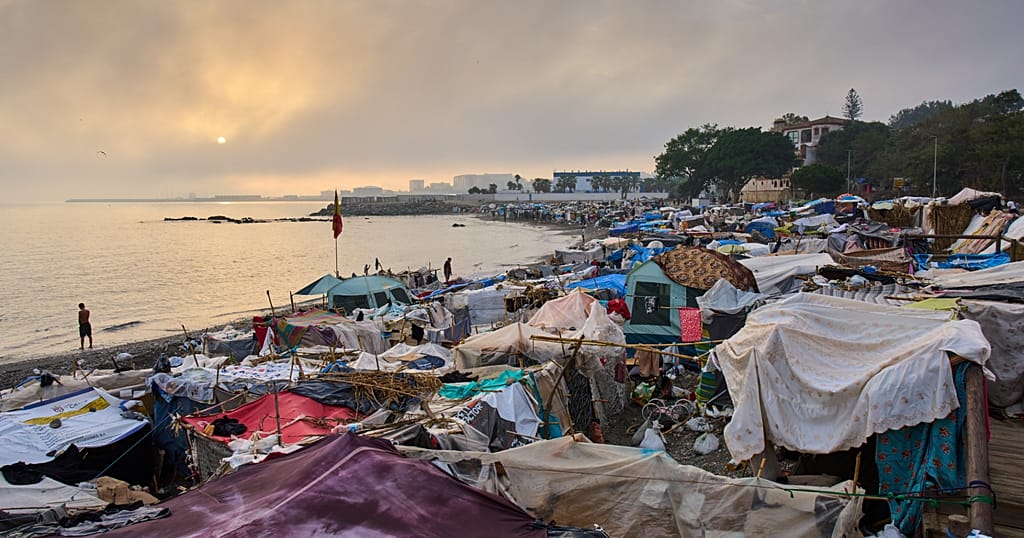
Two months after thousands of migrants crossed into the Spanish enclave of Ceuta, many unaccompanied minors and teenagers are still living in the open. As winter approaches, hundreds of them lined up outside a church in the North African territory in early October. They were hoping the government would tell them they could travel to Europe or, at the very least, get a spot in a shelter off the beach or the streets. Among them was a 17-year-old aspiring model from northern Morocco. "I was expecting like a really easy experience, but it's so hard. Like I was expecting two weeks, three weeks of that, but it's been two months and we're still living in the streets," he said. Members of a neighbourhood association ushered the children down a steep hill to a soccer field, where police stood waiting, to prevent them from overwhelming the minister. Within hours, many of them would return to the same camps and hillsides as before, in another setback for the underage migrants. It also illustrated the Spanish government’s slow, often improvised response to the continuing migrant crisis in the exclave, which thousands of minors reached alone. Many of the estimated 2,000 youngsters have been sleeping on cardboard sheets and ripped sofas in squalid tent camps or on the streets of the city in North Africa. Experts concede that authorities have struggled to process so many migrants, but also appear to be slow-walking so they might give up and head home. It’s a growing crisis. Minors who reach Spain alone fall under the country’s child-protection system, which entitles them to shelter, healthcare, and education In Brussels, a European lawmaker who visit Ceuta recently described the humanitarian situation as “grim” and growing worse by the day. “Children who should be under protection and guardianship are experiencing situations of serious helplessness,” said Estrella Galán, a Member of European Parliament for The Left. Open-air, makeshift camps with adults and children have festered on beaches, at warehouses, and on hillsides. About 3,000 people lived in a beachside camp where the air reeked of human waste. Some underage migrants were visibly under the influence of drugs. Children as young as 13 slept and showered among adult men who frequently broke into fights. Elsewhere, minors hid between the steep, narrow streets of the city’s predominantly Muslim neighbourhoods. Spanish prosecutors are investigating reports of torture and mistreatment of migrants.
Spain's slow response in Ceuta leaves teen migrants still living on streets
Full Article
Original Source
Read the full article at Africanews →KhanList aggregates and links to publicly available news content. We do not host full articles from third-party sources. Always verify important information with original sources.