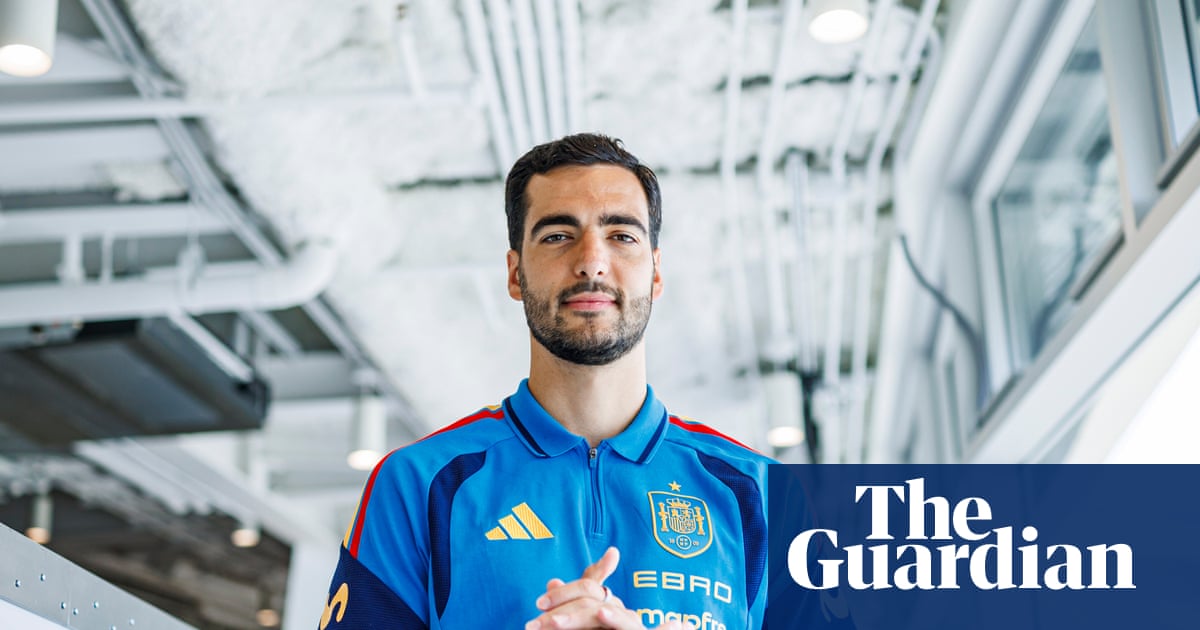
The night before the biggest day of their lives, the Spain players who were about to win the 2010 World Cup gathered in the Da Vinci Hotel in Sandton, just north of Johannesburg, drank hot chocolate, ate chocolate croissants and talked. The night before the biggest day of their lives, the Spain players seeking to emulate them 16 years later will gather in the MC Montclair in New Jersey and talk too, but there won’t be any chocolate this time. Some rituals are not to be repeated.“I think the nutritionists killed that one for us!” Mikel Merino says, hopping off the bus, freshly tuned up for the final, and heading into a tactics room at the Melanie Lane training ground, where Spain’s penultimate day of preparation is about to begin. “We used to do the Cola Cao and cakes in the under-19s and under-21s, copying the seniors, but not any more. Everyone has their own routine, but the main thing is to normalise it all: just another game, doing something we know how to do, that we’ve done since we were five years old and that we love. Treat it like something to be enjoyed, another day in our lives.”Some day. Some year too. “Spectacular,” Merino calls it. “Just the other day we were talking about this; if you had given me the chance, I would have signed up for this: going through the bad moments to have a year like this is incredible. The experiences I’ve been through, that my family have.” A Premier League title, a Champions League final, the birth of his first child and a World Cup final. And the injury that threatened it all. “I’m living every minute with an incredible joy,” he says. “Think where I was a few months ago and look where I am now. I appreciate this all the more.”The Spain coach, Luis de la Fuente, told Merino he would wait but the stress fracture in his foot defied easy analysis at first. “When they told me about my injury I didn’t think I would be at the World Cup,” the 30-year-old admits. Merino was operated on at the end of January, which actually came as relief because it meant that at least there was clarity, at least they were doing something. He spent two months on crutches. And then he went to work: hard.There were days he spent alone, others where he had help from his wife, lifting and carrying, which he said was the wrong way round: she was pregnant, but showed a strength without which he wouldn’t have made it. He learned that he was strong too, stronger than even he had imagined. But still, he played just 28 minutes between January and the World Cup, flying off and leaving his newly born son, Marco, behind. “Just being here is a victory for me,” he says. “God willing we can win it.”‘Just being here is a victory for me,’ says Mikel Merino. Photograph: Pablo Garcia/The GuardianThat Spain still can, that they made it this far, owes much to him, more super than a supersub. Like Lautaro Martínez, on the opposite side in the final, Merino has been a saviour from the bench. “Not even in my wildest dreams did I imagine this,” he says, and yet he sort of did: this is what he prepares for, what he does. He doesn’t just sit there and he certainly doesn’t sulk; he studies.At Euro 2024, on as a substitute against Germany in Stuttgart, Merino scored the 119th-minute goal that took Spain into the semi-finals. Here, he scored the 91st-minute goal against Portugal that took Spain into the quarter-finals. There was only one problem: his wife and son weren’t there in Dallas. So four days later in Los Angeles, when they were, he went and did it again against Belgium. The clock had shown 85min 32sec when he came on; it said 87:27 when he scored the winner. He had just two touches: almost as significant as the strike itself was the alertness to set the ball rolling in the first place.All three goals were celebrated the same way, famous now. Merino circled the corner flag like his father, Ángel Miguel, had done when he scored late for Osasuna in the same Stuttgart stadium 33 years earlier. Win the World Cup and he can definitively say he was the better player, surely? “My mum won’t buy that one, not even with a World Cup,” he says, laughing. “I’m proud to follow in my dad’s footsteps, to have learnt all I’ve learnt from him, and the respect will always be there … even if I have the medal!“Coming from the bench isn’t the ideal plan for any player, but when you join a national team that’s as strong as I and Lautaro have, you value every opportunity and try to help your team if you come on or if you don’t. You focus on the present, embrace the situation, and think of yourself as the guy who can do it. I have complete belief in myself, my ability: every time I come on to the pitch I think I can have impact. In the final, I hope anyone [Spanish] is the hero. The trophy belongs to all of you, not just the 11 on the pitch.”He continues: “It’s important to have ego as a footballer. With all the criticism from outside, you need it. But you also need the humility. Players come to the national team because they’re important [at their clubs] and find a new reality. It is easy to talk about ‘family’ but when things don’t go well, when they’re difficult, is when you truly see that. It’s thanks to Luis and the squad he assembled, focused on being a good human first and then being a good footballer. That helps a lot when it comes to spending a lot of time together. We know each other very well, we know when to joke, when to be silent; that’s the strength of the group. That after 46, 47 days all together, we’re still …”Merino’s late goal proved to be winner for Spain against Portugal in the last 16. Photograph: Jessica Tobias/APThere’s a pause and Merino laughs. Don’t get the wrong idea. “I wouldn’t say we were bursting to spend another two months together,” he says, cracking up. “Thank God, we’re coming to an end now, but, yes, we’re a very strong group. That’s why we’re here.” There may be no hot chocolate and no croissants any more but some meet round the PlayStation, others play Mario Kart or chess, Dani Olmo and Unai Simón battling on the bus to games. Merino is old school, more about the sobremesa: long conversations after eating, no hurry to leave the table, “chatting about life, our kids, the future, holidays”.“I think a couple they’re planning to go away together [after the World Cup],” he says. “Which is … impressive … after all this time. I don’t expect to see anyone!”That collectiveness has deep roots, built on respect and over a long time. After the semi-final, De la Fuente said there was a special embrace with some, a moment’s nostalgia allowed to creep in: look what we did. His first title was the European Under-19s in 2015, 11 years ago now. In the middle of the Spain midfield that day were Merino and Rodri. Simón was on the bench. Ten of the current squad have played under De la Fuente at junior level.“I was talking to the coach about that the other day because it was the anniversary of that tournament,” Merino says. “We were saying ‘how we’ve changed’ But the essence is the same: the essence of the coach, of the players that came through. That’s the strength of the group. There are more grey hairs, more wrinkles, more worries, but the humility and commitment remains.“Luis has had [many of] us at under-17, under-19, under-21. That’s so important. Not just for him, who knows each and every one of us and knows what we can give, which is a guarantee for a coach. But for the players too: you’ve experienced everything with him, good and bad, and you don’t have to give him anything new, you know? He knows what you can give: you don’t need to pull anything out of the hat. He takes you because he knows you as a person and a player. The group knows he has total faith in them and he knows the group will give our lives for him.”Which is why when Spain lost in Scotland at the start of De la Fuente’s tenure, which from the outside seemed destined to be brief, there was belief. Since then Spain have lost once in 37 games – and that was on penalties in the Nations League final. They have won a Nations League, a Euros and now they have a World Cup final too.“Often, it’s more a case of believing than something you actually see,” Merino says. “We have a very good group, a generation of players whose level is high. We knew there was potential there, we could see things happening. Even that night in Scotland, when many people gave us up for dead or thought it wasn’t going to go well with this generation, we trusted in what we were doing, we knew the group was spectacular. And, look, it’s paid off: we were proven right.”‘We knew the group was spectacular,’ Merino says on the confidence in the squad despite a loss to Scotland. Photograph: Pablo Garcia/The GuardianSo to Spain versus Argentina. To Messi versus Lamine. And that photo. “It’s unbelievable,” Merino says. “The first time I saw it, I thought it was AI, that it wasn’t even real. It is funny how life works sometimes: it has these special situations that you think are scripted by someone but it is just the coincidence of life. It’s unbelievable that two of the best to have played the game – hopefully Lamine in the future will be one of those – share a picture like that. It’s old, from a couple of years ago now, so I think all the jokes have been done [in here]. But it’s incredible.“What can I say about Messi? Just see the way he’s playing, how good he is at 39. I don’t know if this will be his last game, his last final. But it’s an incredible challenge to play against him. It will be an intense game, which it has to be: it’s a World Cup final. There will be contact, intense duels, but that’s why you have a referee: to control that. We have to ensure the ball moves fast. The less time it spends with each of us, the less chance they have of making fouls.”And then play, like it was any other day, like Spain always did. “I remember how it felt to watch that [2010] generation make history,” Merino says. “You think about that. You think about being a kid back then, watching players who were idols for me and my teammates. You think about how you dreamed of living that one day, how watching them motivated you. And then you think that you’re the ones representing your country now, you’re the ones this new generation of kids are watching, and it’s something magical.”
Spain’s Mikel Merino: ‘The focus is on being a good human first, then a good footballer’
Full Article
📰 Original Source
Read full article at Theguardian →KhanList aggregates and links to publicly available news content. We do not host full articles from third-party sources. Always verify important information with original sources.