
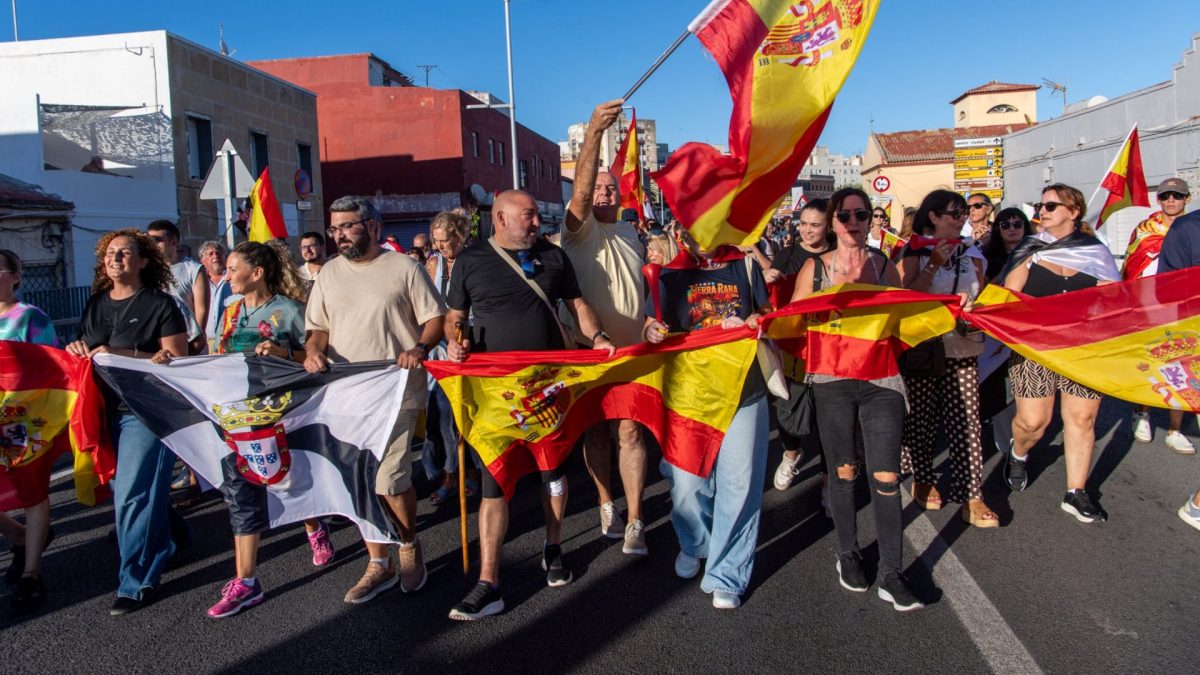
Tens of thousands of angry protesters have marched across Spain as simmering tensions over migration snowball into a crisis that threatens to bring down the government. Spaniards have called on Spain’s prime minister, Pedro Sánchez, to go over his perceived failure to deal with the crisis after a surge into the tiny Spanish outpost of Ceuta on the North African coast last month that made global headlines. The late-July surge of tens of thousands of migrants from Morocco through one of Europe’s only land borders with Africa – along with the Spanish enclave of Melilla – has divided the EU and put Sánchez under huge political pressure at home and abroad. This week, Donald Trump waded into the row by claiming Spain’s handling of the migration crisis will destroy the nation. “Spain will be a ruined country, and I’ve had my own problems with Spain because it doesn’t behave very well with respect to Nato,” he told GB News on Thursday. Trump was referring to Spain’s refusal to agree to the American demand for all Nato nations to pay 5 per cent of GDP to the military alliance, which led to the US President threatening to end all trade with Spain, a threat he has yet to fulfil. Spain has been more open to migration than other countries in Europe, but the issue has become increasingly divisive in the wake of the Ceuta crisis, polls showed. Nationwide demonstrations in Madrid on 2 September following a call by the Federation of Municipalities. Protests were held in major cities across the country (Photo: Burak Akbulut/Anadolu via Getty Images) Tens of thousands of angry protesters filled cities and towns across Spain on Wednesday night to mark Ceuta’s “national day” and protest at the Government’s handling of the issue. Police fired rubber bullets to break up the demonstration in Madrid, and there were major protests in the cities of Barcelona, Valencia and Seville. Waving Spanish flags, demonstrators shouted, “A united Ceuta will never be defeated”, “Sánchez to prison” and “invaders – go home” – in reference to the thousands of migrants who remain in the city. Spanish authorities claim the vast majority of an estimated 72,000 arrivals from Morocco have since returned. Begoña Tamarit, 51, from Valencia, said: “Not only do we want these migrants to go home, we want Sánchez to go too.” After the protest in Madrid, José Ignacio Prieto, 35, said: “This has shown this Government for what it is – unable and unwilling to deal with the biggest crisis in years. They should go.” Days after migrants swam or walked into Ceuta on 30 July, 22 out of 27 EU countries signed a letter criticising Sánchez’s lax migration policy, singling out a recent migration amnesty which has allowed one million immigrants to gain legal status. The Prime Minister angrily hit back at his EU critics, saying they were acting out of “prejudice, fake news, ignorance, or political interest”. A migrant camp in Ceuta for new arrivals from Morocco, pictured this week (Photo: Pablo Gallardo/Getty) Sánchez was also widely criticised at home for going on holiday to Lanzarote days after the crisis exploded. More than a month after the incursion, at least 5,000 migrants are still camped out on the main beach or in the streets in Ceuta. Many pundits in Spain and abroad have pointed the finger at Morocco, saying it could have prevented the entrance of migrants. But Sanchez said there was no evidence Morocco planned the influx. “I can assure you that no institution, not the diplomatic service, nor the European Commission, nor any international body has provided the Spanish Government with any solid evidence that Morocco planned or carried out the incident. None whatsoever,” he told the Spanish Parliament on Thursday. However, a Spanish police report has suggested otherwise, claiming that for over 10 hours, on 30 July, Moroccan police had helped or guided migrants over the border. Sánchez said Spanish authorities were trying to determine whether this was due to unwillingness or inability to stop thousands of migrants. Sánchez blamed the incursion on a misinterpretation of a Spanish Supreme Court ruling in July, which said migrants who swam from Morocco to Ceuta would not be automatically sent back, and disinformation spread on social media. Spain’s Prime Minister Pedro Sanchez is under mounting pressure over Ceuta (Photo: Olmo Blanco/Getty) The Prime Minister has also accused social media accounts linked to Russia and Israel and right-wing groups of exploiting the Ceuta crisis after it happened, a claim dismissed by both countries. Analysts say Sánchez has been politically damaged by the crisis as he faces a general election year in 2027. “The damage is obvious,” Pablo Simón, a political analyst at the Carlos III University in Madrid, said. “I think it is obvious that the general perception is one of slow response and lack of firmness with Morocco.” Before the Ceuta crisis, Sánchez’s Socialist party trailed in second place in polls all this year and the opposition conservative People’s Party won four key regional elections. Ana Carmona, a political analyst at the University of Seville, said the Ceuta incursion was an attack on Spain’s territorial integrity, which she believed was handled “terribly”. “Sánchez has allowed the entire month of August to pass without openly addressing the crisis. The failure to promptly call on [EU border agency] Frontex and seek EU involvement is difficult to understand. Ceuta is an external border of the European Union,” she said. Migration has become a more divisive issue in Spain, a country which was renowned for its liberal attitudes for foreigners – until now. More than 60 illegal migrants jumped from a high-speed smuggling boat onto Cala del Barco beach in Murcia, 🇪🇸Spain, causing startled tourists to flee.So much for the handling of the migration crisis by the Spanish authorities? pic.twitter.com/NMlKyfiv79— Dovydas Vitkauskas (@Dovydas44444) August 20, 2026 A poll published on 31 August for Agenda Pública, a Spanish political website, found immigration was splitting Spanish society, with 40.5 per cent of those polled viewing it in a negative way, while 29.7 per cent said it brought more benefits and 27.9 per cent were ambivalent. In 2025, for the first time, one in five people in Spain – or 10 million – were born outside the country, according to the Spanish National Statistics Institute. Half of all foreigners come from the Americas, principally Colombia and Venezuela, 27 per cent from Europe, 17 per cent from Africa and six per cent from Asia. Videos of people smugglers landing migrants on tourist beaches have further inflamed public opinion. Tourists fled when smugglers landed about 60 migrants on a beach near the famous La Manga sports club in Murcia last month, where the England men’s national football team, Arsenal and Newcastle have trained. It is the latest in a series of landings in which people smugglers shed their human cargo, then escape in their high-speed launches. Trying to stop these speed boats arriving from North Africa with scores of migrants has so far proved beyond the capabilities of Spanish law enforcement agencies.
Spain’s migrant crisis could topple its government
Full Article
Original Source
Read the full article at Inews →KhanList aggregates and links to publicly available news content. We do not host full articles from third-party sources. Always verify important information with original sources.