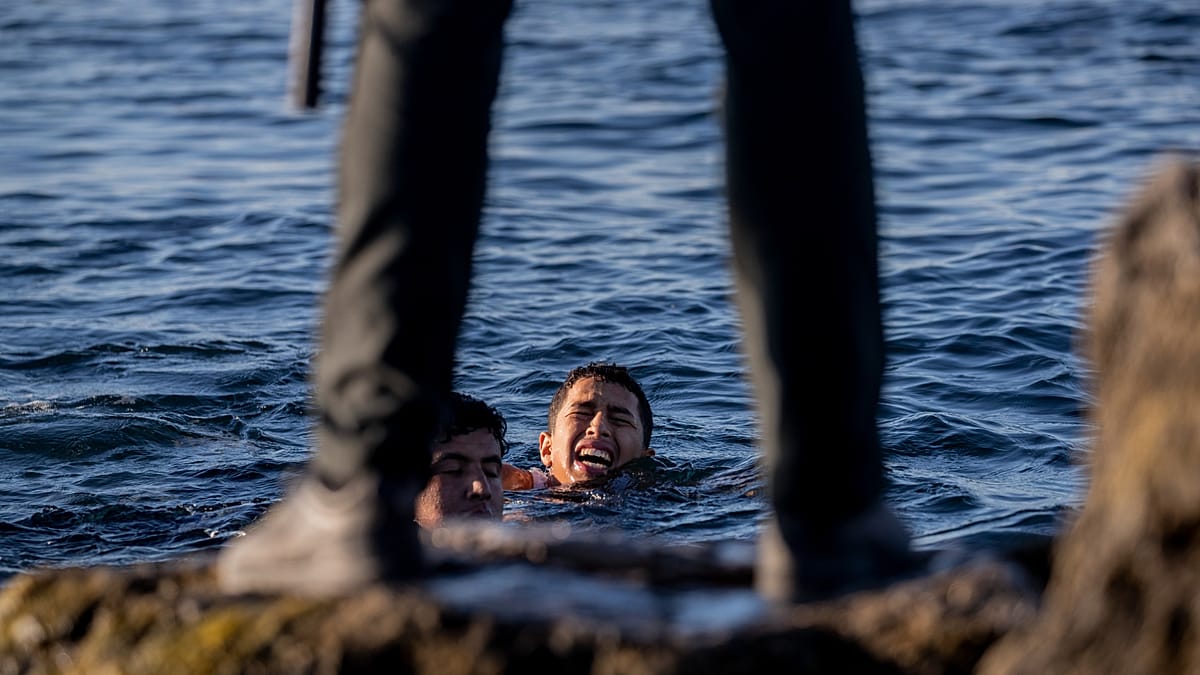
Ceuta has seen its highest number of migrant arrivals in five years. According to Spain's Interior Ministry, around 50,000 people from Morocco, Algeria and sub-Saharan Africa have entered the Spanish enclave since Thursday, most by swimming around the southern breakwater at Tarajal beach. By Friday afternoon, around 48,000 had already returned to Morocco voluntarily. ADVERTISEMENT ADVERTISEMENT Behind the bottleneck are two legal issues that have collided at the worst possible moment. The first stems from a case dating back several years, in which an Algerian migrant challenged his summary return to Morocco, arguing that he had entered Ceuta by swimming rather than by breaching the border fence or climbing over razor wire. Ceuta's court, followed by the High Court of Andalusia and ultimately the Supreme Court, all ruled in his favour, establishing a key legal precedent: migrants who arrive by swimming do not "cross a border containment element", a legal requirement for carrying out summary returns without first opening an individual case file under Spain's Aliens Act. In practice, this means a large proportion of those now crossing at Tarajal cannot be immediately returned under that mechanism. The second legal development is more recent. On 8 July, the Supreme Court (STS 868/2026) struck down several provisions of the 2024 Aliens Regulation, including one that had weakened the authorities' obligation to provide immediate care to unaccompanied foreign minors found on Spanish territory. The ruling strengthens, rather than weakens, protections for migrant children. However, Vivas has described it as an additional obstacle to managing the arrival of unaccompanied minors and has openly called to "legalise" summary returns in their case. On that basis, Ceuta's government has backed a bill tabled by the People's Party (PP) in Congress to amend the tenth additional provision of the Aliens Act. The proposed reform would explicitly extend the special border rejection regime to anyone attempting to enter Ceuta or Melilla irregularly through any unauthorised point, whether by land or by sea. The stated aim is to provide legal certainty for the Civil Guard, whose unions, including the AUGC, have for weeks been calling for a clearer legal framework so officers can act without being caught between judicial rulings and mounting pressure at the border. A divided political debate The proposal is also opposed by organisations including Coordinadora de Barrios, No Name Kitchen and the Jesuit Migrant Service, which represent some of the migrants affected by returns without due process. They argue that the reform would undermine individual safeguards, particularly for unaccompanied minors. The PP's bill is still at an early stage, and its passage through Congress could take months while pressure at Tarajal shows no sign of easing. Any reform directly affecting the status of unaccompanied minors will also have to contend with the line of case law reaffirmed by the Supreme Court on 8 July, raising the prospect of further legal challenges if the bill is approved in its current form. Underlying the debate is the need to ensure any changes comply with the European Pact on Migration and Asylum, a balance that neither Ceuta nor Madrid has yet managed to strike. The stories behind the border: who is crossing and how The entrance to the CETI offers a different, more intimate view of the crisis. As reported by El Mundo, the road leading to the centre's entrance has become a makeshift camp, with families lying along the roadside under Red Cross blankets and improvised shelters made of sheets, cardboard and branches. At the gates of the facility, dozens of men queue to wash, kneeling beneath a street tap. Among them is Mohamed, a 23-year-old Moroccan from Nador, whose testimony was reported by El Mundo. Mohamed said he spent 12 hours travelling by bus to Castillejos before swimming across to Tarajal in the early hours, without flippers, a wetsuit or a flotation device, enduring extreme cold during the crossing. Mohamed spent three years living in Barcelona and speaks fluent Spanish. He said he had returned to Morocco two weeks earlier to visit his family and, lacking the necessary documents, chose to make the journey back via the irregular route. He cited the lack of opportunities and hunger in his country as the reasons for making the crossing. Across the border, in Castillejos, El Faro de Ceuta reports that the Moroccan authorities have closed off part of the seafront promenade in an attempt to stop people, particularly minors, from entering the water. The metal fences erected there are easily bypassed, while buses carrying those intercepted take them further south, mainly towards the Sahara. According to the same outlet, a mother and her three children nearly drowned on Tuesday while attempting the crossing.
Spain's legal dilemma behind Ceuta's record migrant arrivals
Full Article
Original Source
Read the full article at Euronews →KhanList aggregates and links to publicly available news content. We do not host full articles from third-party sources. Always verify important information with original sources.