
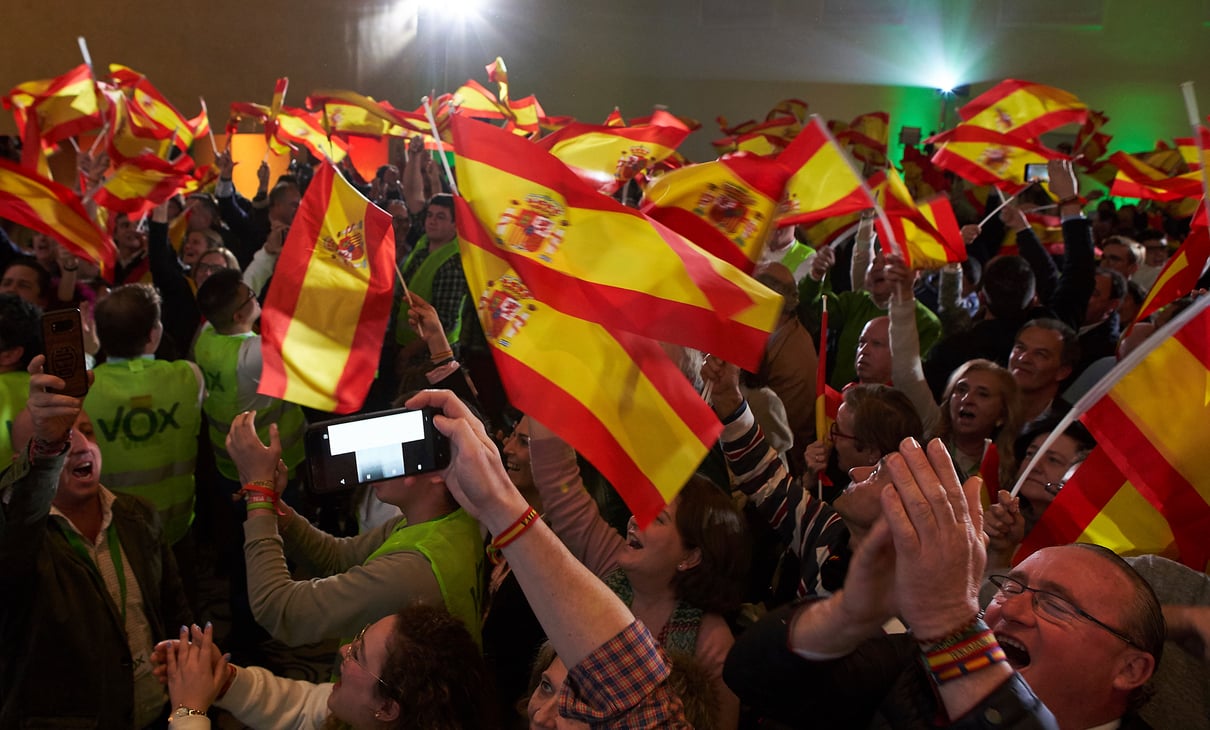
Vox had the polling numbers. Its rivals had parliamentary seats. A European court backed Spain’s decision to reject a TV debate lineup that favored the rising far right.(CN) — Spain could block a TV debate lineup that welcomed far-right Vox but sidelined elected rivals, Europe’s human rights court ruled Thursday.The European Court of Human Rights rejected Atresmedia’s complaint over restrictions on its planned five-party debate before Spain’s April 2019 election. The broadcaster had asked the court to find that Spain violated its freedom to inform viewers.Judges found that protecting fair electoral competition justified the restriction on Atresmedia’s editorial freedom. Spain could give past election results priority over opinion polls, and the broadcaster remained free to arrange a debate that respected the excluded parties’ interests.Spain’s political map was changing fast that spring. The Socialists and conservative Popular Party faced a growing field of competitors, making governments harder to assemble. Socialist Prime Minister Pedro Sánchez called the election after failing to pass a budget.Vox, an anti-immigration party fiercely opposed to independence for Spain’s Catalonia region, was attracting voters disillusioned with mainstream conservatives. It had entered Andalusia’s regional parliament, and a national poll put its support at 11.9%. But it had no seats from the previous national election.Atresmedia wanted Vox alongside the four biggest parliamentary parties for its April 23 debate. Three excluded parties from the Canary Islands, Catalonia and the Basque Country complained to Spain’s electoral commission: They already held parliamentary seats, yet a party whose national breakthrough was still a forecast had made the cut.The commission rejected the lineup and deemed Atresmedia’s offer of airtime elsewhere insufficient. Atresmedia withdrew Vox’s invitation and challenged the restrictions in court.The Strasbourg court accepted Spanish judges’ concern that relying on surveys would force broadcasters and regulators to assess polling methods, making the rules less predictable. It also stressed that the commission had responded to complaints from excluded parties, whose interests had to be weighed alongside the broadcaster’s.“The applicant company’s free choice to hold a debate excluding one participant (representing Vox) rather than add three others does not alter this conclusion,” the court said.Vox won parliamentary seats that April. After parties failed to form a government, Spain held another election in November, and Atresmedia included Vox in an eight-party debate.Alicia González Moro, assistant professor of constitutional law at the University of Cantabria, called the ruling foreseeable.“It confirms its well-established case law on the margin of appreciation afforded to states when regulating their electoral processes, which includes the regulation of political parties’ access to the media,” she said, adding the commission had simply applied Spanish electoral law.But she saw reasons to rethink the rules. Spain’s party system might have become less unstable since 2015 and 2019, she said, yet parliament remained fragmented. She pointed especially to television’s declining prominence and the growing number of competing media outlets as reasons to update the criteria.Sánchez now faces an early election on Nov. 29, with polls suggesting the Popular Party and Vox could together win a majority. One of Europe’s remaining center-left governments is under pressure as politics across the continent shifts rightward.The Spanish government, Atresmedia and Vox did not respond to requests for comment.Atresmedia has one more possible step: Either side may seek review by the court’s Grand Chamber within three months, though acceptance is exceptional. If neither requests it, or a request is rejected, the judgment becomes final and Spain’s restriction stands.Courthouse News reporter Eunseo Hong is based in the Netherlands.Subscribe to our free newslettersOur weekly newsletter Closing Arguments offers the latest about ongoing trials, major litigation and rulings in courthouses around the U.S. and the world, while the monthly Under the Lights dishes the legal dirt from Hollywood, sports, Big Tech and the arts.Additional Reads
Spain wins fight over TV debate’s far-right guest list
Full Article
Original Source
Read the full article at Courthousenews →KhanList aggregates and links to publicly available news content. We do not host full articles from third-party sources. Always verify important information with original sources.