
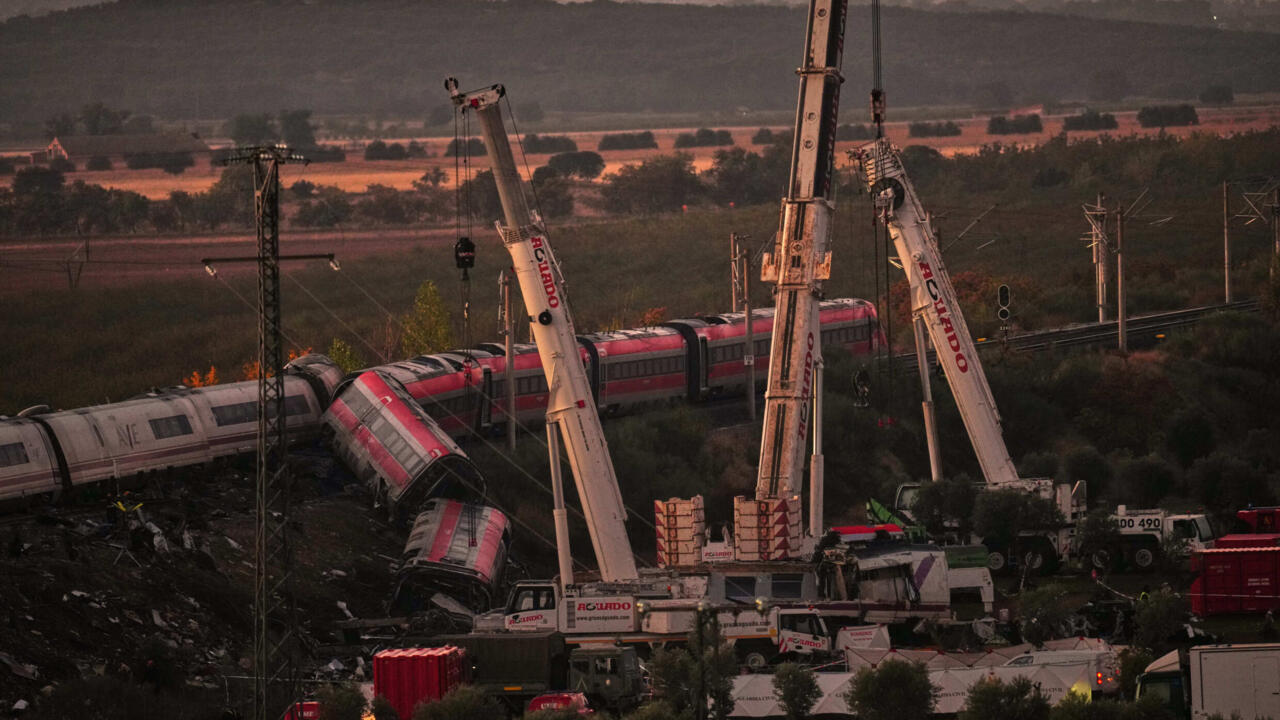
Spain began three days of mourning on Thursday after a rail collision south of Madrid killed at least 68 people and injured more than 100. The Spanish national flag will fly at half-mast outside all public buildings, including Spanish embassies abroad as well as on Navy vessels. "The whole of Spain is in mourning," said Prime Minister Pedro Sanchez after visiting the scene of the crash in the central region of Castilla-La Mancha. "We express our full solidarity and empathy with the families of those who have died, as well as with the injured who remain in hospital. We hope they make a speedy recovery. "Behind every person who has died are shattered lives and broken families," Sanchez added. "There is also anguish among those families who still do not know where their loved ones are. And, of course, there is profound pain — pain that Spanish society as a whole understandably shares." Second fatal crash in 2026 in Spain Spain's second fatal train crash this year has raised fresh questions about safety on Spain's rail network after the transport minister reported an "error" and "inexplicable circumstances" that led to the crash. The collision happened on Wednesday morning when a service run by state operator Renfe ploughed into the back of a stationary train belonging to private Spanish company Iryo. Emergency services combed through the wreckage overnight to find further victims on the line linking Madrid with the southern city of Seville, hoisting pieces of mangled metal with cranes. Survivor Pablo Mejia, 42, escaped with injuries to his head. He said a last-minute change of seat saved his life. Wearing a bloodstained grey jumper and holding his tattered suitcase, he said: "I felt a very strong impact... there were a lot of people on the floor, on top of each other, seats ripped out, suitcases everywhere. There was a lot of chaos. "I think I've been given another chance of life," he said. Help centres for families A school in the nearby village of Urda, around 130 kilometres south of Madrid was deployed to allow relatives to enquire about their loved ones. "We have people who are in shock, who haven't taken on board what has happened, angry people, sad, worried people," said Red Cross psychologist Carmen Garcia. "The grieving will be complicated," she added. The Civil Guard oped our offices in the cities of Madrid, Toledo, Cordoba and Seville to enable relatives of the victims to provide DNA samples and help identify the missing. Blood donation points were set up in Castilla-La Mancha and Madrid. Jose Miguel Fernandez, a parish priest in Urda, joined the emergency services in offering support to the victims' families. "When I arrived at the site, I was confronted with an image of desolation, despair, uncertainty, death," said Fernandez.. "What matters most is being with the victims' relatives, that they feel the closeness, because words at a time like this are pointless, but a hug helps," he added. Reasons for collision Transport Minister Oscar Puente said on Wednesday that an automatic control system went down on 69 kilometres of track, causing all trains there to be stopped. But the control centre decided to "resume traffic in circumstances that, from our point of view, are inexplicable," Puente said, with the Renfe train travelling 25 kilometres before striking the Iryo. "The control centre had more than enough time to verify the error, and they did not fix it," he added. Andalusia train crash In January, two high-speed trains collided in the southern region of Andalusia after one of them derailed and crossed onto the adjacent track, killing 46 people. The investigation into that accident is ongoing, but the faced heavy criticism over its management of Spain's railways. The latest disaster comes one month before Sanchez seeks to extend his eight-year premiership in a general election on 29 November. “I know that the Independent Railway Accident Investigation Commission and the judicial authorities are carrying out their work," said Sanchez. "A country such as Spain cannot accept suffering two high-speed rail accidents in the same year, as we have done. All measures deemed necessary will therefore be taken, firmly and decisively, to restore confidence in our high-speed rail network and, of course, to further guarantee the safety of our fellow citizens who use this service." (With newswires)
Spain starts three days of national mourning after train crash kills at least 68
Full Article
Original Source
Read the full article at Rfi →KhanList aggregates and links to publicly available news content. We do not host full articles from third-party sources. Always verify important information with original sources.