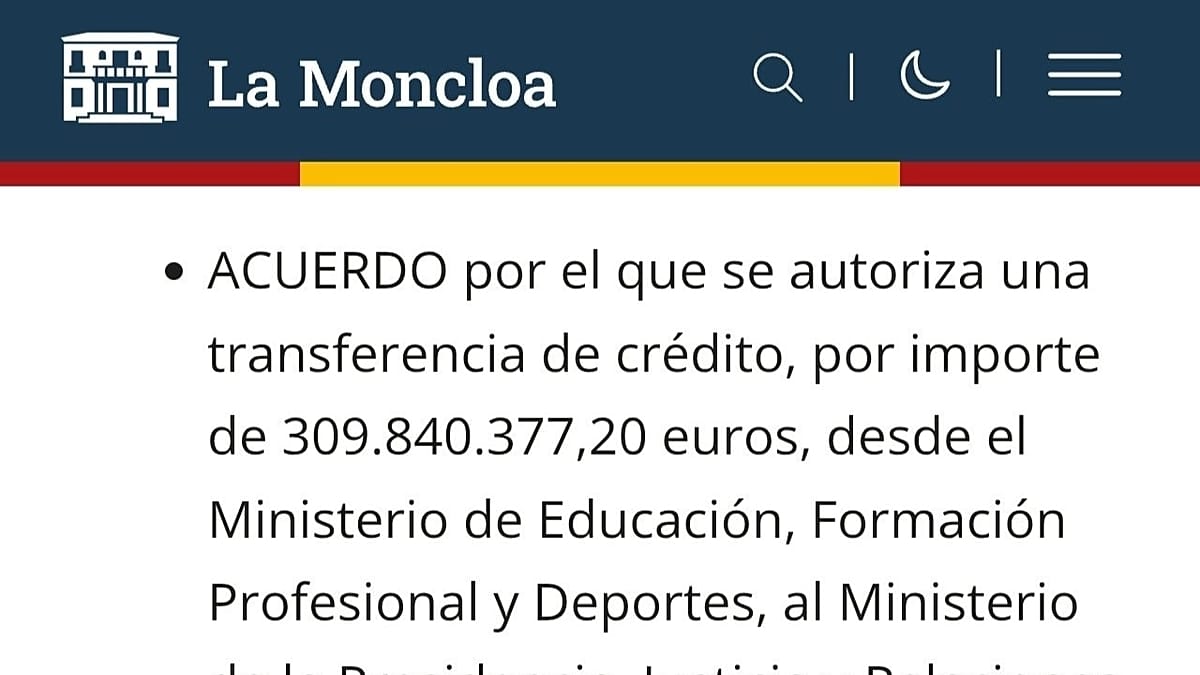
On Tuesday, 14 July, the government approved in the Council of Ministers a budget transfer of over €309,840 from the Ministry of Education, Vocational Training and Sport to the Ministry of the Presidency, Justice and Relations with Parliament. ADVERTISEMENT ADVERTISEMENT The purpose of the money, as set out in the agreement itself, leaves no room for doubt: to cover shortfalls in Chapter 1. In other words, the staff costs of the department headed by Félix Bolaños. That chapter includes payroll, social security contributions, length-of-service increments and pay supplements for civil servants assigned to the ministry. This is money intended to keep the administrative structure running, not to fund specific programmes or investment. The operation is not an isolated exception. Just a few months ago, in April, the same executive had already diverted almost €30 million from the department formerly headed by education minister Pilar Alegría to Justice. That instance was to finance digitalisation projects linked to the Recovery Plan. The difference now is the scale: ten times as much money and a destination that is not technological modernisation but simply meeting payroll. Why education and not another ministry? The official explanation points to the extension of the budget. With the 2023 accounts still in force, the government has gone three financial years without managing to pass a new budget, so any spending that does not fit within the inherited items has to be covered by moving funds between departments. The Ministry of the Presidency, Justice and Relations with Parliament allocates more than 73% of its ordinary funds to staff costs, a share which, according to government sources, has been overwhelmed by rising public-sector pay. What the agreement does not explain is why education has been chosen to plug that gap. The text approved by the Council of Ministers does not spell out which specific lines (grants, classroom digitalisation, catch-up support or vocational training) are left with less budgetary room after losing €310 million. It simply confirms the figure and its final destination. The contrast with the official narrative is clear. While the Ministry of Education, now headed by Milagros Tolón and previously by Pilar Alegría, has recently boasted of distributing more than €31 million among the autonomous communities to boost vocational training, or of the European funds received thanks to the Recovery Plan, the same ministry now sees a sum ten times larger leaving its coffers by administrative means, without public debate or a specific parliamentary vote. The political cost of governing without a budget The extension of the budget is not just a technical problem. Each transfer of this kind forces the government to take decisions which, in a scenario with updated accounts, would have been discussed and approved under a different level of scrutiny. The Independent Authority for Fiscal Responsibility has repeatedly warned that the lack of new budgets complicates both economic planning and oversight of the public accounts. In this context, the decision to cut Education in order to reinforce the internal functioning of another ministry opens up an entirely predictable political flank. The opposition now has a concrete argument (a figure, a date, a signed agreement) with which to question the gap between the government’s narrative of public education as a social priority and the budgetary decisions that, in practice, benefit the state’s administrative machinery. In doing so, the government itself indirectly acknowledges the structural tension at the heart of the problem: without new accounts, staff spending keeps rising while ministries have to adapt to a financial framework designed for another year. The outstanding question is how many similar transfers will be needed while negotiations on the 2026 budget remain blocked.
Spain praises public education but slashes nearly €309m from its funding for Presidency staff pay
Full Article
📰 Original Source
Read full article at Euronews →KhanList aggregates and links to publicly available news content. We do not host full articles from third-party sources. Always verify important information with original sources.