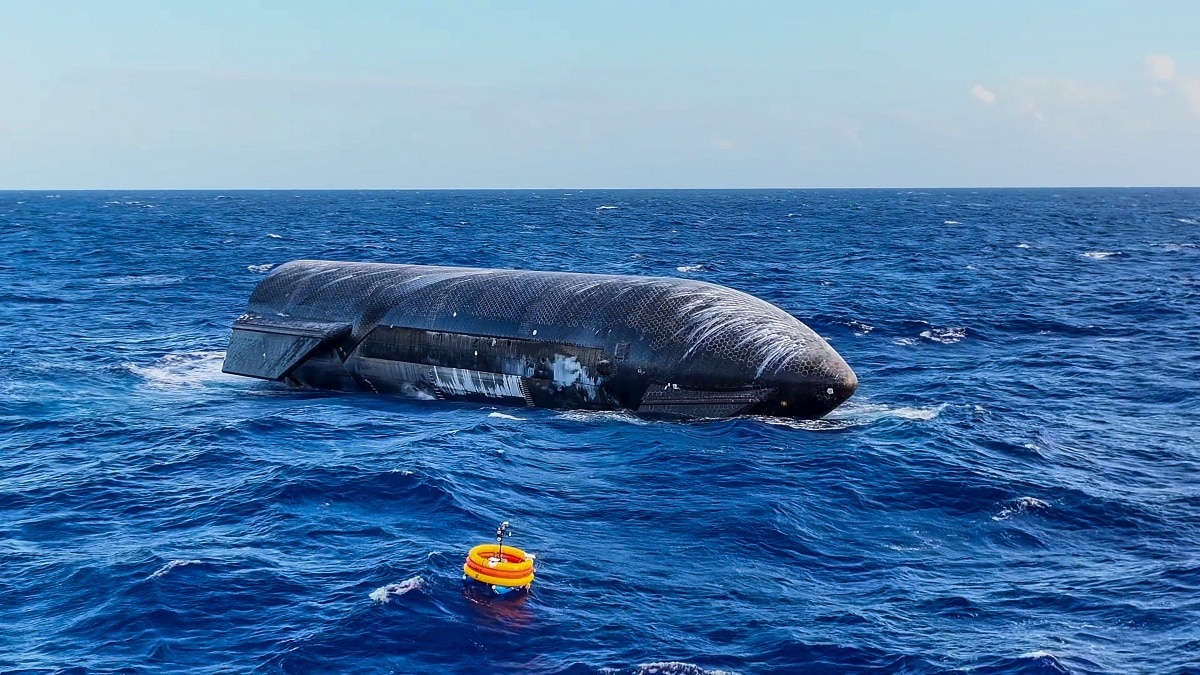
More than two weeks after Starship Flight 13 made an unusually gentle splashdown in the Indian Ocean, its upper stage is still at sea as SpaceX races against worsening conditions to bring the 52-metre spacecraft back to shore.The recovery team is battling increasingly rough seas while trying to stabilise and guide the spacecraft towards port. The latest update, however, is far from encouraging.On August 7, SpaceX CEO Elon Musk said the ship's recovery was "not looking good." The Starship's Upper Stage is seen floating in the Indian Ocean. (Photo: SpaceX) Teams have nevertheless managed to capture close-up images of critical sections of the heat shield and engines, potentially giving engineers valuable information for future Starship upgrades. The ship, identified as Ship 40, has remained afloat since its July 24 splashdown, giving SpaceX an unusual opportunity to examine a Starship after atmospheric re-entry.WHY WAS FLIGHT 13 A BIG DEAL?Starship lifted off on July 24 from Texas at about 4:20 am IST, marking the first Starship mission to deploy next-generation Starlink V3 satellites. Twenty satellites were released on a suborbital path. They briefly operated and communicated with ground stations before re-entering the atmosphere about 20 minutes later, as planned.Starship Flight 13 goals:Deploy 20 next-generation Starlink V3 satellites for the first timeTest Starlink V3 solar arrays, antennas, and laser communications in spaceExecute launch, ascent, stage separation, boostback burn, and offshore landing burn for Super Heavy pic.twitter.com/UXWAnCplSo— Dima Zeniuk (@DimaZeniuk) July 24, 2026The upper stage also successfully restarted a Raptor engine in space and completed a controlled re-entry. It then flipped, fired its engines and achieved what was described as its softest splashdown yet in the Indian Ocean.This was a major change from earlier flights, when Starships had been lost during descent or after hitting the ocean.The Super Heavy booster, meanwhile, made a harder-than-planned splashdown in the Gulf of Mexico after some engines failed to ignite for its landing attempt.WHY DOES BRINGING STARSHIP BACK MATTER?Starship is SpaceX's fully reusable launch system, designed to carry more than 100 tonnes to orbit and eventually support crewed missions to the Moon and Mars. Its upper stage is 52 metres tall and 9 metres wide.The ocean splashdown was part of a deliberate test strategy as SpaceX works towards landing and rapidly reusing the spacecraft.The SpaceX Recovery team is still working to recover Flight 13’s Starship from the Indian Ocean. They’ve been overcoming challenging conditions and increasingly rough seas as they attempt to guide the 52m long spacecraft to port pic.twitter.com/ECT5FyCvr7— SpaceX (@SpaceX) August 7, 2026Keeping Ship 40 intact after re-entry has given engineers a rare chance to study a vehicle that has endured the extreme heat and forces of returning from space.Recovery teams have been working at sea for days, but rough conditions could prevent the ship from reaching port. Even if that happens, Flight 13 has already delivered valuable data.The close-up photographs of the heat shield and engine sections offer engineers a look at how these systems performed after re-entry, information that could feed directly into future upgrades. SpaceX's retrieval team is seen working on the afloat Starship. (Photo: SpaceX) SpaceX now plans an even more ambitious Flight 14; returning the upper stage to land and attempting to catch it with the launch tower's mechanical arms.Whether Ship 40 makes it home or is ultimately lost at sea, Flight 13 has moved Starship closer to the goal of making a giant rocket reusable.- EndsPublished On: Aug 8, 2026 16:05 IST
SpaceX's Starship is stranded at sea. Can the megarocket come home?
Full Article
Original Source
Read the full article at Indiatoday →KhanList aggregates and links to publicly available news content. We do not host full articles from third-party sources. Always verify important information with original sources.