
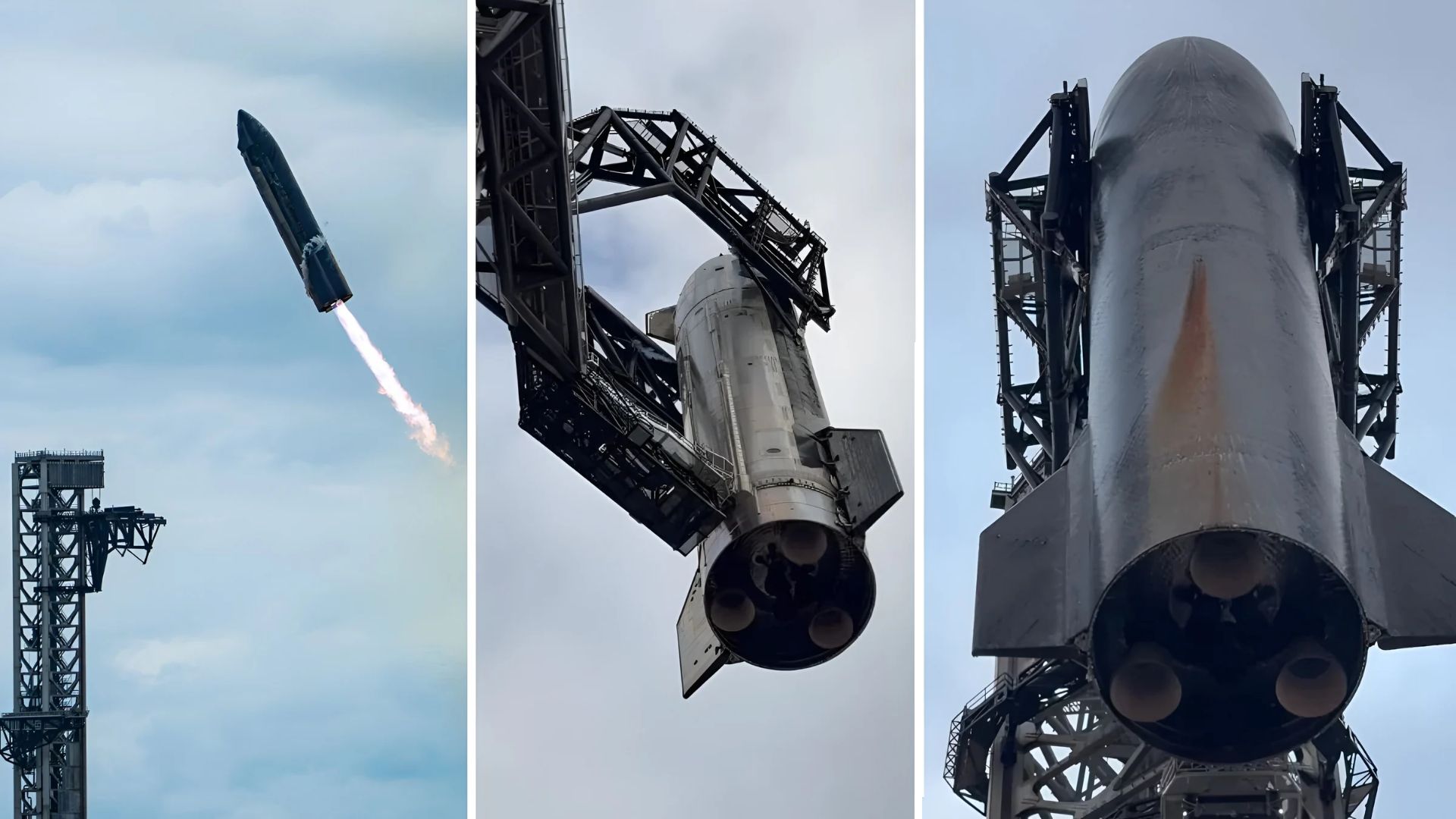
SpaceX has successfully caught its Starship spacecraft at the launch tower for the first time, marking a major milestone in reusable rocket development. The achievement came Saturday, November 14, after the spacecraft completed its longest orbital flight yet. It returned to Starbase in South Texas and landed directly in the tower’s mechanical arms. The recovery followed Starship’s 15th test flight, which began Friday evening. SpaceX had planned to retrieve both stages using its giant launch tower. However, the Super Heavy booster aborted its landing attempt after a low-fuel warning. It instead splashed down in the Gulf of Mexico. Ship 42, the rocket’s upper stage, completed its return successfully. The spacecraft demonstrated that SpaceX could recover both types of vehicles independently. It also brought the company closer to its goal of making Starship fully reusable. Starship completes orbital return During Flight 15, Ship 42 traveled around Earth 14 times over approximately 22 hours. The spacecraft reached an altitude of roughly 161 miles (260 kilometers). It also deployed 26 next-generation Starlink V3 satellites into low Earth orbit. After completing its orbital mission, Starship fired an engine to begin its descent. The spacecraft then faced extreme temperatures as it entered Earth’s atmosphere. Its velocity reached approximately 17,000 mph before atmospheric drag slowed it down. Ship 42 subsequently reignited three engines to control its final descent. The spacecraft maneuvered into a vertical position and approached the Starbase launch tower. Two enormous mechanical arms, nicknamed chopsticks, then secured the vehicle. SpaceX employees gathered outside to watch the historic landing. The company’s webcast captured the moment as Ship 42 settled into the tower. SpaceX commentator Dan Huot described the achievement as a major breakthrough in spaceflight. “That was the missing link,” Huot said during the broadcast. He also described the recovery as a defining engineering achievement for the company. Why the catch matters SpaceX has already demonstrated its ability to catch Super Heavy boosters. The company successfully performed that maneuver on three previous Starship flights. However, recovering the upper stage presents a considerably greater engineering challenge. Ship travels farther and faster than its booster during flight. It must also withstand the intense heating associated with orbital reentry. Successfully guiding the spacecraft back into the tower requires precise control throughout its descent. Recovering both stages could significantly reduce the time between Starship missions. SpaceX wants to inspect, refurbish, and relaunch its vehicles much faster. That approach would bring its rocket operations closer to the turnaround times of commercial aircraft. However, several engineering challenges remain. Starship’s heat shield still requires further development before SpaceX can reuse it with minimal refurbishment. Its black hexagonal tiles protect the spacecraft from extreme temperatures during atmospheric reentry. Bigger ambitions for Starship The recovery milestone could also support SpaceX’s expanding satellite ambitions. Its Starlink V3 deployment represents another important part of Flight 15. SpaceX ultimately plans to build a constellation containing 100,000 satellites. Elon Musk has also discussed a separate project called Starmind. The proposed network would involve one million satellites supporting orbital data-center infrastructure. Such ambitious deployment plans would require an exceptionally high launch cadence. Starship could eventually support these operations alongside SpaceX’s lunar and Mars ambitions. NASA also expects the spacecraft to play a critical role in future lunar exploration. SpaceX has yet to recover both Starship stages during the same mission. Nevertheless, catching Ship 42 demonstrates that the upper stage can return directly to its launch tower. The company will likely attempt the maneuver again during an upcoming flight. Get the latest in engineering, tech, space & science - delivered daily to your inbox.Aamir is a seasoned tech journalist with experience at Exhibit Magazine, Republic World, and PR Newswire. With a deep love for all things tech and science, he has spent years decoding the latest innovations and exploring how they shape industries, lifestyles, and the future of humanity.
SpaceX catches Starship after blistering 17,000 mph orbital return in historic first
Full Article
Original Source
Read the full article at Interestingengineering →KhanList aggregates and links to publicly available news content. We do not host full articles from third-party sources. Always verify important information with original sources.