
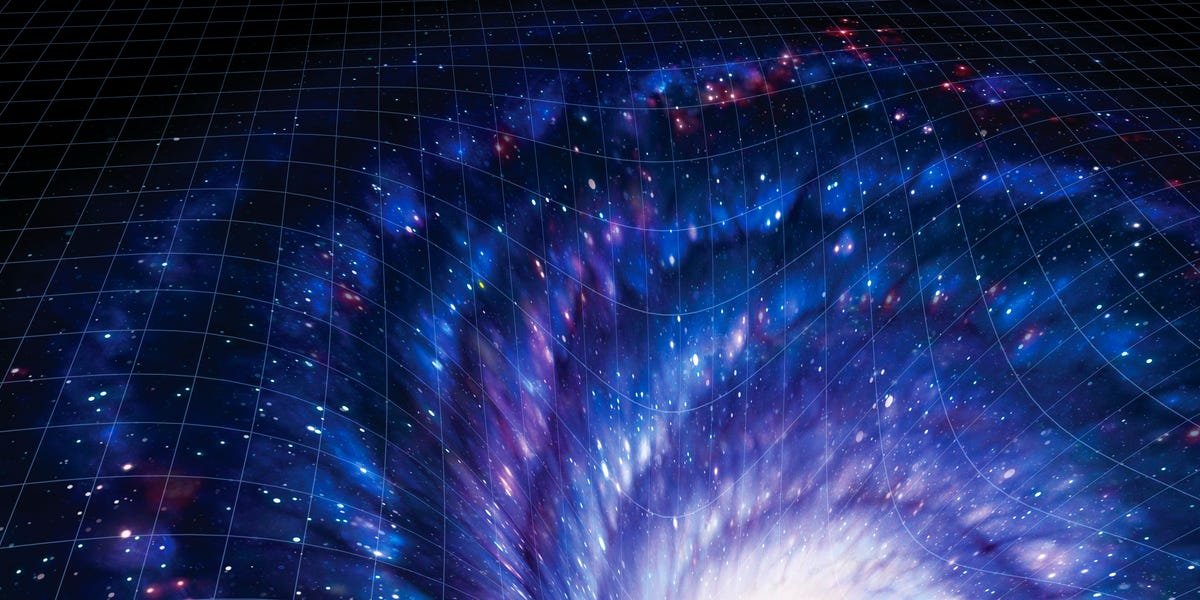
7 min readHere’s what you’ll learn when you read this story:Physicists have long struggled to make the general theory of relativity and quantum mechanics agree, and some scientists believe that there’s a sign that there might be something deeper at play.One scientist, Mayank Mehta, believes that his mathematics point to something beyond our familiar four dimensions. Instead, Mehta suggests that space-time could be just one layer of reality—embedded in a higher-dimensional space. In the brilliant Einsteinian universe we have inhabited for more than a century, space-time is the stage and matter the actors. His general theory of relativity tells us that planets, stars, galaxies, and even you move through a four-dimensional arena, where matter and energy bend and warp the stage beneath us. This is why some of the spectacular James Webb Space Telescope images we devour online show distant galaxies curved into strange, banana-like shapes: massive foreground galaxies and galaxy clusters buckle space-time, bending the path of the light traveling through it. But what if the Einsteinian stage is not as rock-solid as we thought? What if space-time has something to do with a deeper layer of reality we have yet to fully understand?Physicists have good reason to ask. General relativity works spectacularly well on the cosmic scale. The trouble begins when they try to reconcile it with quantum mechanics, the theory describing the microscopic world with equally astonishing accuracy. Try making Einstein’s smooth space-time obey the strange, probabilistic rules of quantum mechanics, and the two theories become stubbornly incompatible. A century later, physicists are still trying to figure out how gravity and quantum mechanics can both be right—and how the two fit together. But perhaps this incompatibility is trying to tell us something much more radical: space-time may not be the most basic layer of reality at all.Some researchers imagine space-time emerging from deeper quantum structures; theoretical physicist Mark Van Raamsdonk has explored the possibility that space-time itself may be stitched together by quantum entanglement, the strange connections linking quantum systems. Reduce that entanglement in his mathematical description, and regions of space-time begin to pull apart from one another. Cognitive scientist Donald Hoffman skews digital, proposing that space-time is more like the desktop on a computer—a useful interface hiding an underlying reality that, in his theory, is built from networks of conscious agents. And theoretical physicist Nima Arkani-Hamed has supplied perhaps the most ominous verdict: “space-time is doomed.”Mayank Mehta, PhD, a physicist and neuroscientist at UCLA, thinks his own mathematics points beyond the familiar three dimensions of space and one of time. His calculations, he says, suggest that the physics of our universe may be embedded in a higher-dimensional space, making the space-time we experience only part of a larger unseen structure. But to understand how he arrived at that possibility, we first have to go back to the century-old clash between relativity and quantum mechanics, and to the physicists who first tried to bridge it.Our first stop is 1920s Britain. There, a young physicist named Paul Dirac is trying to bring quantum mechanics into Einstein’s relativistic universe when the mathematics begins misbehaving, spitting out seemingly impossible negative-energy solutions—states suggesting that electrons could occupy energies below what physicists thought should be the lowest possible level. As Dirac wrestles with what those strange solutions could mean, his theory leads to an astonishing prediction: the electron should have a mirror counterpart, identical in mass but opposite in charge. Within a few years, scientists find it. Antimatter is real.But the mathematical headaches don’t go away. In the decades that follow, physicists including future Nobel laureates Richard Feynman and Julian Schwinger develop increasingly powerful ways of describing the quantum world. One particularly useful trick is to translate calculations from the space-time of relativity into a mathematically friendlier version known as Euclidean space. But with matter particles such as electrons, that translation introduces its own complications. In some formulations, the mathematical objects used to describe these particles have to be doubled. In Mehta’s telling, physicists could make the calculations work—but they treated the extra pieces as mathematical devices, not as real particles.By the 1970s comes supersymmetry, an audacious idea proposing that every known particle has a hidden counterpart, or “superpartner.” None has ever been found, but put these hypothetical partners into the equations and some troublesome quantum effects neatly cancel one another out. Fast-forward to around 1990, supersymmetry became the subject of Mehta’s PhD research at the Indian Institute of Science in Bangalore.Digging through earlier attempts to describe fermions (the tiny building blocks of matter that include the familiar electron in Euclidean space) and the later mathematics of supersymmetry, Mehta spotted what he thought was a problem. “These two worlds had never talked to each other,” he says, referring to Euclidean fermions and supersymmetry. Specifically, the extra fermions introduced in the earlier mathematical treatment created a problem when brought into supersymmetry, Mehta explains.To remedy this, Mehta developed a framework that replaced what he regards as the mathematical “duct tape” of the earlier treatment with a mathematically rigorous description of Euclidean fermions. More radically, Mehta argues that the extra pieces appearing in the mathematics aren’t just calculation tools: they represent another set of particles and antiparticles that should actually exist.Take those extra particles seriously, and suddenly the universe contains much more than just the familiar matter and antimatter we know. His mathematics points to what he calls a “quadruple universe”: matter and antimatter would be joined by a second, still-undetected set of matter and antimatter. “The matter that we see is only 1/4,” Mehta says. “Three-fourths of the matter is missing, hidden in these extra fermions, according to my theory.” This raises an obvious question: if Mehta’s mathematics predicts all this additional matter, where is it?Here the story brushes against another cosmic mystery. Astronomers already know that the ordinary matter we can see accounts for only a small fraction of the cosmos (5 percent, versus roughly 27 percent dark matter and 68 percent dark energy). Mehta is now investigating whether the additional fermions predicted by his mathematics could have something to do with dark matter. He hasn’t completed those calculations, however, and the connection remains a hypothesis.It’s an audacious idea. So much so that, when Mehta first developed his theory of Euclidean fermions as a graduate student, he says his thesis adviser was so appalled that he fired him and told the university dean that Mehta had “lost his mind” and “should be put in a mental hospital.” But the mathematics did eventually make it into print. In 1990, Mehta published a paper in Physical Review Letters proposing a way to carry the Dirac fermion from ordinary space-time into Euclidean space without doubling its degrees of freedom. He followed it with papers exploring how this treatment of Euclidean fermions interacted with supersymmetry and higher dimensions. It was in this subsequent work, Mehta says, that the additional fermions underlying his “quadruple universe” emerged.Mehta says the reaction from some eminent physicists was startling. One Nobel laureate wrote to him calling the work “the biggest discovery since the theory of relativity,” he recalls. Later, he says, Nobel laureate Abdus Salam examined his proof and encouraged him to pursue it—but warned that such an extraordinary claim would struggle for acceptance without support from established figures.Yet even if the UCLA professor’s missing particles exist, an obvious question remains: what does any of this have to do with space-time itself? His theory may have added new actors to the universe, but has it really changed Einstein’s stage? Mehta thinks the answer may be yes. Look back at Dirac: an attempt to make quantum mechanics work with Einstein’s relativity ended up predicting an entirely new form of matter—antimatter. For Mehta, that is a clue that the stage and the actors, or matter and space-time, may not be fundamentally separate things at all. The mathematics governing one, he says, keeps having unexpected consequences for the other.Not everyone is convinced there is something behind Einstein’s stage, though. Nicola Kistler, PhD, a mathematician at Goethe University Frankfurt, argues that the century-long failure to reconcile relativity and quantum mechanics doesn’t by itself demonstrate that space-time is emergent—or doomed.“I would be extremely, extremely cautious,” Kistler says. Before abandoning space-time as fundamental, he wants something considerably harder than an unresolved theoretical conflict: “a counterexample, a smoking gun”—something grounded in mathematics or experiment.After all, a century can feel like an eternity in physics, but not necessarily in mathematics. The failure to solve a problem, Kistler argues, doesn’t tell us that its premises are wrong. Perhaps relativity and quantum mechanics really are “built [...] on sand,” as he puts it. Or perhaps the mathematics required to reconcile them is simply extraordinarily hard.So where does that leave space-time?Mehta thinks there may be another possibility. His calculations, he says, point beyond the familiar four-dimensional picture. Instead, the standard model—which is physics’ remarkably successful recipe for explaining almost everything that happens at the smallest scales (with gravity as the conspicuous exception)—appears to be “embedded in a higher-dimensional space,” he told an audience of scientists at an invitation-only meeting in San Diego this summer, where Popular Mechanics was the only media outlet in attendance. If so, our familiar three dimensions of space and one of time may be only one layer of a structure extending beyond the dimensions we ordinarily experience.Yet Mehta himself is skeptical of claims that cannot ultimately be tested. Beautiful mathematics is not enough to rewrite reality. At the meeting, while discussing another speculative idea, Mehta made the point himself: eventually, a theory has to make a prediction that scientists can actually go out and test. Until then, he said, it remains “in the world of possibilities.”The question remains whether space-time is the whole stage or merely one level of a larger reality that extends beyond the four dimensions we live in. But one thing’s for certain: Einstein’s space-time isn’t doomed—yet.Special Digital IssuesAugust/September 2026Download HereThis issue is optimized for mobile/tablet viewing.It's also available on Apple News+.Featuring:➡ A Luxury Resort Hid a Secret Government Doomsday Bunker Below It for 35 Years. The Clues Were Everywhere.➡ 7 People Have Confessed to Being D.B. Cooper. Is One of Them Telling the Truth?➡ A B-52 Accidentally Lost Two Hydrogen Bombs Over North Carolina. One Nearly Detonated. One Is Still Buried.➡ The Secret Midnight Mission to Stop a 59-Story Skyscraper From Collapsing—and Save a New York City Neighborhood➡ Inside the Nightmare Scenario Where the Hoover Dam Goes Dark-and What Happens Next➡ The Deadly Steamboat Fire That Killed 1,000 People—and the Corporate Cover-Up That History ForgotJune/July 2026Download HereThis issue is optimized for mobile/tablet viewing.It's also available on Apple News+.Featuring:➡ 12 Years Ago, This Jumbo Jet Vanished Without a Trace. New High-Tech Ocean Robots May Finally Reveal What Happened.➡ No Rope. No Mistakes. No Second Chances. The Truth About Free Soloing—and the Climbers Who Never Came Back.➡ Nine Coal Miners Were Trapped Underground in a Surging Flood. "We're Going to Watch Them Die."➡ America Could Be Headed Toward a Future of Ghost TownsApril/May 2026Download HereThis issue is optimized for mobile/tablet viewing.It's also available on Apple News+.Featuring:➡ Blood Was Everywhere. Inside the Heroic Fight to Save a U.S. Nuclear Submarine After a Deadly Crash.➡ The FBI Denies Digging Up Long Lost Civil War Gold. Newly Released Records Suggest a Very Different Story.➡ The Hunt for a Deadly "Ghost Plane" Threatening the Nation's Capitol➡ This Simple Device Could Finally Defeat Alzheimer's and Safeguard Your MemoryFebruary / March 2026Download HereThis issue is optimized for mobile/tablet viewing.It's also available on Apple News+.Featuring:➡ Archaeologists Found a Skeleton Wearing a Silver Amulet. The Discovery Is Rewriting the History of Christianity.➡ The Stray Dogs of Chernobyl Are Rapidly Mutating. Scientists Are Still Trying to Figure Out What It Means.➡ New Evidence Could Upend What We Know About the Charles Lindbergh Baby Murder➡ Police Found Mysterious Notes in a Dead Man's Pocket. They Turned Out to Be Codes That Not Even the FBI Can Break.December 2025 / January 2026Download HereThis issue is optimized for mobile/tablet viewing.It's also available on Apple News+.Featuring:➡ An Angel of Death Preyed on Hospital Patients for Years.➡ How America's Most Advanced Lab Brought the Killer to Justice.➡ A 3,000-Ton Locomotive Was Loose, Unstoppable, and Filled With Toxic Cargo➡ An Underwater Cave Promised Adventure and Glory. No One Expected It to Become a Tomb.➡ Your Consciousness Can Predict the Future, Some Scientists SayOctober / November 2025Download HereThis issue is optimized for mobile/tablet viewing.It's also available on Apple News+.Featuring:➡ Inside the Secret Island Where Death Is Optional➡ A Legendary Ship Sank Without Warning. Fifty Years Later, Science Could Finally Solve the Mystery of the Edmund Fitzgerald.➡ This Tech Rebel Threw Away $900 Million in a Municipal Dump. Can Robots Find His Lost Fortune?➡ Sex Workers, LSD, and Mind Control: What Happened in the CIA's Lab of Nightmares at 225 Chestnut StreetAugust / September 2025Download HereThis issue is optimized for mobile/tablet viewing.It's also available on Apple News+.Featuring:➡ The Worst Air Disaster in American History Happened in Broad Daylight. Will More Mistakes Keep Happening?➡ NASA Has a Plan to Save Earth from Planet-Destroying Asteroids. It Sounds Even Wilder than Science Fiction. ➡ A Naval Officer Says Underwater UFOs Are Legitimate Threats. The Evidence Is Hard to Ignore.➡ When You Die, a Psychedelic Molecule Shapes Your Final Moments of Consciousness, a New Theory Reveals. Popular MechJune/July 2025Download HereThis issue is optimized for mobile/tablet viewing.It's also available on Apple News+.Featuring:➡ This Undersea Explorer Found America's Greatest Sunken Treasure. Then Things Got Really Weird.➡ Is Bigfoot Hiding in the Swamps of Florida? This Group Says It Has Proof.➡ Scientists May Have Gotten the Global-Warming Timeline Seriously Wrong.➡ A Third State Now Exists Between Life and Death, Some Scientists Now BelieveApril/May 2025Download HereThis issue is optimized for mobile/tablet viewing.It's also available on Apple News+.Featuring:➡ Scientists Successfully Revive a Dead Brain, Redefining the Boundary Between Life and Death➡ Fingerprints Keep Leading to Wrongful Convictions. Why Do Courts Still Rely on Them?➡ For 80 Years, the North Sea Held a Deadly Killer. Now Scientists Are Racing to Defuse the Threat.➡ They Built the Quietest Room in the World. Why Is Everyone So Afraid to Step Inside It?February/March 2025Download HereThis issue is optimized for mobile/tablet viewing.It's also available on Apple News+.Featuring:➡ This Guy Says He Knows the Truth About UFOs. Should We Believe Him?➡ Scientists Are Now One Step Away From Solving Nuclear Fusion—And Unlocking Unlimited Energy.➡ A Million-Dollar Heist Rocked the Art World— Then Amateur Sleuths Cracked the Case➡ A New Era of Missile Warfare Has Begun—and the U.S. Isn’t ReadyDecember/January 2025Download HereThis issue is optimized for mobile/tablet viewing. It's also available on Apple News+.Featuring:➡ A Clue Hidden in a 400-Year-Old Map Might Have Just Solved One of America's Greatest Mysteries➡ Inside the Deranged Plot to Smuggle Cocaine With an Armed Soviet-Era Submarine➡ This Brilliant Engineer Helped Build the B2 Bomber—Then He Sold America's Stealth Secrets to China➡ Your Consciousness Can Connect With the Whole UniverseOctober/November 2024Download Here This issue is optimized for mobile/tablet viewing. ➡ Untold Secrets Reveal How the Castle Bravo Test Became America’s Worst Nuclear Disaster➡ This Body Was Found Preserved on a Block of Ice in a Colorado Shed. It Had Been There for 30 Years. ➡ It Was Supposed to Be America's Greatest Victory in Space—Then It Became NASA’s Worst Nightmare➡ The Sidewinder Missile Ruled the Air—Then the Soviets Stole the DesignAugust/September 2024Download HereThis issue is optimized for mobile/tablet viewing.It's also available on Apple News+.Featuring:➡ This Man Knows the Truth About Amelia Earhart. Why Doesn't Anyone Believe Him?➡ The Army's Machine Gun Is No Match for Cheap Chinese Body Armor. So It's Making a New One.➡ Russia Built a Stunning Rival to the Supersonic Concorde—and Then It Fell From the Sky➡ A Navy Admiral Says Underwater UFOs Are a Threat—and the Pentagon is Withholding SecretsJune / July 2024Download HereThis issue is optimized for mobile/tablet viewing.It's also available on Apple News+.Featuring:➡ 4 Black Eggs Have Surfaced From the Depths of the Ocean— and the Mysterious Creatures Inside Are Baffling Science➡ A $2 Million Treasure Appeared in a Kentucky Cornfield. No One Knows Where It Came From.➡ A Million-Dollar Heist Rocked the Art World— Then Amateur Sleuths Cracked the Case➡ A New Era of Missile Warfare Has Begun—and the U.S. Isn’t ReadyApril May / 2024Download HereThis issue is optimized for mobile/tablet viewing.It's also available on Apple News+.Featuring:➡ The Man Who Knows Too Much About Area 51➡ How the FBI Took Down the Internet's Most Dangerous Website➡ A Staggering New Clue Emerges in the D.B. Cooper Hijacking Mystery➡ The Wildest Prison Break in U.S. History➡ The Secret to a Perfect Lawn Lies in One of These 10 Electric LawnmowersFebruary / March 2024Download HereThis issue is optimized for mobile/tablet viewing.It's also available on Apple News+.Featuring:➡ The Incredible Mystery of NASA’s Missing Moondust➡ Inside the Final Fiery Minutes of the East Palestine Train Wreck➡ Scientists Believe They’ve Unlocked Consciousness—and It Connects to the Entire Universe➡ Why This Unstoppable Stealth Bomber Will Rule the Skies➡ America Is Developing a New Nuclear Bomb—But Can’t Test Whether It Works➡ The 8 Best, Expert-Recommended Solar-Powered Generators Special Issue: NukesDownload HereThis issue is optimized for mobile/tablet viewing.It's also available on Apple News+.Featuring:➡ How Deadly Nuclear Waste Is Menacing This St. Louis Neighborhood➡ The Terrifying History of Russia's Nuclear Submarine Graveyard➡ Strange Mutations in Stray Dogs Near Chernobyl Suggest They Are Rapidly Evolving➡ America Dumped 56 Million Gallons of Radioactive Material Along the Columbia River—Then It Started to LeakDecember 2023 / January 2024Download HereThis issue is optimized for mobile/tablet viewing.It's also available on Apple News+.Featuring:➡ A New Clue In Amelia Earhart's Disappearance Emerges From the Ocean➡ How an Alleged Water Bandit Stole $25 Million in Water from Thirsty California Farms➡ A Coal Mine Exploded and 300 Miners Died. What Went Wrong?➡ China Just Built a Terrifying New Aircraft Carrier and May Soon Dominate the SeasOctober / November 2023Download HereThis issue is optimized for mobile/tablet viewing.It's also available on Apple News+.Featuring:➡ How Rats Took Over Our Cities—And Why We Can't Stop Them➡ This Language Is on the Verge of Extinction. Can It Be Saved?➡ America's Deadliest Warplane Returns in a New Doomsday Role➡ This Amateur Diving Group Kept Solving Cold Cases. Then Its Own Skeletons Surfaced. ➡ The Scientific Breakthrough That Could Put an End to Gray Hair. August/September 2023Download HereThis issue is optimized for mobile/tablet viewing.It's also available on Apple News+.Featuring:➡ Immortality Is in Reach. But It’s Not What We Imagined.➡ Your Next iPhone (and Nuclear Subs) Will Be Powered By Space Metal➡ Scientists Now Think We Can Build a Warp Drive➡ China and Russia Have Cracked the Stealth Code. Can the U.S. Regain Air Dominance?June/July 2023Download HereThis issue is optimized for mobile/tablet viewing.It's also available on Apple News+.Featuring:➡ The CIA’s Secret Plan to Build a Laser Beam Powered by the Human Mind➡ The 747 Ruled the Skies—Then One Slammed Into a Mountain➡ The Race to Contain AI Before Singularity➡ These Florida Homes Aren’t Just Hurricane-Proof—They’re Blueprints for the FutureApril/May 2023Download HereThis issue is optimized for mobile/tablet viewing.It's also available on Apple News+.Featuring:➡ AI Is on the Cusp of Taking Control—This Is How It May All Go Wrong➡ There’s No Weapon Russia Fears More Than the HIMARS Rocket Launcher➡ The Nuclear-Submarine Arms Race Is Getting Intense, and the U.S. Just Took a Massive Leap Forward➡ Iran Is Becoming a Drone Superpower—By Stealing American TechnologyFebruary/March 2023Download HereThis issue is optimized for mobile/tablet viewing.It's also available on Apple News+.Featuring:➡ The Greatest Treasure Hunt in American History Ended—and Then Things Got Weird➡ These Are the High-Powered Weapons Ukraine Needs to Send Russia Running➡ The Secret War to Take Out Iran’s Fleet of F-14 Jets➡ Russia Is Trying to Intimidate the U.S. with Hypersonic Missiles and Big, Scary Nukes—And It's More Than a ThreatDecember 2022/January 2023Download HereThis issue is optimized for mobile/tablet viewing.It's also available on Apple News+.Featuring:➡ Is Death Real? ➡ China and Russia Are Dominating the Hypersonic Arms Race—And It’s Not Even Close➡ When the South Fork Dam Broke, a Pennsylvania City Washed Away. Which Town Is Next?➡ The Navy’s New $13 Billion Aircraft Carrier Is Already Obsolete. This Weapon Can Save It.October/November 2022Download HereThis issue is optimized for mobile/tablet viewing.It's also available on Apple News+.Featuring:➡ Can America's M1 Abrams Still Compete With China's and Russia's Latest Battle Tanks?➡ Inside the Final Minutes of the Concorde Disaster—and How It Doomed Supersonic Travel for Decades➡ How the Massive Cargo Ship Felicity Ace Sank, Taking $400 Million Worth of Exotic Supercars With It➡ I Turned My Old Gas-Guzzler Into a Zippy EV for $15,000August/September 2022Download HereThis issue is optimized for mobile/tablet viewing.It's also available on Apple News+.Featuring: ➡ Cosmic Secrets of the 17 Most Powerful Mega-Telescopes on Earth—and Beyond➡ Can the Air Force's Secret, Hypersonic Jet Reclaim the Skies From Russia and China?➡ For 50 Years, the Zodiac Killer's 340 Cipher Stumped the FBI—Then Three Amateurs Cracked the Code➡ America's Most Fearsome Howitzer Has Entered the War in UkraineJune/July 2022DOWNLOAD HEREThis issue is optimized for mobile/tablet viewing.It's also available on Apple News+.Featuring:➡ Every Single Drone Fighting in the Skies Over Ukraine➡ How to Buy a New Car in 2022 Without Getting Fleeced➡ This Megastructure Could Keep Us Alive Forever➡ The Race to Revolutionize EV BatteriesStav Dimitropoulos is a Gold and Community Anthem Award–winning journalist, and writes about consciousness, science, and culture for Popular Mechanics, Nature, and the BBC. Her work often explores mind-stretching angles where science meets philosophy. Her debut nonfiction book, Slow, Lazy, Gluttons (Greystone Books, 2026) asks: What if the traits society shames — laziness, darkness, nostalgia, and more — are actually survival superpowers?
Spacetime May Be Just One Layer of the Universe—Embedded in a Deeper Reality We Don’t Understand, Physicist Suggests
Full Article
Original Source
Read the full article at Popularmechanics →KhanList aggregates and links to publicly available news content. We do not host full articles from third-party sources. Always verify important information with original sources.