
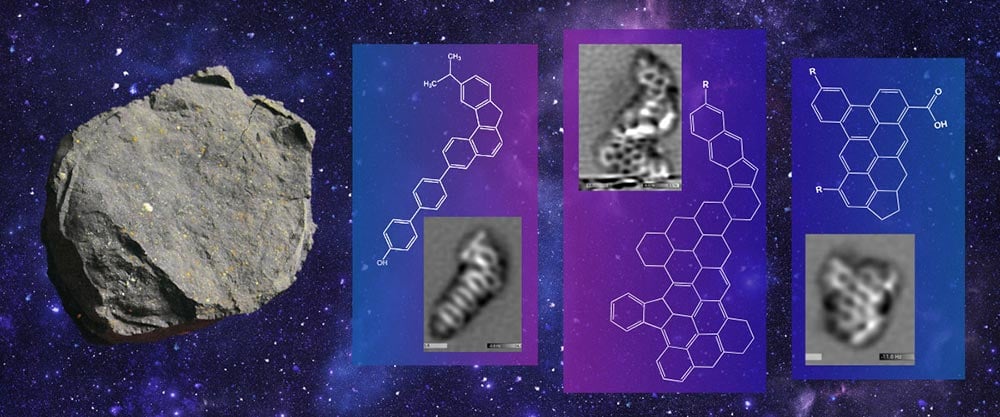
Scientists have known for a while that meteorites contain the “building blocks” of life - complex organic molecules such as amino acids, simple sugars, or even the chemical rungs of DNA. But anyone who has taken an organic chemistry class knows there are plenty of other carbon-based molecules out there, and a new study from Joseph W. Frye-Jones of the National High Magnetic Field Laboratory and Florida State, which was published in The Planetary Science Journal, found tens of thousands of types of previously unseen organic compounds in two of the world’s most famous meteorites. Many meteorites formed even before the planets of the solar system, in a cauldron of gas and dust that circled the Sun. Some of them, known as carbonaceous chondrites, managed to avoid the planetary formation process and preserved their chemistry, which in some cases dates back to even before the Sun was born. Chemists have spent decades analyzing meteorites to unlock their secrets. But when studying their organic compounds, they typically focused on specific molecules. They would take powdered meteorite samples, wash them in water or acid, and search for familiar organics like glycine or uracil. Typically those experiments were successful, but they ignored the vast majority of organic compounds in these meteorites, known as their soluble organic matter (SOM). Fraser talks about the sugars we found in the asteroid Bennu. Dr. Frye-Jones decided to take a different approach. He and his team gathered samples from the Murchison meteorite, which landed in Australia in 1969, and the Aguas Zarcas meteorite, which landed in Costa Rica in 2019. They then crushed them into a powder and rinsed them in four sequential solvents with decreasing polarity - methanol, ethanol, chloroform, and toluene (plus acetone specifically for the Murchison samples). Since “like dissolves like”, the more polar solvents captured many open-chained organics containing nitrogen and oxygen, whereas the less polar ones captured oily organics with “aromatic” rings. All of the dissolved solutions were subjected to two extremely powerful instruments - a 21-Tesla Mass Spectrometer and a high resolution Atomic Force Microscope (AFM). The 21-Tesla Mass Spec is housed at the National MagLab in Tallahassee, and is the most powerful superconducting mass spectrometer in the world. Its superpower is to measure the mass of a compound down to an absurd level of precision - the paper describes the error as being less than the mass of a single electron. Fraser discusses finding organic building blocks in OSIRIS-REx samples. The AFM was housed at Brookhaven National Laboratory on Long Island, and its specialty is taking actual pictures of the molecules themselves. Researcher Percy Zahl, who happens to also be an avid astronomer in addition to being an AFM expert, deposited the extracts from the organic solvents onto a copper crystal in a vacuum. Then he attached a single carbon monoxide molecule to the tip of the AFM and traced the dissolved molecules by measuring the pushback the CO molecule received while gliding over the rings of the organics. Essentially, the mass spec showed what the compounds were made of, and the AFM showed what their structure looked like. And there were a lot of different compounds. The team found over 66,000 unique molecular formulas in Murchison and over 91,000 in Aguas Zarcas. Their mass ranges extended up to 1,000 atomic mass units, with the number of carbon atoms ranging from 10 up to 70, and with as many as 20 oxygen atoms. Interestingly, there was very little overlap in the types of molecules dissolved by the different solvents - for example less than 1% of the molecular formulas were shared between the methanol extract and the toluene extract of the Murchison samples. Even more interesting was the discovery of organometallics. The mass spectrometer found plenty of iron-bearing organic molecules, with carbon chains that included over 35 carbon atoms. They represent stable organometallic compounds, some of which were heavily oxidized, and many of which also contained magnesium. And, despite being from the same category of asteroid, only a minority of the molecular formulas from each asteroid overlapped. Aguas Zarcas, for example, had many fewer organometallic formulas that involved magnesium than did Murchison. The most important takeaway from this work is that meteorites didn’t simply deliver pure amino acids directly to the Earth’s surface before life sprang up here. Instead they looked more like a petrochemical reservoir similar to an oil field, with hundreds of thousands of organic compounds contained in their interiors. Ultimately, it is yet more proof that there was complex organic chemistry going on in the solar system long before there was life - and we are still very much in the dark about how that transition from abiotic chemical refinery to complex biological systems happened. But meteorites and their pristine asteroid cousins remain one of the best places to keep exploring for that answer. Learn More: Brookhaven National Lab - A Glimpse of the Solar System's Origins: Striking Details on the Molecules Inside a Meteorite J. W. Frye-Jones et al - Direct Molecular-scale Insight into Soluble Organic Matter from the Murchison and Aguas Zarcas Meteorites Enabled by 21T FT-ICR MS and Single-molecule HR-AFM Imaging UT - A Martian Meteorite Contains Organic Compounds. The Raw Ingredients for Life? UT - Organic Material Found in an Ancient Meteorite
Space Rocks Carry Hundreds of Thousands of Complex Organic Molecules—and We Just Photographed Them
Full Article
Original Source
Read the full article at Universetoday →KhanList aggregates and links to publicly available news content. We do not host full articles from third-party sources. Always verify important information with original sources.