
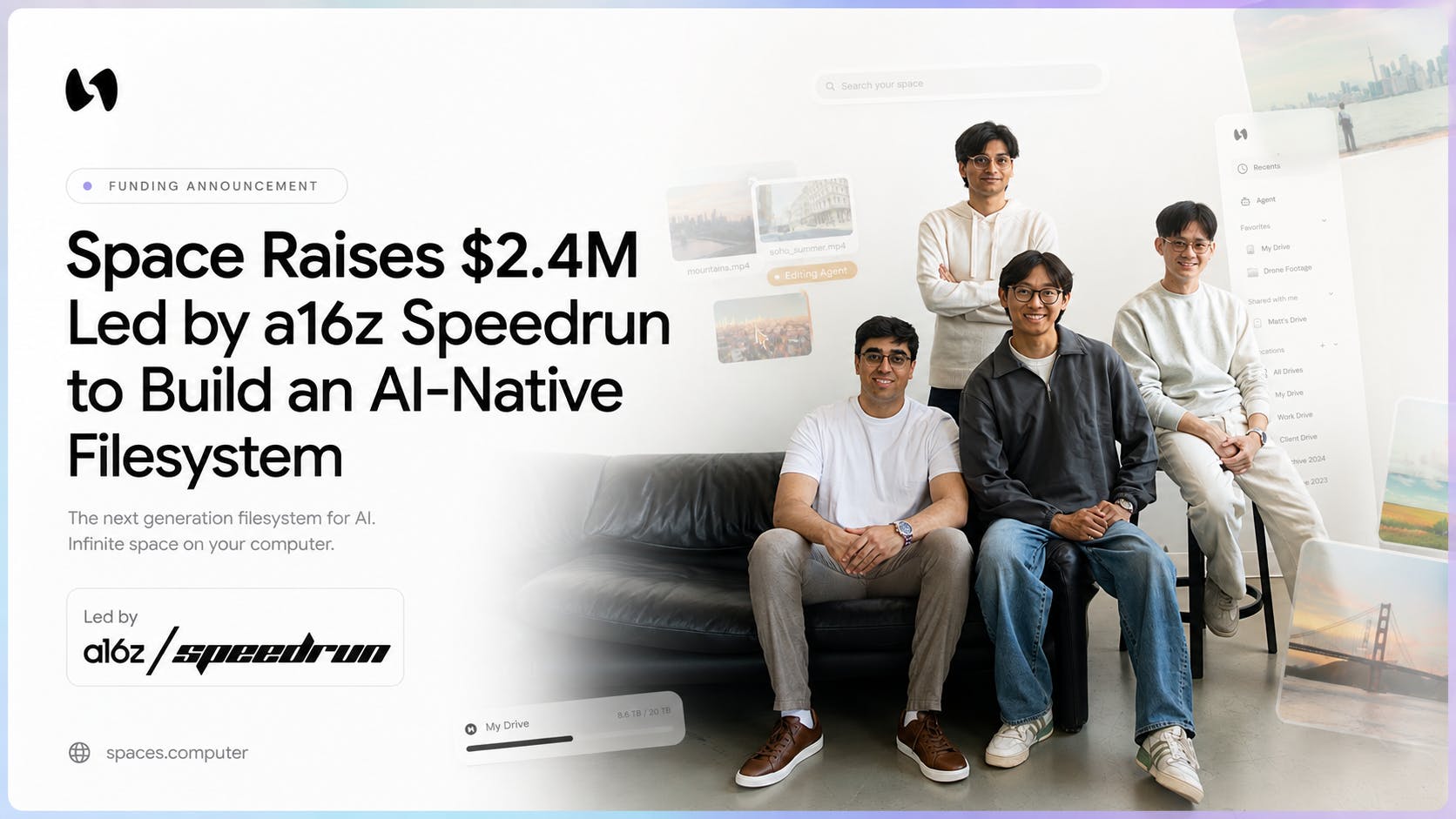
The world will create and replicate roughly 181 zettabytes of data this year, and it has installed about 12.6 zettabytes of storage capacity in which to keep it. Nearly everything interesting about the last decade of computing is contained in that ratio, because the number on the left is growing far faster than the number on the right, and no amount of cheap capacity closes a gap of fourteen times. Space announced a $2.4 million pre-seed round led by a16z Speedrun, with participation from Golden Ventures, Northside Ventures and around a dozen angels drawn from prosumer and enterprise software including Parsec, Sentry, Stan, Superwhisper and Modem. The company, incorporated as Space Computer, Inc., is building a distributed filesystem that makes cloud-hosted data behave like local files inside applications that already exist, without full-file downloads, duplicated copies or an integration written for each tool.Space does not ask a video editor to open a web application, and it does not ask an agent to call an API. It presents a drive in Finder, and every program above it, from DaVinci Resolve to a coding agent, reads that drive the way it reads any other. When an application asks for data, Space streams only the byte ranges required to satisfy the request.The most expensive gap in computing For twenty years the storage industry optimised placement. Object stores got cheaper, durability improved, tiering became automatic and the marginal cost of keeping a byte fell to something close to a rounding error. What did not improve at the same rate was reach, which is the time and money it takes to get a specific byte in front of the process that needs it. Annual global data creation against installed storage capacity, 2012 to 2025The chart above is the reason a filesystem company can raise money in 2026. In 2020 the world created roughly 64.2 zettabytes against an installed base of about 6.7 zettabytes. By 2025 creation had reached 181 zettabytes against an installed base of about 12.6. The gap did not narrow as capacity grew. It widened, because the ratio of what is produced to what can be held is now 14.4 to one, and every workflow that assumes a file must land on a disk before it can be used inherits that arithmetic as a tax.The demonstration folder it uses to show the product contains twelve clips from a single day of shooting, and those twelve files total 145.8 gigabytes. A base-configuration MacBook Air ships with 256 gigabytes. Two days of that shoot fills the machine, which is not a storage problem so much as a scheduling problem, because the operator now spends their morning deciding what to delete.What the sync era ran out of The incumbents in this category are not weak companies. They are companies whose business model presumes the thing Space is trying to remove. Sync-and-share monetises seats against a quota, which means the unit of value is how much you keep. That model needed two things to keep compounding, which were new humans to sell seats to and a rising willingness to pay per seat. Both have flattened.Dropbox added 2.3 million net new paying users in 2016. In 2023 it added 350,000, in 2024 it added around 100,000, and in 2025 it lost 140,000, finishing the year at 18.08 million against 18.22 million a year earlier. That is the first annual decline in paying users since the company began disclosing the figure. Revenue per paying user has barely moved since 2022, landing at $138.91 for 2025 against $140.23 the year before, and full-year revenue slipped 1.1% to $2.521 billion while annual recurring revenue fell 1.9% to $2.526 billion. Management has been candid that winding down FormSwift accounts for roughly half the user attrition, and the company is running the business for margin and cash rather than growth, with unlevered free cash flow above $1 billion and a buyback that retired about 60 million shares.None of that is a failure of execution. It is what maturity looks like in a category where the addressable population of humans who want a synced folder has been reached. The strategically interesting fact is the timing. The seat market saturated at almost exactly the moment a new class of client arrived, and agents do not buy seats, do not tolerate ingestion pipelines and do not care where a file lives.The bill is in the read, not the write The economic argument for streaming byte ranges is stronger than the convenience argument, and it is the part of the story most coverage will miss. Storage cost against egress cost per terabyte across four providers, August 2026Chart 3. Sources: vendor list prices, August 2026, including Backblaze and Cloudflare R2. At list price, holding a terabyte on Amazon S3 Standard costs about $23 a month. Reading that same terabyte out once costs about $90. The read is 3.9 times the month of storage, and on Google Cloud the same terabyte costs $120 to move and on Azure Blob $87. Cloudflare R2 and Wasabi have attacked exactly this line, which tells you where the industry believes the margin sits.Now apply those rates to real work. Pulling Space's 145.8 gigabyte demonstration day off S3 once costs $13.12 in egress before anyone has cut a frame, and a five-person team that each pull their own copy turn that into $65.60 for a single day of rushes. Time behaves the same way. A single 24.3 gigabyte BRAW clip takes 32.4 minutes to download on a 100 Mbps connection and 3.2 minutes on a gigabit line, and a colourist scrubbing that clip touches a small fraction of its bytes. The remainder is pure egress, paid for and waited on, in service of data nobody looked at.This is the number that matters, and it deserves a name. Read amplification is the ratio of bytes moved to bytes actually needed. Most agentic tooling today runs read amplification of several hundred to one, because the interface demands an entire file be uploaded to reach one page of a PDF, one frame of a clip or one function in a repository. A filesystem that serves byte ranges is an attempt to drive that ratio toward one, and the saving falls simultaneously on latency, on egress and on the context window of whatever model is doing the reading.Space's positioning against Dropbox, Box and Google Drive rests on this distinction. Those products are built around syncing whole files onto devices or moving work into a browser. Space sits at the filesystem layer, low enough that Premiere, DaVinci, Blender, CAD packages, code editors and agents all reach the same data without a separate connector for each. The integration count is one rather than N, which is the same argument Parsec once made about the machine and Unity paid $320 million to own. That an angel from Parsec appears on this cap table is not a coincidence so much as a thesis being carried forward from the machine to the data.Founder-market fit measured in terabytes Space was founded by Matthew Ao, Arihant Bapna and Jason Zhao, and the origin story is unusually literal. Zhao has documented his life on YouTube for a decade without deleting a clip, which produced dozens of terabytes scattered across drives, cloud accounts and retired computers. The constraint followed the three of them from personal archives into a company, where a team moving terabytes of footage each month while running an aggressive organic growth strategy lost hours to transfers, quality to compression and whole workflows to a drive left at home. Bapna is the technical anchor, a University of Toronto computer science graduate who now runs engineering and whose GitHub sits under the Space Computer organisation. Ao brings distribution, having built websites for artists and early-stage companies before the trio's previous venture. The founding team built the first prototype in November 2025, worked out of Founders Inc at Fort Mason while raising, and joined a16z Speedrun in San Francisco.The cap table has a structural logic that is easy to miss. Golden Ventures and Northside Ventures are both Toronto firms, and Northside exists specifically to back Canadian founders operating on both sides of the border, writing first cheques of $100,000 to $500,000 out of a $15 million fund. Golden invests $500,000 to $2.5 million from a $100 million Fund V. a16z Speedrun writes up to $1 million and has backed well over a hundred pre-seed and seed companies. What this round assembles is a Canadian founder pipeline plugged into a San Francisco distribution engine, and for a company whose first market is creators and studios, that combination matters more than the headline number.Distribution is the quietly strong part of the story. Space is in private beta with roughly 100 users and teams already onboarded, drawn from an organic audience of more than 80,000 across platforms. That is a conversion signal most pre-seed companies never get to report, and it exists because the founders did not buy an audience in order to sell a filesystem. They accumulated the problem in public, on camera, in front of the exact people who suffer from it.The ledger nobody was supposed to read as a chart Most pre-seed companies ask you to take execution on faith. Space publishes a dated changelog with build numbers for every platform, which turns a claim into a measurable series. Space desktop build numbers by platform, 30 July to 10 August 2026Between 30 July and 10 August the build counter advanced 163 times, which is a shade under fourteen builds a day sustained across twelve consecutive days. On 4 August the macOS build jumped 35 numbers in twenty-four hours. On 7 August Windows sat 18 builds behind macOS and closed the entire gap the following day with a release dedicated to account handling and import diagnostics.Two things follow. The first is that a three-person founding team is shipping at a cadence normally associated with a funded engineering org, and doing it while a fundraise is in flight. The second is more consequential for anyone sizing the opportunity. The public marketing leads with the Mac, and the changelog shows the ambition is considerably broader, with macOS, Windows and Linux moving in near lockstep at 0.1.561, 0.1.561 and 0.1.559 respectively. A Mac utility ships for the Mac. A filesystem for a fleet ships for all three, and the work visible in that ledger, which covers pinned files for offline use, share links, keyboard navigation, drag and drop into Finder, workspace-wide search and remote agent sessions, is the work of a company building an access layer rather than a folder.The product surface reflects that ambition. Files appear in Finder as an ordinary drive. Changes save and propagate to every device on the same Space within seconds. A global search called Spacebar opens on a keystroke. Teammates and agents can open and scrub a file before its upload has finished, which is the sort of behaviour that only becomes possible once you stop treating a file as an object to be transferred and start treating it as an address to be read.The one thing every forecaster agrees on Sizing the market Space is entering is harder than it looks, and the reason turns out to be the interesting part. Published forecasts for cloud and object storage, 2024 to 2035Seven research houses publish forecasts for cloud and object storage and they arrive at seven different numbers, because they are counting different things. Some measure software licences, some measure managed services and some fold in the hardware underneath, which is why the most conservative house tracks a narrower slice of the segment than the most expansive one. What none of them disagrees about is direction. Every forecast on the page compounds at a double-digit annual rate, from 10.4% at the most conservative to 22.5% at the most aggressive, and on the median of all seven the market rises 89% between 2025 and 2030.For a company at Space's stage that combination is close to ideal. A category with an agreed size has agreed incumbents and a fixed pie to divide between them. A category compounding at double digits whose definition is still being written is one where the primitive everyone ends up building on has not been chosen yet, and the firm that ships it sets the terms rather than inheriting them. Space is arguing that the primitive is the filesystem, which is the one interface every application, every person and every agent already speaks.What has to go right The filesystem is the most demanding layer in the stack, which is precisely why the position is worth holding and hard to dislodge once held. Correctness is the first requirement, because a filesystem is judged on the day it is wrong rather than on the thousand days it is right. Conflict handling when two people save the same asset, behaviour when a connection drops mid-scrub, and which byte ranges are cached and for how long are the questions that decide whether a studio trusts the drive. Space has been working through them in public. The changelog shows pinned files and folders for offline use shipping on 2 August, share links and drive recovery on 31 July, and remote agent sessions the day before that, which is the order a team that takes durability seriously would sequence the work. Latency is the second. Streaming byte ranges converts a bandwidth problem into a round-trip problem, and the product is at its strongest on good connectivity. Pinning is the designed answer, keeping chosen files resident for work away from the network, and the company addresses offline behaviour and recommended connection speeds directly in its own published FAQ rather than leaving a buyer to discover them.Procurement is the third. Software that sits this close to the operating system attracts a security review that a browser tab never does. The offset is that the same architectural depth removes the need for a connector per application, which is the argument that wins the review once it starts.Pricing is the fourth and the most genuinely open. If the value has moved from what you keep to what you reach, a seat-and-quota meter is the wrong instrument, and a pure bytes-streamed meter would penalise the behaviour the product exists to encourage. Whoever answers that question will set the commercial shape of this category, and Space is early enough to be the company that answers it.What to watch The honest read on this round is that Space has made a large bet on a small and very old idea, which is that the filesystem is the only interface every application, every person and every agent already speaks, and that rebuilding it around live distributed data makes everything above it faster without asking anyone to change how they work. That bet is legible in the numbers rather than the narrative. The gap between what the world creates and what it can hold is now fourteen times and widening. The sync era's flagship stopped adding paying users last year for the first time on record. Reading a terabyte off the incumbent object store costs four times what holding it does, and a colourist scrubbing a clip pays that toll on bytes nobody will ever look at. What comes next will be decided in three places, and none of them is a press release. The first is the changelog, which is already a public metronome and will show whether the cadence that produced 163 builds in twelve days survives contact with a growing team and a support queue. The second is the conversion of that 80,000-strong organic audience into teams that pay, since a hundred private beta accounts before a public launch is an unusually strong start and the arithmetic gets considerably more interesting once a studio retires its drive-shuttling workflow entirely rather than running Space alongside it. The third is the agent question, which is the one the round was really priced on. If read amplification becomes a line item that engineering leaders track the way they track egress, then a filesystem that serves ranges instead of files stops being a better Dropbox and starts being infrastructure, and the phrase Space uses for its longer-term ambition, the infinite computer, becomes a roadmap rather than a slogan.The near-term test is smaller and more specific than any of that. Space has begun with video, marketing and architecture, engineering and construction, which are the industries whose working sets already exceed the disk in front of them and which are simultaneously furthest along in adopting agentic workflows. The signal to look for is the first team that stops thinking about where its footage lives, because that is the moment a tool crosses into infrastructure, and infrastructure is the one category in software where arriving early to the primitive is worth more than arriving first to the market. On the evidence of the last twelve days, Space is building like a company that understands the difference.Don’t forget to like and share the story!Vested Interest Disclosure: HackerNoon has reviewed the report for quality, but the claims herein belong to the author. #DYOR.
Space Raises $2.4M Led by a16z Speedrun to Build an AI-Native Filesystem
Full Article
Original Source
Read the full article at Hackernoon →KhanList aggregates and links to publicly available news content. We do not host full articles from third-party sources. Always verify important information with original sources.