
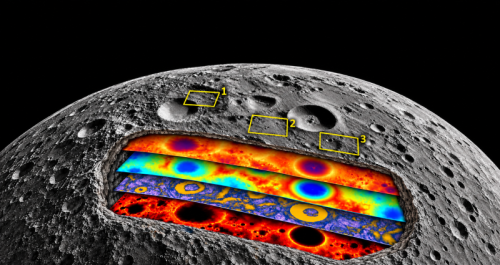
NASA plans to return astronauts to the lunar surface in 2028 for the first time since Apollo 17 in 1972. But the famed agency has no intention of stopping there, as they plan to establish a permanent human presence on the Moon through a slow and meticulous process involving power, resource extraction, and habitat technologies. However, with the soaring use of artificial intelligence (AI) in our everyday lives, how could this emerging technology be used to identify new landing sites for future outposts on the Moon and possibly Mars? Now, a team of researchers from The Ohio State University might have contributed to how AI can be used for future space outposts. As discussed in a recent study presented at the 58th Annual Meeting of the Division for Planetary Sciences (DPS 58) of the American Astronomical Society, the researchers introduced how a novel AI model could be used to both identify safe landing sites and develop a human outpost strategy at those landing sites. The model is called LUMINA, which is an agentic AI framework designed to help mission planners evaluate safe landing sites on the lunar surface, specifically focusing on key resources like water ice, along with potential scientific value. To identify prime landing sites, LUMINA doesn’t just rely on orbital images. It incorporates a myriad of lunar surface data, including topography and terrain hazards, scientific value, geology, surface properties, and even comparing the candidate landing sites to each other. As a result, LUMINA demonstrates a keen ability to identify landing sites across the lunar surface that could maximize mission success and effectiveness for both human habitation and science. But the researchers don’t want to limit LUMINA to the Moon, as they envision LUMINA contributing to other planetary bodies, specifically Mars. “AI systems are going to become critical tools for space exploration that will help humans analyze the millions of images and datasets that future missions will require,” said Gokce Inal, who is a PhD candidate in Civil Environmental and Geodetic Engineering at The Ohio State University and lead author of the study. “This work is meant to serve as a bridge between those two worlds, AI and planetary science.” LUMINA is built upon previous research by this same group called the Large Language-and-Vision Assistant for Lunar Exploration (LLaVA-LE), which demonstrated its ability to analyze and describe orbital images of the lunar surface. The LLaVA-LE model is currently available on arXiv, was recently presented at the CVPR2026 AI4Space Workshop in June 2026 and can be found on GitHub. As noted, NASA has ambitious plans to establish a permanent human presence on the lunar surface with the long-term goal of sending humans to Mars. Developing the necessary technologies to accomplish both goals is part of NASA’s Moon to Mars Architecture, which is a constantly evolving strategic framework designed to develop and test vital technologies that will allow humans to work and live on the Moon that can then be used for human missions to the Red Planet. These technologies include power systems, transportation, habitation & life support, robotics & construction, in-situ resource utilization (ISRU), communications, and more. The question then becomes how can AI, and specifically the LUMINA model, be used to further develop these technologies? “NASA’s Artemis program creates important opportunities for our research,” said Inal. “As new lunar data becomes available, their results can improve systems like ours and better support future mission planning.” Of the technologies listed above, ISRU plays a crucial role in using local and available resources for crew use and survival. This includes water ice for drinking, bathing, fuel, and even oxygen from electrolysis, and using the lunar regolith to potentially grow plants and for construction. Also known as “living off the land”, ISRU aims to reduce, and potentially eliminate, the need for resupplies from Earth. Essentially, it wants to create a self-sustaining system exactly like life on Earth. How will LUMINA help plan future space outposts on the Moon and Mars in the coming years and decades? Only time will tell, and this is why we science! As always, keep doing science & keep looking up!
Space Outposts Beyond the Moon May Rely on Planetary AI
Full Article
Original Source
Read the full article at Universetoday →KhanList aggregates and links to publicly available news content. We do not host full articles from third-party sources. Always verify important information with original sources.