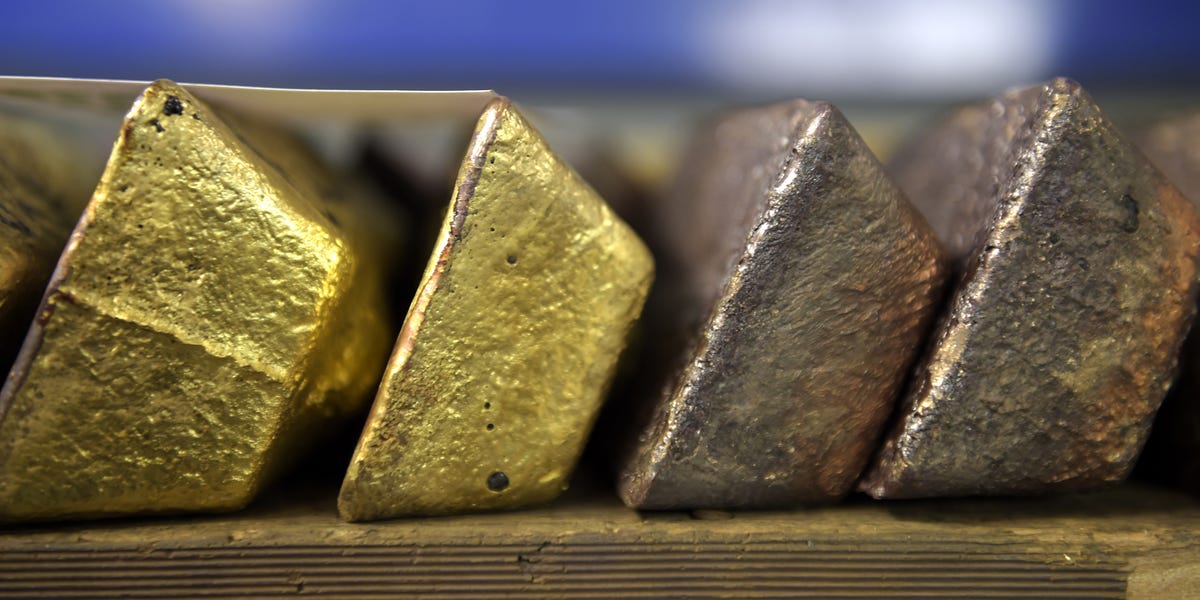
4 min readHere’s what you’ll learn when you read this story:A British ship carrying a payment of gold from the Soviet Union to the United States was attacked by Germans in the Barents Sea in 1942.When the badly damaged HMS Edinburgh sank, it took 58 crew members and the 465 gold bars down with it.A daring 1981 salvage operation recovered 431 of the gold bars.The HMS Edinburgh, damaged from an attack by German ships in 1942, sank 800 feet below the surface of the Barents Sea, along with 58 of its crew members. Along with the crew, the vessel also took with it 465 of Joseph Stalin’s gold bars—planned payment to the United States for wartime equipment.The lost gold became a forgotten casualty of World War II—that is, until a brazen (though officially sanctioned) salvage operation nearly 40 years later recovered most of the bars. Dubbed the “salvage of the century,” the 1981 operation required the team to locate the wrecked ship and manage intense diving operations in the frigid waters 200 miles from Murmansk.When the Edinburgh departed Russia en route to the United States on April 28, 1942, its mission was to deliver a payment of gold bars from the Soviet Union to America for much-needed goods for the war effort. Just days after the Edinburgh’s departure, though, German planes spotted the ship and its convoy. The Germans sent U-boats and three Kriegsmarine destroyers, launching an attack on the Edinburgh, as chronicled by crew members on the minesweepers supporting the British ships.Two U-boat torpedoes struck the Edinburgh. The damage was thorough, crippling the ship and killing 58 sailors (though about 750 were rescued). As the other ships towed it toward port, another attack proved to be too much to bear, and the convoy scuttled the badly damaged Edinburgh, dropping it into the Barents Sea.With the gold onboard covered under the 1942 War Risks Insurance contract signed by the wartime Soviet Trade Delegation to London, retrieving the gold wasn’t an immediate priority, according to Michele Blagg, a researcher at the Institute of Contemporary British History. The first salvage contract was eventually written up in 1954, but was put on hold over concerns from an uncooperative Soviet Union, calls against disturbing the grave of the sailors, and worries over the feasibility of the operation.Talk of Stalin’s lost gold died down until the late 1970s, when Keith Jessop (director of Jessop Marine Recoveries) stepped in. He created a consortium, joining forces with British diving firm Wharton & Williams, the German-based ship owners Offshore Services Association, and British maritime survey company Racal-Decca to win a contract with the British government—a “no cure, no gain” rule that meant he got nothing if he found nothing and 45% of the value of any gold recovered.First, though, he had to locate the ship. The team identified a search area based on survivor accounts and historic records combined with reports from Norwegian fisherman (nets were getting caught in a specific area). In April 1981, with a search area set, the team used echo sounding and sonar to locate wreckage of a ship. On May 14, 1981, using a remotely operated vehicle for inspection, the team concluded they had discovered the Edinburgh. It was positioned on its port side, but in good condition.The team traveled to the Imperial War Museum in London to use the Edinburgh’s sister ship, the HMS Belfast, as a guide for creating a proper layout of the sunken vessel. And by late August 1981, they were ready to go. A crew of divers and a support team—along with representatives from the Soviet Union and British governments—traveled on the Stephaniturm to the site. As the ship held in place, divers investigated the wreck while living and working inside a controlled environment (to maintain high pressure to combat decompression sickness) for up to 30 days. A mixture of helium and oxygen prevented nitrogen narcosis.Original plans called for divers to enter through the torpedo hole, but debris blocked the passage, forcing them to cut through the hull and spend a week clearing a path to the bomb room, which still contained live ammunition. “It was the maritime equivalent of a Moonwalk,” Ric Wharton of Wharton & Williams told The Scotsman in 2010. “Undoubtedly, it was the greatest treasure hunt of the 20th century.”After weeks of underwater effort, the call came over the radio on Sept. 16 from 27-year-old diver Jon Rossier: “I’ve found the gold! I’ve found the gold!”The crew then brought up 40 gold bars at a time in a metal cage, each weighing 23 pounds. Soviet observer Igo Ilijn reportedly called it “the very best Soviet gold.”The consortium salvaged 431 of the 465 bars before adverse weather forced them to leave the Edinburgh. The gold was divided, with 161 bars going to the consortium and the rest split between the Soviet Union and Britain’s Department of Trade (the latter of which sent theirs to the Bank of England, where most were melted at the Royal Mint to produce gold coins). The consortium returned in 1986 to salvage an additional 29 bars, leaving only five unaccounted for.Tim Newcomb is a journalist based in the Pacific Northwest. He covers stadiums, sneakers, gear, infrastructure, and more for a variety of publications, including Popular Mechanics. His favorite interviews have included sit-downs with Roger Federer in Switzerland, Kobe Bryant in Los Angeles, and Tinker Hatfield in Portland.
Soviet Gold Sat Trapped in a Sunken Submarine for 40 Years. Then, Divers Pulled Off a Daring Rescue.
Full Article
Original Source
Read the full article at Popularmechanics →KhanList aggregates and links to publicly available news content. We do not host full articles from third-party sources. Always verify important information with original sources.