
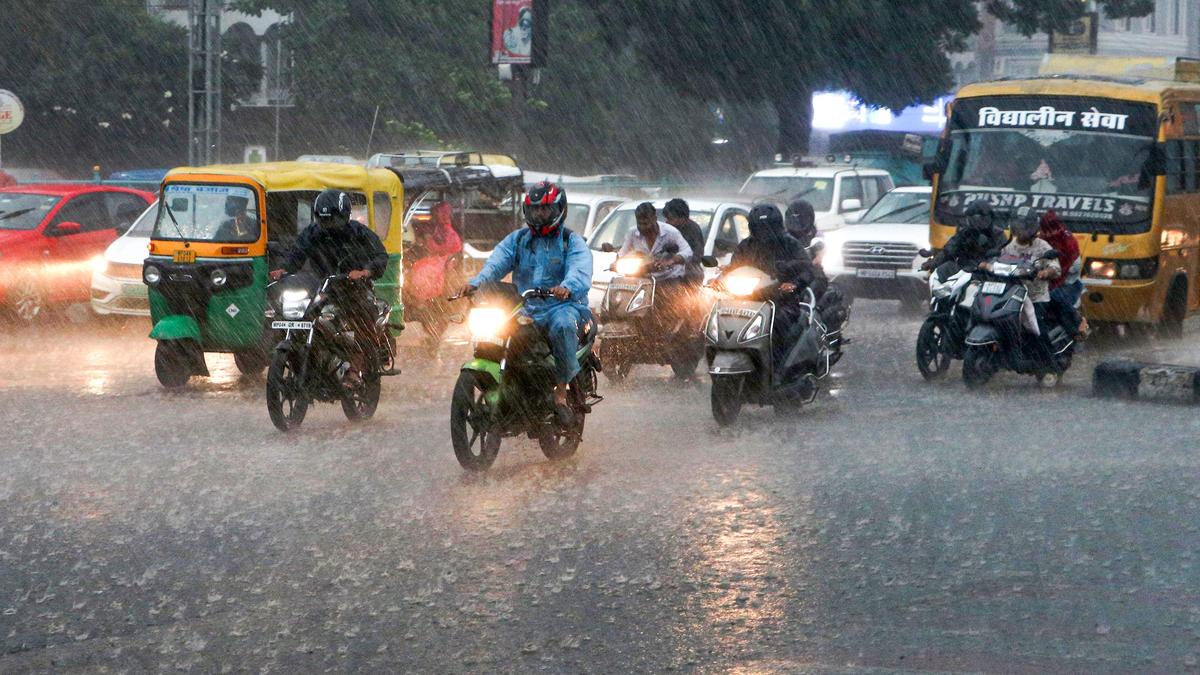
Bhopal, Sep 11 (ANI): Commuters make their way through heavy rainfall, in Bhopal on Friday. (ANI Photo) | Photo Credit: ANI India’s 2026 southwest monsoon ended with 759.4 mm of rain, 12.6% below the 868.6 mm normal, the India Meteorological Department (IMD) said on Wednesday. At 87% of the Long Period Average (LPA), this is the lowest rainfall recorded during the monsoon season since 2015, which was a tad drier at 758.2 mm.The east and northeast region, which recorded 1,017.1 mm of rainfall, had its driest monsoon since 1901, or since the IMD started to keep systematic records.The subdued rainfall was in line with forecasts by global weather agencies, including the IMD, which anticipated one of the strongest El Ninos in recent history. The IMD had, since April, predicted a subdued monsoon rainfall and overall, reality corresponded to what was forecast. On April 13, for instance, it anticipated the June-September rain to be at 92% of LPA, with an error window of 5%. The May 29 update lowered that to 90% with a 4% error window. The IMD’s final estimate sits within this range.June rains fell shortHowever, its regional and monthly forecasts were much farther off the mark. June, which got only 65% of normal rainfall, was far drier than the 92% forecast. July rainfall, which was expected to be below 94%, ended up with 1% more, thanks to rains in central India, which got 33% more rain than normal. August came in at 84% of the LPA, in line with the “below 94%” that was forecast. September, at 92.4% finished a little above the forecast of “below 91%”.IMD director general M. Mohapatra told journalists on Wednesday that the IMD’s predictions matched conditions in “many regions, except some parts of northwest and adjoining central India”.Diminishing trend in the eastThe largest deviations from normal rainfall were in east and northeast India (25.6% below normal). Mr. Mohapatra said that there was a “marked trend” of diminishing rainfall in this region “in recent years”. Rainfall in the southern peninsula was 24.3% below normal, and at 542 mm, this was the fourth lowest monsoon rainfall recorded in the region since 1901. Northwest India ended 5.9% below normal and central India stood at 2.6% below normal, according to an IMD statement.Punjab, Arunachal Pradesh, and the Assam & Meghalaya subdivisions were rain-deficient in every month from June to September. Nationally, 17 of 36 subdivisions (covering 42% of the country’s land area) saw deficient rainfall, 18 were normal, and one had excess rain. Of 741 districts assessed, 282 were deficient and 34 were “large deficient”.Hotter, drier October expectedThe southwest monsoon this year is in the process of withdrawal and is likely to completely exit within the first weeks of October, Mr. Mohapatra said. The country will then see the advent of the northeast monsoon.With the El Nino still gaining strength, rainfall for the country in October is likely to be below 85% of the LPA of about 75.4 mm. Most regions are expected to get below-normal rain, except parts of northwest India, southern peninsular India, and isolated pockets of the east, which may see normal to above-normal rain.“Parts of Punjab, Haryana and northern states may see good rainfall because, in El Nino years, western disturbances are likely to increase. We’ve seen some good rain in these regions in the last week and this means soil-moisture is high, which will help the forthcoming winter crop,” Mr. Mohapatra added.Maximum and minimum temperatures are likely to be above normal across most of the country. The exceptions are in parts of the northeast, where normal to below-normal minimums are likely, and pockets of central and northwest India, where normal maximums are expected. Published - September 30, 2026 10:23 pm IST
Southwest monsoon ends with 12% deficit
Full Article
Original Source
Read the full article at Thehindu →KhanList aggregates and links to publicly available news content. We do not host full articles from third-party sources. Always verify important information with original sources.