
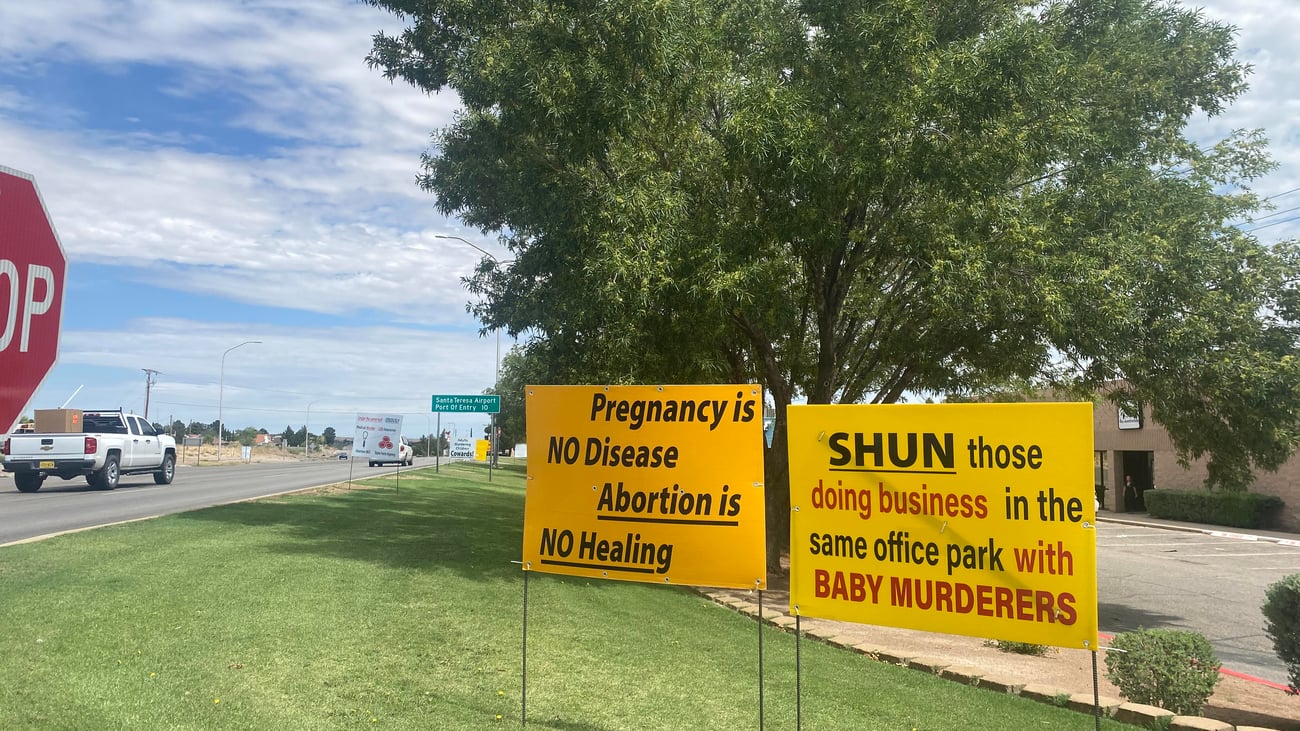
Mark Hamman challenged the city of Carbondale's ordinance prohibiting signs that "encroach upon the public right of way" after he was forbidden from staking his anti-abortion signs outside a local clinic.CHICAGO (CN) — A Southern Illinois man asserted to a Seventh Circuit panel Tuesday morning that a local sign ordinance runs afoul of his First Amendment rights.The city of Carbondale, located about five hours south of Chicago, has an ordinance prohibiting any signs that “encroach upon the public right of way.” Mark Hamman challenged the ordinance in 2025 after city officials forbade him from posting anti- abortion signs outside of a local abortion clinic. A lower court denied his request for a preliminary injunction in 2026, which Hamman swiftly appealed.Hamman’s attorney Nathan Moelker maintained to the three-judge panel that the ordinance is unconstitutionally vague. He said the law fails to define what constitutes “the public right of way.”“An ordinance whose central prohibition rests on a term left undefined — one that the city’s own officials had trouble understanding — fails the most basic requirement of due process,” Hamman claimed in the appellants’ brief. “An ordinance interpreted to ban a two-foot yard sign planted twenty feet from a curb while permitting sidewalk restaurants, block parties, and commercial encroachments in the same public space fails the most basic requirements of content neutrality and narrow tailoring.”The ordinance provides exemptions for certain permitted encroachments, like block parties, patio restaurants, and sidewalk sales. Hamman tried to apply for a permit so his signage would fall under the permitted encroachments, but he was told that no such permits existed.Moelker argued that the ordinance does not survive strict scrutiny, as city officials cannot point to any sort of empirical evidence that necessitates the statute. Arguing for the city, attorney Stefanie Brody said the only evidence the city needed to adduce is “common sense evidence supporting the purpose set forward in our standards.”U.S. Circuit Judge Amy St. Eve asked Brody if she was relying on common sense as evidence of the city’s interest in public and traffic safety.“Yes, all the interests, including the other two that are set forth in our ordinance — the confusing use of signs, and even to protect property values — all of those are set forth in the statute, and this court can take judicial notice of our ordinance interpretation guidelines,” Brody said.“They both call for liberal construction, and they call for saying if there’s a conflict resolve it favor of the more prohibitive ordinance,” she continued.U.S. Circuit Judge Nancy Maldonado touched on the common sense argument while Moelker was presenting his arguments.“We don’t leave [our common sense] at the door when we’re doing this kind of analysis,” the Joe Biden appointee said. “I mean, one can imagine that a public right of way with 100 signs might not look so good, right? So what kind of empirical evidence would you be saying that the city would have to offer?”Moelker said at minimum the city should cite some sort of study or expert testimony.“It’s taken the position it doesn’t need to provide evidence,” Moelker said. “But I think that leads back to where I started here, which is the vagueness problem, because as interpreted by the city, this ordinance sweeps much broader than ordinances this court has upheld.”St. Eve pressed Moelker on his characterization of the ordinance, and its restrictions, a bit further.“I have a hard time understanding your argument that alternative means were not available here, given that your client could have held the exact same sign, in the exact same position, without any problems — you just couldn’t put it into the ground,” the Donald Trump appointee said. “That seems like as easy of an alternative communication as possible.”Moelker responded that holding the signs creates more of a safety concern for Hamman. In 2025, when city officials recommended that Hamman carry the sign instead of posting it in the ground, he responded that a carried sign could be used to strangle him, and staked signs cannot blow into traffic on windy days.U.S. Circuit Judge John Lee, a Joe Biden appointee, joined St. Eve and Maldonado on the panel, which did not indicate when they might rule on the matter.Subscribe to our free newslettersOur weekly newsletter Closing Arguments offers the latest about ongoing trials, major litigation and rulings in courthouses around the U.S. and the world, while the monthly Under the Lights dishes the legal dirt from Hollywood, sports, Big Tech and the arts.Additional Reads
Southern Illinois man challenges local sign ordinance at Seventh Circuit
Full Article
Original Source
Read the full article at Courthousenews →KhanList aggregates and links to publicly available news content. We do not host full articles from third-party sources. Always verify important information with original sources.