
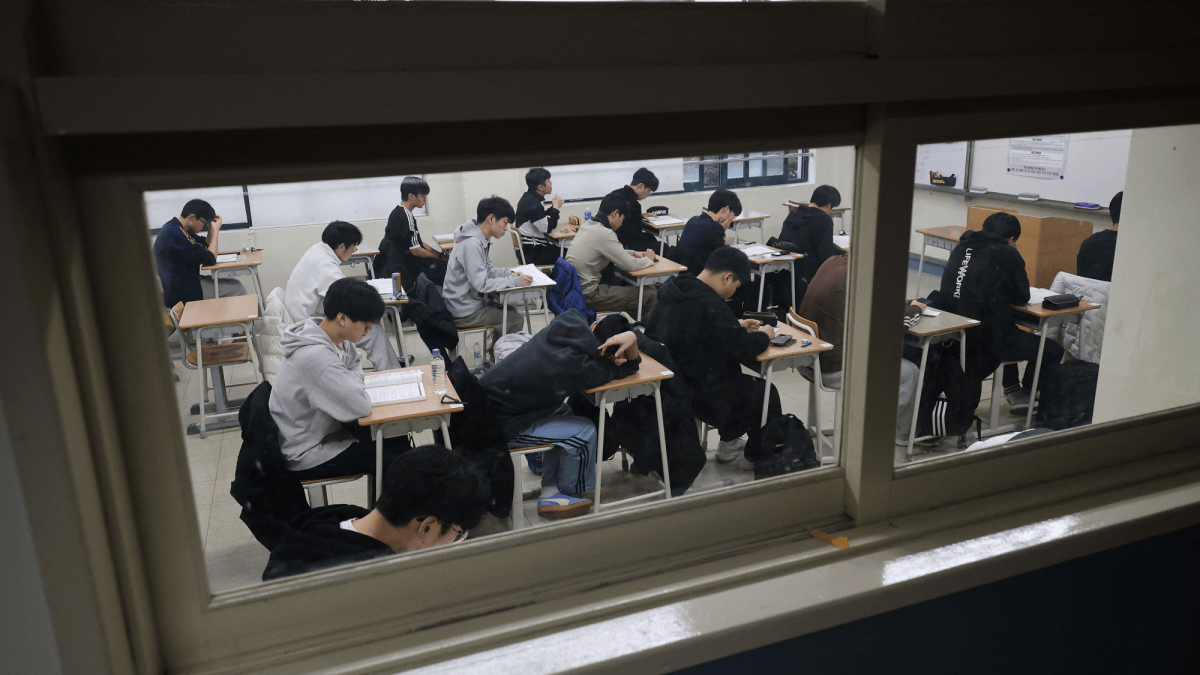
Students wait for the start of the annual college entrance exam, known locally as Suneung, at an exam hall in Seoul, South Korea on November 13, 2025. Image: KIM HONG-JI/POOL/AFP via Getty Images On Thursday morning, millions of phones across South Korea will belt out a loud, buzzing alert normally intended to warn residents about earthquakes or other disasters. This time, the alert is targeting a much different kind of public threat: sneaky standardized test cheaters. Officials plan to send the notifications ahead of Suneung, the country’s notoriously gruelling, eight-hour-long college entrance exam, in an attempt to flush out any of the roughly 550,000 test-takers who may have smuggled in a banned smartphone. Proctors will also inspect all pairs of glasses for hidden cameras, and students wearing clothes with buttons will have to cover them with stickers. The aggressive, last-minute measures come just days after a student in a national tax accountant exam admitted he used a miniature camera and a generative AI tool to achieve a near-perfect score. That surprise revelation sent educators and officials scrambling to come up with solutions to instill confidence in the upcoming test. Korea’s measures come as educators around the world are struggling to keep up with a growing arsenal of AI-enabled tools that make cheating easier than ever. But while AI is the focus today, students have been tinkering with new tech and other creative ways to skirt the rules for as long as tests have carried weight. Exposed cheater fuels a nationwide panic The sudden rule changes in South Korea come days after a 34-year-old man named Han Won-seok posted a video on his lawyer’s YouTube channel admitting he used AI to cheat on the country’s national tax exam. According to the Associated Press, Han scored 397.5 out of 400 points on the first stage of the multiple-choice test, a suspicious result that made him the subject of several media interviews. Other test-takers saw those results and accused him of trickery. Days after denying those allegations, Han reversed course. In the video, he admitted to using a miniature camera to photograph the exam questions, which were then fed to an AI tool. He then viewed the AI-generated answers on his smartphone. Now, Han says he is cooperating with investigators and is warning others against following his lead. “I cheated on the tax accountant exam. I sincerely apologize for causing damage to a lot of people,” the student said in the video, according to CNN. “If there is someone thinking of cheating like I did, I’m going to tell the investigators everything, so I hope you don’t think that you won’t get caught.” In the days since the videos, officials have rushed to put in place new anti-cheating safeguards. South Korean Prime Minister Han Sung-sook reportedly held a meeting on Monday with the country’s top education officials, where they agreed to officially add smart glasses to the list of prohibited items in testing rooms. Some lawmakers had reportedly even called on officials to postpone the Suneung exam until they could come up with more rigorous anti-cheating safeguards, though the country’s Education Minister Choi Kyo-jin quickly shot that idea down, arguing delays would cause “even a larger disruption.” And while Han never said he specifically used smart glasses to cheat, worries about that tech in particular aren’t hypothetical. Earlier this year, two other South Korean students taking an exam to assess English skills were also caught using camera-equipped glasses. Concerns about AI-enabled cheating aren’t limited to South Korea either. Last week, England’s Office for Students, an independent higher education regulator, released a statement warning that AI tools are making it “close to impossible” to assess university classwork. In China, major tech companies disabled features on their AI apps during last year’s national college entrance exam (the gaokao), to keep students from using them to cheat. Educators in the United States and elsewhere are also increasingly requiring students to take exams in person and defend papers orally due to the pervasiveness of AI-generated submissions. Sales of Blue Books have soared as a result. Creative cheating is as old as tests While fancy AI tools and camera-equipped smart glasses may be new concerns, creative cheating isn’t. In fact, evidence of sneaky test-takers dates back centuries. One example is this replica of a linen vest from China’s Qing dynasty (1644–1911). The impressive garment has 62 essays, more than 40,000 characters in all, hidden inside. Students wearing the vest would sneak peeks during the country’s grueling imperial exams, which played an important role in determining government employment and social status. An even older Ming Dynasty (1368 to 1644) jacket was covered with some 50,000 characters from classical texts likely served a similar purpose. Creative cheating has of course persisted into the modern era. In 2015, police in India’s Bihar state detained more than 1,000 people after relatives of test-takers were photographed scaling the walls of an exam center to pass cheat sheets to students through a window opening. A college student in the U.S. made headlines in 2011, after he was arrested for allegedly using fake IDs to stand in for at least six high school students during SAT exams. In China, a team of exam proctors equipped with surveillance drones regularly seizes a variety of wearables and other devices students use to try and cheat. Among the seized items were a hidden camera placed inside a pen and glasses with cameras connected to a tiny receiver embedded in a coin. One has to wonder if all that time and effort spent devising intricate cheating methods could have been used to study instead. 2026 Popular Science Home of the Future Awards 39 products that will improve your everyday life.
South Korea will use emergency alert system to warn about exam cheaters
Full Article
Original Source
Read the full article at Popsci →KhanList aggregates and links to publicly available news content. We do not host full articles from third-party sources. Always verify important information with original sources.