
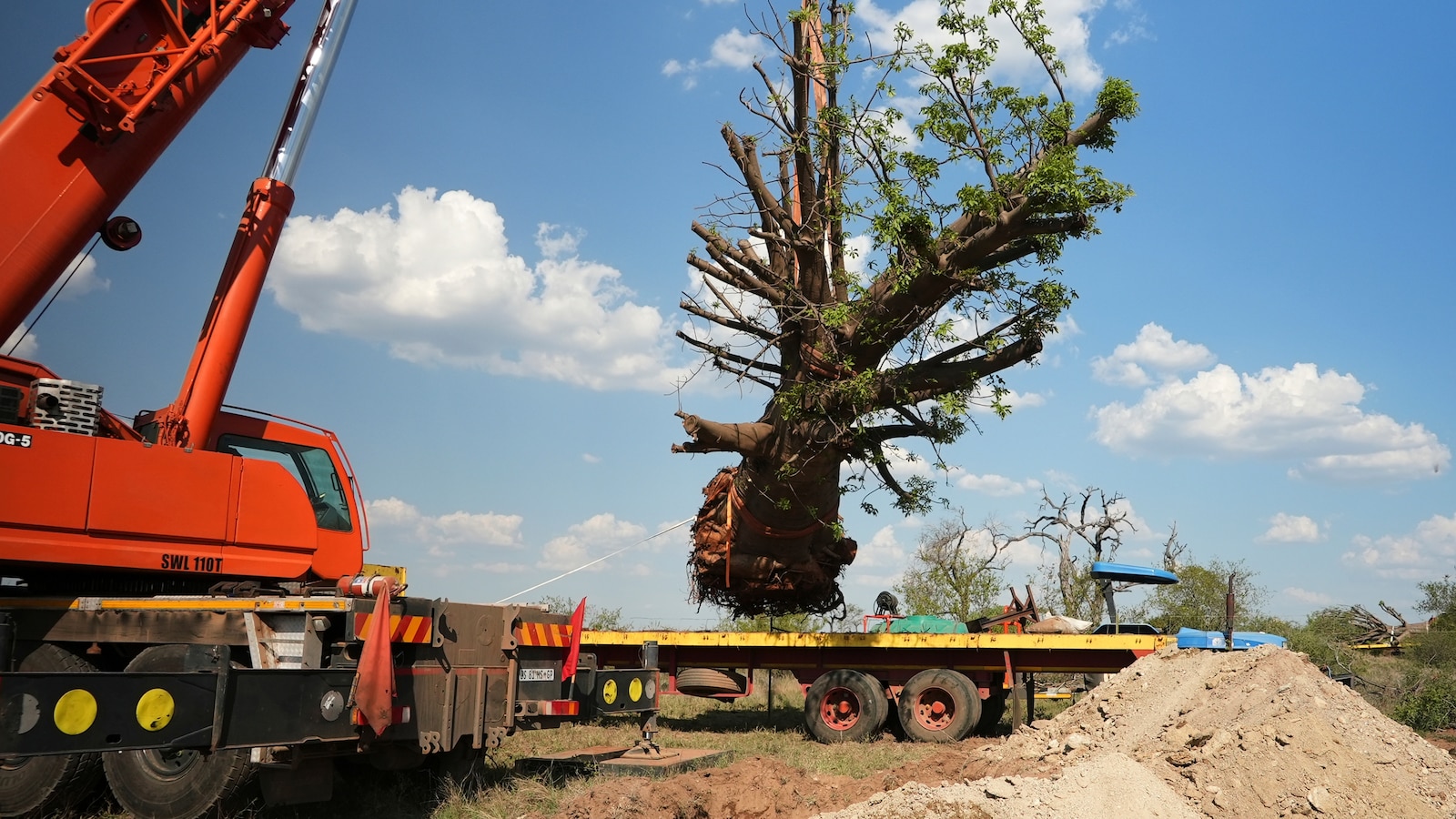
TIMBAVATI NATURE RESERVE, South Africa -- Five large baobab trees have been transported nearly 1,000 kilometers (621 miles) and replanted in their natural habitat in northern South Africa in a last-ditch effort to save them. The centuries-old trees had been uprooted without authorization and taken to a port for export.Environment Ministry officials found the protected baobabs — one of Africa’s iconic species — in July, lying on their sides in a freight company’s parking lot in the port city of Durban in eastern South Africa. They were replanted earlier this month in the privately owned Timbavati Nature Reserve near South Africa’s famous Kruger National Park.The ministry and the Baobab Foundation conservation group led an operation involving oversized trucks and cranes to rescue the trees, but it remains uncertain whether they will survive the stress of being out of the ground for months.Despite having their roots and branches cut and spending at least four months on tarmac before their transfer could be organized, the resilient trees began to sprout leaves. That gave officials renewed hope that they could save them.Baobabs, with their thick trunks and root-like branches that make them look as if they are upside down, can live for 1,000 years in dry environments because they store water in their trunks. The five rescued trees are estimated to be between 200 and 300 years old, said Sarah Venter, an ecologist at the Baobab Foundation.“It’s an amazing tree and that’s why it’s an icon of Africa,” Venter told The Associated Press as they were being replanted. She said that their ability to store water might have saved them, but they wouldn't have survived much longer.Environment Ministry officials believe the trees were illegally taken from another area of northern South Africa. They said that a landscaper has been charged with wildlife offenses related to the unauthorized harvesting of protected trees.The trees were destined for an unidentified private collector in Georgia, in the Caucasus region on the eastern side of the Black Sea, officials said. They said that the trees were intercepted just in time before they were shipped.“These trees are really just symbolic of everything that we are losing out of Africa to people who just want to take them for their collections, for their gardens, where they play no role, no ecological role,” Venter said. “We want our natural resources to stay here in Africa.”While endangered animals like the black rhino often dominate African conservation efforts, exotic or rare plants are poached in high numbers on the continent. Conservation groups estimate that around 500,000 plants — from tiny succulents to tall trees — are poached in South Africa every year.Popular ReadsMoving the baobabs, which weigh between 20 and 30 metric tons each, required five flatbed trucks. At the Timbavati reserve, an excavator dug huge holes, and water was poured in to improve the trees’ chances of survival. A crane lifted the trees upright and lowered them into place.Electric fences will protect the trees as they recover, Venter said, keeping out elephants that might knock them over to eat their leaves and shoots.The trees will be checked twice a year for the next 10 years to monitor their growth. The rescue team hopes that they will live for hundreds more years.Lynette Rink, a baobab lover who runs a website dedicated to the trees, traveled to Timbavati to watch the replanting after hearing about the rescue.“I am a baobologist,” she said. “It’s a word that I invented to describe my love for baobabs. The images of these trees lying on their sides on the pavement ... it was absolutely heartbreaking.”___Gerald Imray reported from Cape Town, South Africa.___AP Africa news: https://apnews.com/hub/africa
South Africa makes a last-ditch effort to save centuries-old baobab trees dug up for export
Full Article
Original Source
Read the full article at Abcnews →KhanList aggregates and links to publicly available news content. We do not host full articles from third-party sources. Always verify important information with original sources.