
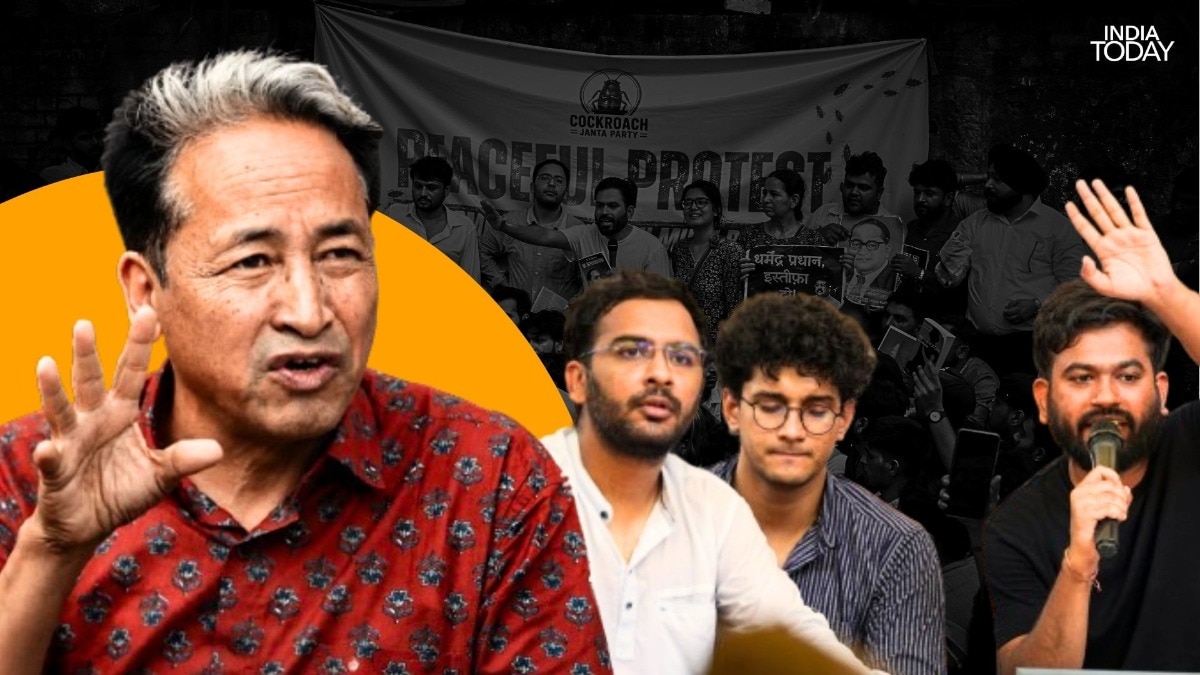
The Cockroach Janta Party (CJP) protest might have appeared determined from the outside, but activist Sonam Wangchuk has revealed that the outfit's leadership was struggling with low morale. He said some of the CJP leaders pleaded to him with folded hands to end the protest.Sonam Wangchuk claimed that the CJP leadership had very little hope of any outcome from their protest at New Delhi's Jantar Mantar. (Image: India Today Group and PTI)For 26 days, activist Sonam Wangchuk's hunger strike became the beating heart of a protest at Delhi's Jantar Mantar that had begun as a youth-led agitation but soon grew into a much larger movement. Wangchuk's fast until death drew crowds, gave the protest a recognisable face and helped the Cockroach Janata Party (CJP) establish connections with people across age groups. Though the CJP succeeded in forcing Dharmendra Pradhan to resign as the Union education minister, its leadership had earlier approached Wangchuk seeking an exit.Behind the slogans of a 45-day-long CJP protest, Wangchuk has now revealed a very different picture of the movement's leadership. Wangchuk revealed that the morale of the CJP leadership kept dipping, political calculations influenced decisions and some leaders were looking for an off-ramp as soon as possible.Wangchuk claimed in a recent podcast that one of the CJP leaders with "folding hands" requested him to figure a way out to "exit the protests".The 59-year-old Wangchuk, who emerged as the face of the CJP protest through his indefinite hunger strike, has made a series of revelations about the outfit's leadership and its approach to the agitation held for 45 days in New Delhi's Jantar Mantar. The CJP leadership was then led by its founder and convenor Abhijeet Dipke, co-convenors Ashutosh Ranka and Saurav Das, and its ousted spokesperson Vijeta Dahiya. Dahiya is not associated with the CJP with the outfit ousting him for "insensitive conduct".Wangchuk detailed the internal developments surrounding the protest during a nearly two-hour-long podcast with YouTuber Prakhar Gupta, published on Saturday (August 29). His account suggests that the determination publicly projected by the CJP leadership to continue the protest did not remain constant.EVERYONE WAS LOOKING FOR AN EXIT FROM PROTEST, SAYS SONAM WANGCHUKWangchuk said the spirit with which the CJP leadership repeatedly announced that it would not call off the protest changed at several points."The spirit of the CJP with which they were announcing that they won't call off the protest had been changing at many junctures, from time to time," Wangchuk said while speaking to Prakhar Gupta.He attributed the changing approach to the "political mindset" of the leadership."I would say that their political minds played a vital role in the changing spirits," he said.According to Wangchuk, the leadership's morale had fallen significantly before July 20, the day of the march to Parliament. The protest march resulted in violence and the police crackdown infused unmatched energy into the CJP protest. Wangchuk, who was forcibly removed from the protest site on July 18 and taken to a hospital, had given a call for people to join the march in large numbers."Before July 20, to be precise, before I was forcefully taken to the hospital, the CJP leadership didn't think that there could be any outcome from this protest. As a result, their morale was very low," Wangchuk said. "At that time they [CJP leadership] were looking for a potential exit from these protests," he added.Wangchuk further added that there were several possible routes being discussed for ending his hunger strike, including one involving Leader of Opposition (LoP) in the Lok Sabha, Rahul Gandhi."There were many exits that they had decided on how to end my fast. You might also have heard about Rahul Gandhi's name popping up. There were questions about Rahul Gandhi's name coming up. It was exactly because of this context," the social activist said.CJP'S MORALE AND SPIRIT DEPENDED ON THE TURNOUT OF PROTESTERSIn the initial days of Wangchuk's fast, the protest witnessed a strong turnout. But according to him, the momentum did not remain constant. After around eight to nine days, the influx of people began to shrink. "And with the crowds, the morale of the CJP leadership also began to fall," Wangchuk said."I won't name who, but one-two people among the leadership would always ask and raise questions about how we exit from this protest," he said.Wangchuk said he himself was left in a dilemma over whether he should encourage the leadership to remain firm or help them find a way out."I had an ambiguity if I should help them to stay firm or get them an exit," he said.He then asked the leaders how long they could continue staying at the protest site. According to Wangchuk, the response from CJP leaders was striking."Some of them said, with hands folded, 'Sir, we want to go. We want to leave this place'," he recalled.The image is sharply at odds with the CJP leadership's projection of itself as determined to continue until its demands were met.For Wangchuk, the size of the crowd became closely linked to the morale of the CJP leadership."People's influx and absence decided their morale," he said.WHEN WANGCHUK TESTED CJP LEADERSHIP'S COMMITMENT FOR THE CAUSEThe 59-year-old, who is a renowned educationist, recounted how he had initially tested the commitment of the CJP leadership before deciding to join the protest.When the CJP decided to turn its campaign into a protest from June 20, Wangchuk said its leaders approached him and asked whether he could support the agitation. According to him, there was also an indication that his participation could "involve a hunger strike".But Wangchuk had a science conference scheduled in Switzerland around the same period. He therefore decided to test the leadership's commitment. He told the CJP leaders that he would join them only on June 28, while they could begin their protest on June 20.According to Wangchuk, the response of the outfit's leadership revealed that they had expected Wanghcuk to join from the start."Hearing my response they were shocked, and they were like, 'Oh my God, we need to wait for eight days'," Wangchuk recalled.In retrospect, that eight-day gap became significant. Wangchuk eventually joined the protest on June 28 and began his hunger strike after seeing that the young faces leading the protests sustained the stir for eight days.Wangchuk's revelations made in the podcast are his account of events and his assessment of the CJP unit. They offer an insider's view of the uncertainty that he says existed behind the protest's public facade. And perhaps the most revealing moment in his account is not a political calculation or a disagreement over demands, but the simple image of leaders with folded hands asking for an off-ramp.- EndsPublished By: Avinash KateelPublished On: Aug 31, 2026 18:19 IST
Sought protest exit with folded hands: Sonam Wangchuk's revelation on CJP leaders
Full Article
Original Source
Read the full article at Indiatoday →KhanList aggregates and links to publicly available news content. We do not host full articles from third-party sources. Always verify important information with original sources.