
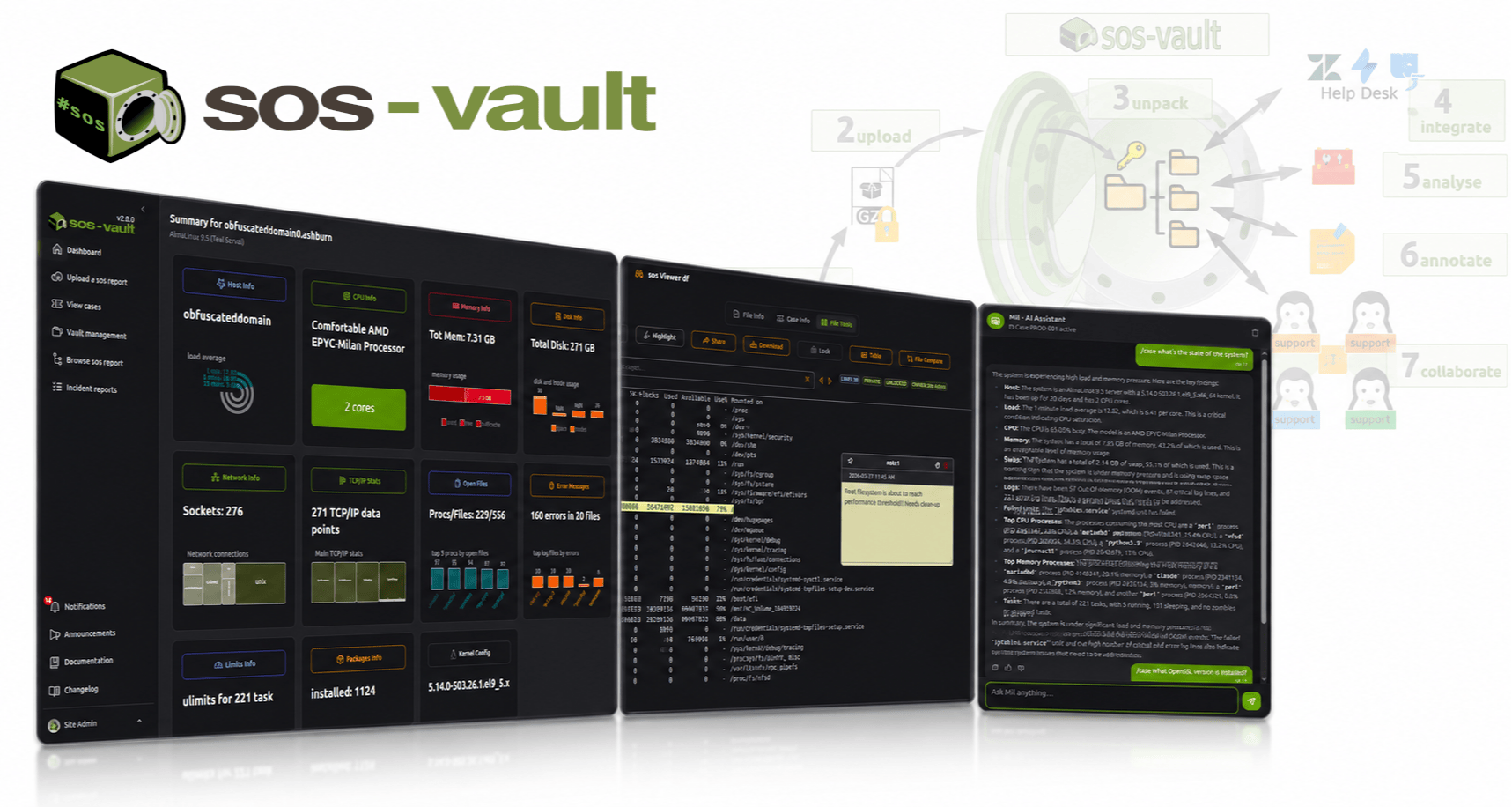
Welcome to the Proof of Usefulness Hackathon spotlight, curated by HackerNoon’s editors to showcase noteworthy tech solutions to real-world problems. Whether you’re a solopreneur, part of an early-stage startup, or a developer building something that truly matters, the Proof of Usefulness Hackathon is your chance to test your product’s utility, get featured on HackerNoon, and compete for $150k+ in prizes. Submit your project to get started!In this interview, we sit down with Jorge Rueda, the creator of sos-vault. This open-source, self-hosted platform provides a secure environment for Linux support engineers and SRE teams to upload, decrypt, unpack, and analyze sosreport archives. By integrating an AI-assisted analysis pipeline, sos-vault enhances collaborative troubleshooting and diagnostic workflows.What does sos-vault do?An open-source, self-hosted platform for analyzing sosreport archives (the diagnostic bundles Linux support engineers and SRE teams collect for troubleshooting). It lets you upload, decrypt, unpack, browse, annotate, and compare sosreports through a web interface, in a highly secure isolated environment. A key feature is its AI-assisted analysis pipeline. It's aimed at Linux system administrators and support teams who need collaborative SOS report analysis with shared context and notes. Now’s a good time for sos-vault to exist because it mitigates the security and performance risks of diagnosing live Linux systems with AI tools by providing a highly secure and private environment for collaborative Linux analysis and troubleshooting using a human-on-the-loop AI perspective.Who does sos-vault serve?Linux sysadmins, DevOps, SRE, support, and cybersecurity teamsWhat technologies were used in the making of sos-vault? And why did you choose the ones most essential to your tech stack?To build sos-vault, the project utilizes a modern and robust tech stack featuring Docker, Filament, Livewire, and Tailwind. These technologies were specifically chosen to ensure a responsive, highly secure, and easily deployable web interface that streamlines diagnostic analysis for technical teams.What is traction to date for sos-vault?While still in its early stages, sos-vault is beginning to capture attention within niche sysadmin communities. The project has sparked discussions on platforms like Reddit, LinuxCommunity.io, and Medium, alongside video demonstrations on YouTube showcasing its unique approach to sosreport analysis.What excites you about this sos-vault's potential usefulness?This is the only tool of its kind (that I'm aware of) in the sense that provides a secure sosreport archive environment that allows for private and collaborative analysis environment and in the current AI turmoil is a good alternative to mitigate the risks involved in diagnosing/troubleshooting live Linux system with AI toolsWalk us through your most concrete evidence of usefulness.I’m a senior developer and 3rd level support engineer for a Linux-based appliance system for a few years now. When I started in this position, I couldn’t believe how customer technical support was handled (an eternal send me the output of this command, " email cycle. Every ticket lasted weeks open), so I built a script to collect diagnostic data and a web interface to exploit the data and share it with the team. It improved the support service dramatically from weeks to hours.At that time I didn’t know about the sos command (it was called sosreport back then), but it was very much the same concept. Based on that experience, I soon realized that a tool capable of managing, sharing, and analyzing sosreports was missing, so I built one.How do you measure genuine user adoption versus "tourists" who sign up but never return? What's your retention story?Is too early to be sure, but I'm expecting more stars on the GitHub project page.If we re-score your project in 12 months, which criterion will show the biggest improvement, and what are you doing right now to make that happen?I guess that user adoption will show itself in the number of issues and requests for enhancements open on the project's page. I'm also expecting to release at least new versions with more exciting tools that I have in the pipeline, like alerts with metrics thresholds to Slack and Teams, software inventory, more integrations to ITSM systems like incident.io, PageDuty, etc.How Did You Hear About HackerNoon?I was looking for places where developers used to promote their projects on Reddit, and in one of the comments, a user mentioned HackerNoon, and here we are!Given that sos-vault currently receives around 10 visits per month and is less than a month old, what are your primary strategies for driving awareness and adoption among enterprise Linux support teams?My current strategy is writing articles (Medium, DEV) and posts (LinkedIn, Reddit, etc) about two main subjects: the power and flexibility of the sos command (sosreport) and at the same time writing articles and posts on how to best exploit sosreport data using sos-vault. At this point, I honestly cannot measure the effectiveness of the strategy as it still too early. I can say however that I definitively see people interested in my articles and post as I can see how some of them have been plagiarized but that is ok with me.As an open-source project aimed at highly technical sysadmins and SREs, how do you plan to grow the contributor community around sos-vault over the next year?Good question. I don't have an answer to that. I guess that we will see how things turn in that sense by themselves.Your Proof of Usefulness report highlights sos-vault's strong problem-solution fit for analyzing diagnostic bundles. How do you plan to prove its broader market usefulness and validate that the AI-assisted pipeline significantly reduces troubleshooting time for live systems?In this early version, the sos-vault ai assistant (Mil is its name), can only provide accurate, hallucination-free insights of the system for most common metrics (CPU, memory, disk, filesystems. systemd state, hardware and software inventories, active network connections, firewall rules, load, I/O throughput, security settings, errors in the logs, kernel modules and configuration, etc) however, a sosreport can contain data about software solutions like OpenShift, JuJu, OpenStack, Docker, Kubernetes, Ansible, Ceph, Proxmox, Rancher, VMware and so many more that is not possible to list here. I'm aiming to expand Mil's troubleshooting capabilities for each one of these third-party solutions. Another planned feature is to provide Mil with the capacity to retrieve logs from SIEM systems and traces from Application Performance Monitoring (APM) platforms and correlate it with data in the sosreport from the Linux fleet to provide a unique RCA point of view, deeper than existing SRE tools can provide, as Mil will have direct access to diagnostic command outputs and underlying system information.As you can see, sos-vault is in its early stages, but it can grow to become a very powerful tool for the Linux professional.Meet our sponsorsBright Data: Bright Data is the leading web data infrastructure company, empowering over 20,000 organizations with ethical, scalable access to real-time public web information. From startups to industry leaders, we deliver the datasets that fuel AI innovation and real-world impact. Ready to unlock the web? Learn more at brightdata.com.Neo4j: GraphRAG combines retrieval-augmented generation with graph-native context, allowing LLMs to reason over structured relationships instead of just documents. With Neo4j, you can build GraphRAG pipelines that connect your data and surface clearer insights. Learn more.Storyblok: Storyblok is a headless CMS built for developers who want clean architecture and full control. Structure your content once, connect it anywhere, and keep your front end truly independent. API-first. AI-ready. Framework-agnostic. Future-proof. Start for free.Algolia: Algolia provides a managed retrieval layer that lets developers quickly build web search and intelligent AI agents. Learn more.
sos-vault Earns a 50.6 Proof of Usefulness Score by Building a Secure, AI-Assisted Platform for Analyzing sosreport Archives
Full Article
Original Source
Read the full article at Hackernoon →KhanList aggregates and links to publicly available news content. We do not host full articles from third-party sources. Always verify important information with original sources.