
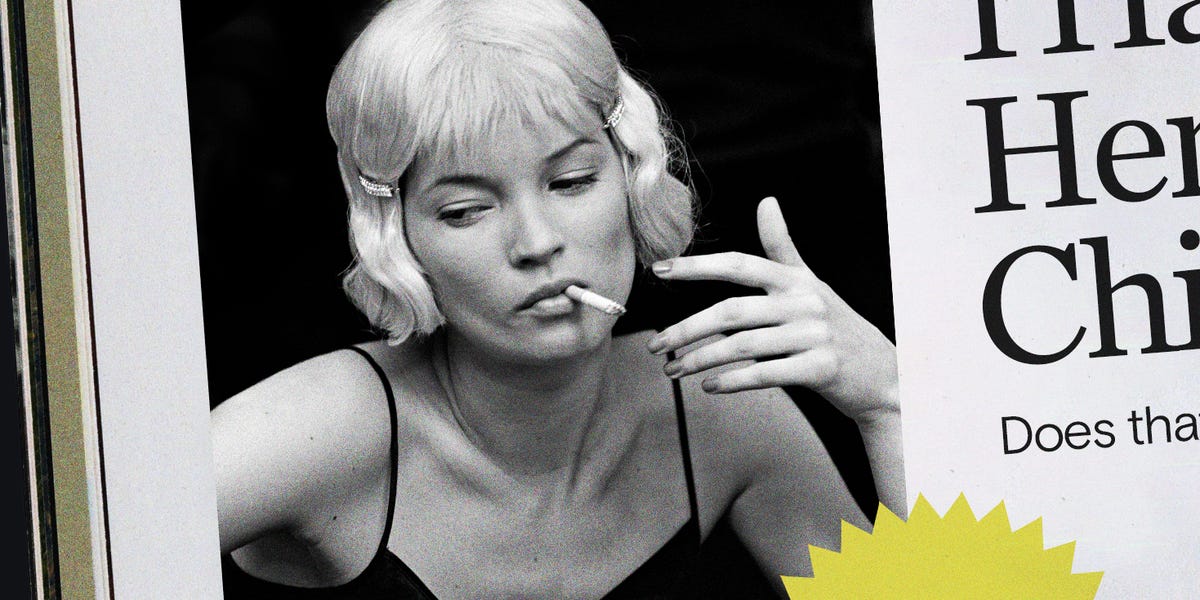
I first noticed it during New York Fashion Week for fall/winter 2024. Both Christian Cowan and LaQuan Smith sent models down the runway holding lit cigarettes as props. Then Brat took over the cultural zeitgeist, with Charli xcx herself defining the essence of “brat” as “a pack of cigs, a Bic lighter, and a strappy white top with no bra.” Then came Addison Rae’s “Aquamarine” music video, in which she smoked two cigarettes simultaneously.Is it possible? I wondered. Are cigarettes back? George Chinsee//Getty ImagesChristian Cowan RTW Fall 2024Victor Virgile//Getty ImagesLaQuan Smith RTW Fall 2024For a while, I thought the days of performative self-neglect were behind us. But over the past two years, my FYP has become overrun with nihilistic cig-fluencers. Fashion mags from Who What Wear to Numéro to Marie Claire are heralding the indie sleaze revival, but I know this marks the return of something darker, a shadow that hung over my adolescence: heroin chic.The “heroin chic” look was popularized in the early ’90s as a counterculture rebellion against the vibrant, more-is-more energy of the ’80s. It was epitomized by a love of cigarettes, cynicism, and concerningly slim bodies—although the phrase wasn’t coined until 1997, when Interview editor-in-chief Ingrid Sischy condemned the aesthetic following the fatal overdose of 20-year-old fashion photographer Davide Sorrenti.At Sorrenti’s wake, Sischy told his mother, “This is heroin; this isn’t chic. This has got to stop, this heroin chic,” as The Guardian reported at the time. Just a few months later, the New York Times published “A Death Tarnishes Fashion’s Heroin Look,” and the term became part of the lexicon.And so when I thought of “cool,” I imagined the infamous 2007 Kate Moss stairwell photo snapped by Greg Brennan, with her fur coat and cigarettes, her spindly legs and sucked-in cheekbones, her distraction and disaffected edge.Heroin, thinness, smoking, and disaffection all became key components of fashion and glamour, and I was paying close attention. At 15, I had a whole Pinterest board dedicated to waif-like models with sunken eyes, listless poses, and cigarettes clutched between their bony fingers. At that point, I’d never smoked a cigarette—I’d even won an 8th grade contest for my essay deriding nicotine as part of our 10-week D.A.R.E. program—but the appeal was not lost on me.Collecting these pictures felt like a seemingly low-stakes rebellion, like watching Laguna Beach and The Girls Next Door (both of which my mom hated). I wasn’t participating in any sort of risky behavior myself. I was simply observing it, absorbing it, giving it my tacit approval.It would take me years to appreciate how insidious those images were.Cigarettes have long been marketed as appetite suppressants, but over the years, Big Tobacco’s tactics became subtler. In the 1920s, Lucky Strike launched an ad campaign with the slogan, “Reach for a Lucky instead of a sweet,” and after legal threats, the company was eventually forced to alter its explicit weight-loss claims.Bettmann//Getty ImagesLucky Strike ad from 1929.But in the ’90s and early aughts, fashion shoots featuring cigarettes were ubiquitous—and tobacco companies capitalized on (and undoubtedly reinforced) the association between smoking and thinness by featuring skeletal, moody models in their advertising. While not as explicit as the Lucky Strike campaign, the message was still clear: To be thin is to smoke, and to smoke is to be thin.I think often of what Kate Moss told Women’s Wear Daily in 2009, two years after that stairwell photo was snapped: “Nothing tastes as good as skinny feels.” She later distanced herself from the mantra, claiming the words were just “a little jingle.” The same way I used to look at the Pinterest board I’d unknowingly stacked with thin-spiration and think, They’re just pictures.But they weren’t just pictures, just as cigarettes aren’t just props. Those slouching, pouting models taped to the front of my agenda book seemed to say—with their sunken cheeks and prominent collarbones—that to appear on the verge of unwell was to be cool, sexy, chic. And I believed them.I went on to have my own brief party girl era in college, but after getting diagnosed with anorexia and starting antidepressants, I found a new preoccupation with wellness culture. I lifted weights. I added protein powder to my smoothies. I no longer used Pinterest, but if I had, I would have replaced those gaunt models with quotes like, “Skinny girls look good in clothes, but fit chicks look good naked.”(Was my fitspo phase any healthier? Of course not. But that’s an entirely different conversation.)By the time I read about Mary-Kate Olsen and Olivier Sarkozy’s 2015 wedding reception, where party decor consisted of “bowls and bowls filled with cigarettes,” per Page Six, neither Kate Moss nor Mary-Kate Olsen felt like the pinnacle of cool to me. For most of my 20s, sunscreen was everywhere and cigarettes were nowhere. It was the years of fitness trackers,high-intensity interval training, and pocket-sized JUULs, and while The Cut declared that “Mary-Kate Olsen’s Wedding Was Cooler Than Yours,” I personally found the tobacco-tinged celebration more bleak than chic.Raymond Hall//Getty ImagesMary-Kate Olsen and Ashley Olsen in 2015.For a while, popular culture seemed to agree. Plus-size model Tess Holliday was signed to Milk Management, UFC champ Ronda Rousey was put on the cover of Self magazine, Khloé Kardashian debuted her size-inclusive Good American denim brand, all while major public health agencies launched high-profile anti-cigarette initiatives. Celebration was in; suppression was out. And like someone emerging from a smoky pub, I could breathe more easily.But the pre-pandemic wellness craze lost steam when the world shut down, and by the time the quarantine ended and Trump began his second term in office, the It Girls had decided: no more green juice. No more Spin class. The world is burning, and the coolest thing you can do is say less, weigh less, and care less.The same way defenders of the latest cadaverously thin starlet will say, “But she’s always been skinny.”I wish we could stop talking about women’s bodies—and the substances they consume—once and for all. But as GLP-1s make ultra-thinness even more achievable, to not acknowledge the troubling trend of shrinking Hollywood stars would be to accept it as normal. Glamorizing this look feels eerily familiar to those of us who lived through heroin chic and its fallout. I still remember when Star magazine revealed in 2014 that Nicole Richie had achieved her 88-pound frame with a strict diet of “sunflower seeds, celery, juice, and chewing gum.”“Tragic Relapse: Anorexic Again,” the headline proclaimed, with cruel contempt and not a trace of concern. And while supermarket tabloids were once the biggest culprits of policing famous bodies, the worst offenders now live in the comments section. A quick glimpse at Esquire’s “How I Got Here” video interview with Jenna Ortega last month will show you comments like these:Why is no one eating?Did Hollywood run outta food or sum?I never thought I could hear someone’s hunger in their voice.And she purposely wore that so we could see her shoulder bones. I think she got bit by Ariana.Nicole was right when she told Marie Claire UK that it’s “a little unfair to say someone has an eating disorder when they don’t. It’s extremely insulting and irresponsible. An eating disorder is serious and it’s a disease.” A magazine can’t diagnose a disease, and a celebrity can’t be shamed out of one.But we can’t just ignore the effect these photos have on people. What one person considers alarming is considered aspirational by someone else. And chances are, that latter person is young, impressionable, and thinking, Jenna does look cool with a cigarette.... Thin has always been in, and it would be silly to pretend otherwise. Even during the height of body positivity (which then morphed into body neutrality), skinny people continued to dominate mainstream media. But in 2026, pop stars everywhere are shrinking, jeans are getting lower rise, injectable weight-loss medications are as ubiquitous as bobs, and everyone from Hailey Bieber to Kylie Jenner is on a magazine cover with a performative cigarette in hand.Are the cigarettes popping up in movies and music videos and magazine spreads merely paying homage to Old Hollywood glamour, as some claim? Or does the defiant rejection of wellness culture—and the hearty endorsement of cigarettes—mean that wasting away is back and here to stay? If New York Fashion Week for spring/summer 2027 was any indication, we are still louche, smoking, and skinny.Victor Pagan//Getty ImagesGrace Ling RTW Spring 2027WWD//Getty ImagesStreet style for NYFW SS27At 34, I’m still not comfortable. I’ve lived through several body trends and have—at various points—wished to be thicker, thinner, stronger, bonier. I sometimes miss the days when people were concerned about my thinness. I also feel nostalgic for my two pregnancies, when I felt untouchable, beyond reproach, allowed to eat anything and admired by all.Mostly, I look at my two daughters and wish for a future of true body neutrality. Is it achievable? The nihilistic, world-is-burning part of me says no. But that optimistic young girl inside me, wearing her D.A.R.E. t-shirt and pledging to never smoke cigarettes? She likes to think that there are things that do taste better than skinny feels. Because this has got to stop, this heroin chic.
Sorry to Report That Very Thin Women Smoking Cigarettes Is Back in Style
Full Article
Original Source
Read the full article at Cosmopolitan →KhanList aggregates and links to publicly available news content. We do not host full articles from third-party sources. Always verify important information with original sources.