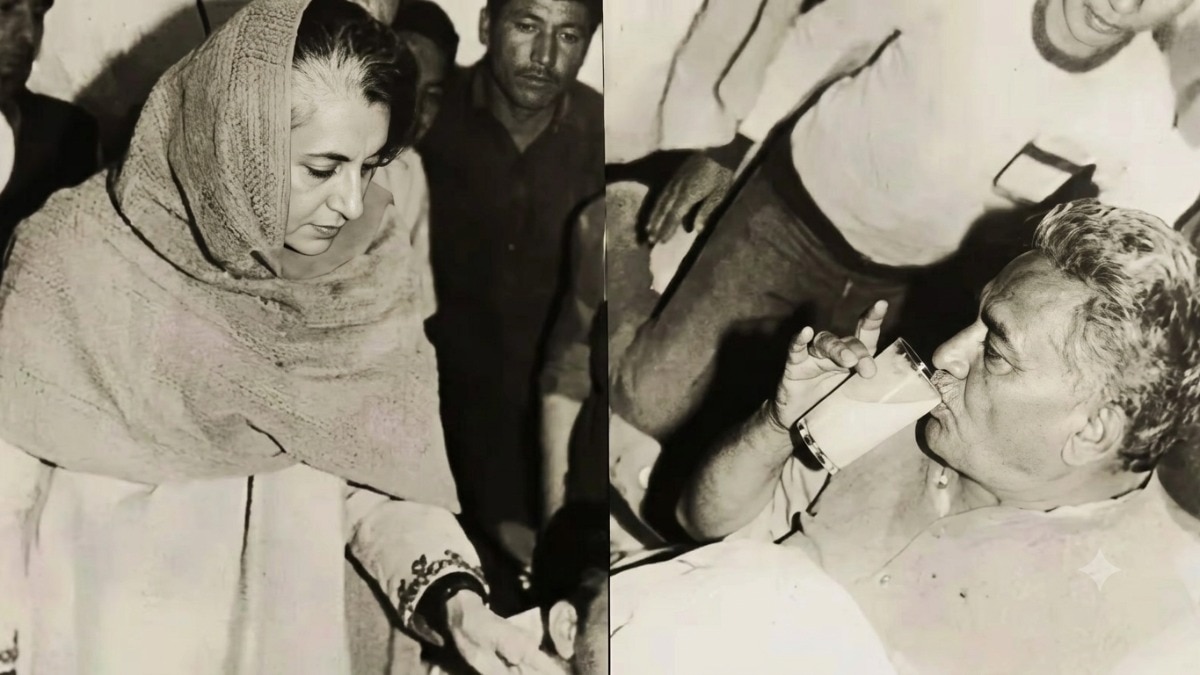
Sonam Wangchuk's hunger strike has brought Ladakh's demands back into the national spotlight. But decades earlier, his father Sonam Wangyal fasted for the region's Scheduled Tribe demand. Indira Gandhi visited Leh and assured support, and in 1989, a constitutional order formally recognised eight Ladakhi tribal communities as STs.Sonam Wangchuk's hunger strike has brought Ladakh's demands back into the national spotlight. But decades earlier, his father Sonam Wangyal fasted for the region's Scheduled Tribe demand. Indira Gandhi visited Leh and assured support. (AI-enhanced image)White bedsheets suddenly went up around Sonam Wangchuk.At Jantar Mantar on Saturday morning, Delhi Police formed a human chain around the 59-year-old activist, shielded him from the crowd and lifted him from his bed.Wangchuk had been on an indefinite hunger strike for 21 days. Within minutes, he was taken to an ambulance and shifted to Safdarjung Hospital as his health deteriorated.The police said the action followed Delhi High Court directions and medical advice. Organisers alleged that Wangchuk was forcibly removed. Either way, the images were dramatic.And they carry a strange echo from Ladakh's past. More than four decades ago, Wangchuk's father, Sonam Wangyal, was also sitting on hunger strike, trying to force the country to listen to Ladakh.The son is now in hospital.The father's story takes us back to 1984.THE MAN WHO FASTED FOR LADAKHWangyal was not a newcomer to public life.Before he became one of Ladakh's key political figures, Sonam Wangyal had already made history on Mount Everest. In 1965, at just 23, he became the youngest person to reach the summit. Sonam Wangyal as a young man (Photo: Rediff) Born in 1923 to a poor farming family, he rose to become one of Ladakh's key political figures, serving in Jammu and Kashmir's Legislative Council and later as an MLA and minister.The Ladakh Studies journal records that he was active in the campaign for Scheduled Tribe status for Ladakh during the 1980s.The demand was not simply about a government label.Ladakh's communities had long faced concerns over economic and educational disadvantage, political representation and the protection of their distinct social and cultural identity.The region's politics had already begun to change rapidly, with roads, administration and outside influences altering traditional life.Academic research on Ladakh has documented how these changes affected everything from the economy and education to language and the balance between local communities and newcomers.Then, in 1984, Wangyal went on hunger strike to push the demand for Scheduled Tribe recognition.The episode drew the attention of Prime Minister Indira Gandhi, who visited Leh in 1984. Later accounts of the movement say she intervened and gave assurances that the ST demand would be looked into.A study of Ladakh's ST movement records Wangyal's fast and the 1984 intervention, while noting that the promise was not fulfilled immediately.The fast ended.But the struggle did not.THE PROMISE TO THE LAWFive years later, the demand finally moved from political promise to constitutional recognition.The Constitution (Jammu and Kashmir) Scheduled Tribes Order, 1989, issued under Article 342, formally recognised eight communities in the state as Scheduled Tribes: Balti, Beda, Bot/Boto, Brokpa, Changpa, Garra, Mon and Purigpa.That detail matters.Ladakh did not receive a blanket "ST status" as one single community. The 1989 constitutional order recognised specific tribal communities in Jammu and Kashmir, many of whom lived in Ladakh.For Wangyal, the recognition came after years of campaigning. For the region, it became one of the defining victories of a much longer political struggle. President Ram Nath Kovind presents the Tenzing Norgay National Adventure Award 2017 to Sonam Wangyal (Photo: PIB) FOUR DECADES LATER, THE STORY FEELS FAMILIARMore than four decades after Sonam Wangyal's hunger strike, his son Sonam Wangchuk is once again using a fast to make a political point.But this time, the issue is not Ladakh.Last year, Wangchuk went on a 35-day fast in support of Ladakh's long-standing demands for safeguards, including statehood and Sixth Schedule protection.Now, on the 19th day of an indefinite hunger strike at Delhi's Jantar Mantar, he is sitting in solidarity with the Cockroach Janta Party's protest over examination irregularities and the NEET paper leak controversy.The protesters are demanding Union Education Minister Dharmendra Pradhan's resignation and reforms in India's examination system.CJP has also linked its campaign to the deaths by suicide of students. Its founder Abhijeet Dipke has publicly referred to 17 students, accusing the Education Minister of having "blood of 17 students on his hands".The issues are different.The image, however, is strikingly familiar.A father fasted for Ladakh in the 1980s. Decades later, his son is once again sitting on hunger strike, this time for India's students and the education system.And somewhere between those two fasts lies a family history of using the one weapon both men believed could force the country to listen: their own bodies.- EndsPublished On: Jul 18, 2026 12:04 IST
Sonam Wangchuk's father fasted for Ladakh in 1984. Then Indira Gandhi came to Leh
Full Article
📰 Original Source
Read full article at Indiatoday →KhanList aggregates and links to publicly available news content. We do not host full articles from third-party sources. Always verify important information with original sources.