
Dunche, Nepal: High on a remote hilltop, Pasang Tamang bore stunned witness to a tidal wave, its body dark and dragging debris. It crashed through his village, Syabrubesi, the start of the famed Langtang Valley trek.It also is the last known location of an Australian family from Cherrybrook, in Sydney’s north-west.It was not a full hit at first, Tamang says. Much of the surge that had only just taken out villages further north actually flowed into a Trishuli River tributary adjacent to Syabrubesi, allowing some enough time to run.Pasang Tamang stands where he witnessed his home, Syabrubesi, being swept away by flash flooding in Nepal. Kate GeraghtyTamang saw them. But it soon surged back, slamming into the torrent from which it had come, shooting waves “at least” 100 metres into the air.“That’s when [Syabrubesi] was wiped out,” Tamang tells this masthead from the hill where he saw it happen.He’d been down there in Syabrubesi last Wednesday morning, too, but left shortly after 8.30 for the small village of Sano Bharkhu, a kilometre away, to check on some property. Unknown to anyone as he curled up those hair pin turns, a massive avalanche of glacier and rock was hurtling toward the river system at 150 metres per second near the Nepal-Tibet border.According to relatives, it was also about this time – 8.40am to 8.50am – Sydney’s Sreedharan Iyer, 53, his wife Lakshmi, 49, and their two gifted sons, Rishab, 23, and Rudhra, 20, were checking out from the Royal Himalaya, a hotel on Syabrubesi’s lower section.The Hindu pilgrims were on a family trip of a lifetime with 11 other Australian friends to see Mount Kailash, the earthly abode of Lord Shiva. A photo with most of the group a day before the flood shows them beaming in matching blue T-shirts with mountain print from Himalayan Glacier, the tour company.The Iyer family, from left to right: Rudhra, 20; Sreedharan, 53; Lakshmi, 49; and Rishab, 23.The Iyers appeared in a tour group photo. smiling and wearing matching shirts, a day before the floods hit.None of the 15 have been heard from since Wednesday morning. More than 1050 people were killed – and some 4500 are still missing, including 38 Australians – when the floods hit Nepal and Tibet.The smack of two raging water courses came about 9am, Tamang says, sending buildings “rolling and rolling in the flood”.“After half an hour, everything was similar to what we see now,” he says. That is a silver silt pan, where a village once stood.The vantage point of Sano Bharkhu offers clear views of a handful of buildings still standing in the upper section of Syabrubesi, and more are obscured by a mountain.But the entire lower half is gone, including Tamang’s home. Images circulating of the village post-flood suggests the Royal Himalaya is too.Most of Syabrubesi was swept away or buried.Kate GeraghtyWhere the Iyer family was at the time is unclear. They may have spent time in the village after check-out getting organised or sourcing coffees before getting in their car to be driven about 15 kilometres north to their friends at the doomed Hotel Kailash, which was swept away.If they had left immediately after check-out, they would have been roughly halfway between Syabrubesi and Timure on the road running directly alongside the soon-deadly Trishuli.Timure was destroyed, too. That’s where Tamang’s nephew, Lama Sanam Tamang, 28, a husband and father, was killed.His five-year-old girl, Sonam Dolma, is being minded in Sano Bharkhu by her grieving grandfather, Maywan Tamang. She is playing with a soft drink bottle and scratching at the road with a stick.“We haven’t told her her father is dead,” the grandfather says. “She keeps asking where he is.”Maywan Tamang says his granddaughter Sonam doesn’t yet know her father was killed in the flooding.Kate GeraghtyThe road the pilgrims took between Dunche, the small capital of Rasuwa district, and Syabrubesi is destroyed from the point it crosses the Trishuli River. Upstream and downstream, the river’s bridges are gone, leaving survivors and residents of undamaged villages on the other side cut off from the main towns and the capital, Kathmandu.Nepal’s private fleet of helicopters have been commandeered for the rescue, aid and salvage efforts, but it is still not enough.A staging point in Dunche for helicopter rescues and distributing aid.Kate GeraghtyA temporary morgue has been set up on the outskirts of Dunche.Kate GeraghtyAt Dunche, helicopters fly in and out, laden with sacks of food and other supplies, in perpetual motion. “But people keep asking for more,” a rescuer says.Nepal has declined offers from other nations for search and rescue teams, ostensibly because the devastating 2015 earthquake proved it was too unwieldy. It has walked back the initial hardline, however, and is asking for specialised technical teams in matters like DNA testing and tunnel rescues.Close to 900 hydropower station workers remain trapped in various tunnels across the impact zone with uncertain access to oxygen, food and clean drinking water. Time is running out, if it hasn’t already.Destroyed buildings in Betrawoti.Kate GeraghtyBody bags lay on the roof of a destroyed building in Betrawoti.Kate GeraghtyThe flood barrelled on through Syabrubesi to the town Betrawoti, about 40 kilometres south. Unable to make the sharp right turn in the river bed, it smashed into a mountain.“And then it came flying, not from the ground, but from the sky,” says Jhalak Bahadur Shrestha, 68. He was at his farm across the river at Simila at the time, sparing his life, but not his home.Shrestha can see its ruins poking out from the flat rink of sludge, and thinks there could still be clothes and cooking gear inside, important items for a now-homeless elderly man and wife.“We are too old to go there and get our things,” he says. They were saying we couldn’t go, anyway. We need either the police or army. Maybe they can help us?”Jhalak Bahadur Shrestha looks over the Trishuli River and what remains of Betrawoti.Kate GeraghtyTanka Kumar Acharya witnessed the flood that claimed the life of her daughter-in-law from her home in Simila village.Kate GeraghtyLocals say there were 300 homes in the area wrecked by the sky flood alone. Nothing of any worth is left there now bar a blasted-out building with enough structural integrity to remain standing with an intact roof.It’s where salvage teams are laying the occupied body bags – at least nine on this masthead’s visit – for collection by helicopter.“Everybody’s gone,” says Tanka Kumar Acharya, a Simila resident who lost her daughter-in-law over the river.“They haven’t found her and it’s been days. Our whole world was taken away”.Read more on the Nepal flood disaster:‘I saw many dead bodies’: Worker’s harrowing escape from flooded tunnelWastelands of mud: The death zone where not one body has been foundPilgrims saved: How sheer luck saved seven Australians from catastropheIn pictures: Grief and devastation in flood-ravaged villages Visual story: How the disaster unfoldedGet a note directly from our foreign correspondents on what’s making headlines around the world. Sign up for our weekly What in the World newsletter.
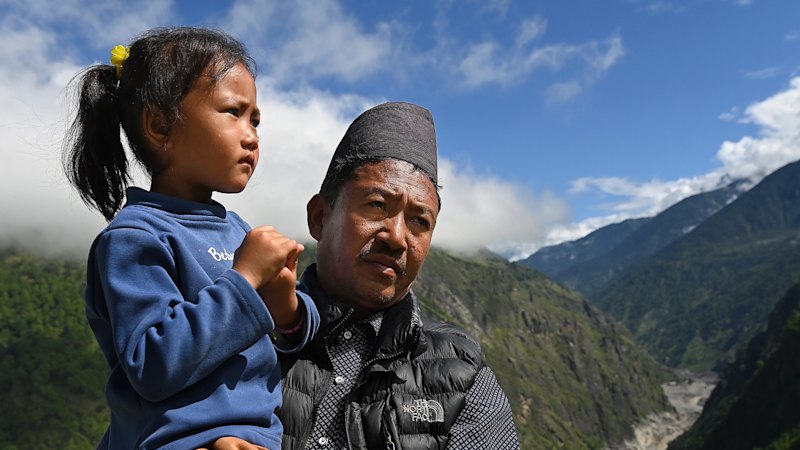
Sonam, 5, is waiting for her father. She doesn’t yet know he’s never coming home
Full Article
Original Source
Read the full article at Smh →KhanList aggregates and links to publicly available news content. We do not host full articles from third-party sources. Always verify important information with original sources.