
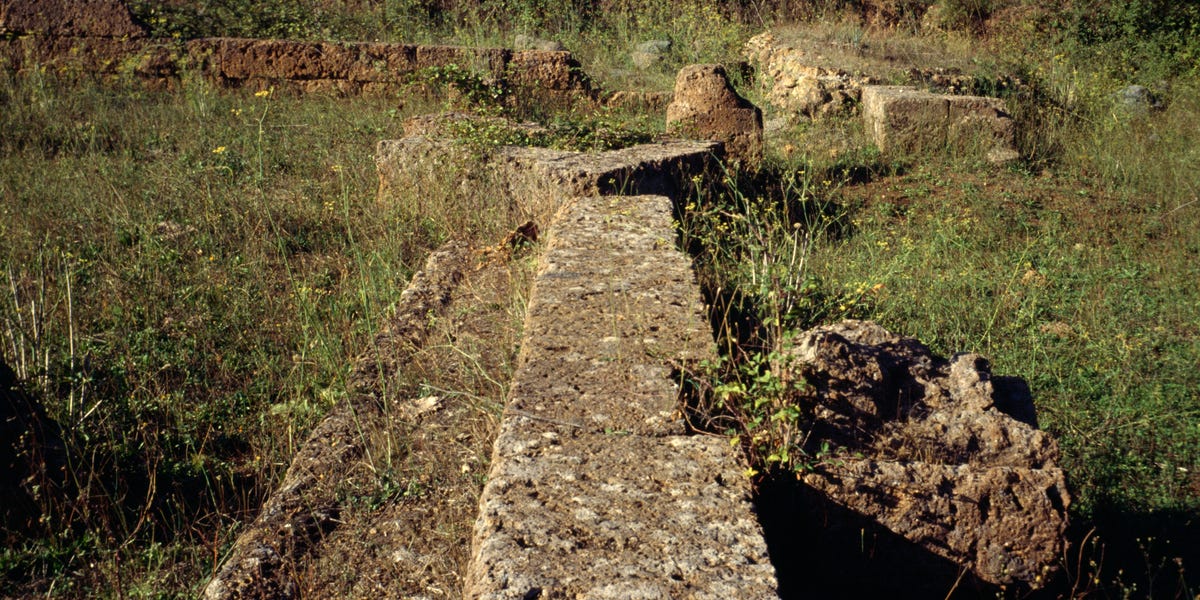
3 min readA heatwave wreaked havoc upon all facets of life in Europe to some degree this past summer, but it also provided archaeologists in Switzerland with an interesting opportunity: the chance to view ancient Roman history in an entirely fresh way. With vegetation stripped back and parched, a team researching Aventicum, a once-thriving Roman city, took to the air via drone for a bird’s-eye view of the entire site. From the new vantage point, they discovered things they simply hadn’t ever known existed.The site in Switzerland’s state of Vaud, which is now known as Avenches, looked different in the unusually hot and dry months of July and August, allowing archaeologists to “observe remains usually invisible underground,” according to a statement from those working at the Aventicum archaeological site. The airborne exploration revealed previously unseen buried structures, redrawing the map of what was once the capital of Roman Helvetica.“These are the richest discoveries made there in the last 50 years, at least over the last two generations of archaeologists,” said Jordan Anastassov, archaeologist for Vaud and the University of Geneva, according to Reuters.The archaeologist said less vigorous plant growth occurs atop buried structures. Combine that with a drought-stricken region and wilting vegetation this past summer, and the archaeologists were able to make a number of “observations that complement the data from the excavations in an exceptional way and show the full potential of surface prospecting methods.”Aerial images not only showed the locations of houses (making up a full neighborhood), expansive villas, and roads, but also highlighted thermal baths and a potential rectangular temple site running nearly 100 feet in length that was lost to history. Some of the buildings appear in sections of the historic city that haven’t been excavated, and the large building sits on what was once thought to be the town’s outskirts.Founded originally after Julius Caesar conquered local tribes 2,000 years ago, Aventicum had a successful run under Roman rule, eventually succumbing to Germanic invasions, starting in the third century. “We are now asking really interesting questions we wouldn’t otherwise be asking,” said Hugo Amoroso, an archaeologist on the project.The team hopes on-the-ground exploration of the newly discovered areas will provide fuller detail and a richer history.The summer heat proved critical in exposing the areas. By September, as temperatures returned to normal and vegetation started to flourish again, many of the newly seen sites slipped from view, although the pools discovered at the bath location were still visible in a struggling alfalfa field. “We aren’t going to wish for droughts,” said Pierre Blanc, director of the site’s excavations, “but we’re going to make the most of this and keep looking.”The use of droughts to reveal lost sites isn’t a new concept. Going aerial simply helps cover more ground quickly. A post from the tourism website About Switzerland that Anastassov shared on his LinkedIn page noted that a 1976 drought played a role in the discovery of a Roman villa in the nearby municipality of Orbe.With droughts increasing throughout the world, archaeologists are turning to aerial monitoring as a planned tactic, scheduling surveys systematically to better understand potential excavation sites and more accurately redraw ancient maps, just like at Aventicum.Tim Newcomb is a journalist based in the Pacific Northwest. He covers stadiums, sneakers, gear, infrastructure, and more for a variety of publications, including Popular Mechanics. His favorite interviews have included sit-downs with Roger Federer in Switzerland, Kobe Bryant in Los Angeles, and Tinker Hatfield in Portland.
Something Was Hiding in This Ancient Roman Capital. It Took a Drought to Finally Reveal It.
Full Article
Original Source
Read the full article at Popularmechanics →KhanList aggregates and links to publicly available news content. We do not host full articles from third-party sources. Always verify important information with original sources.