
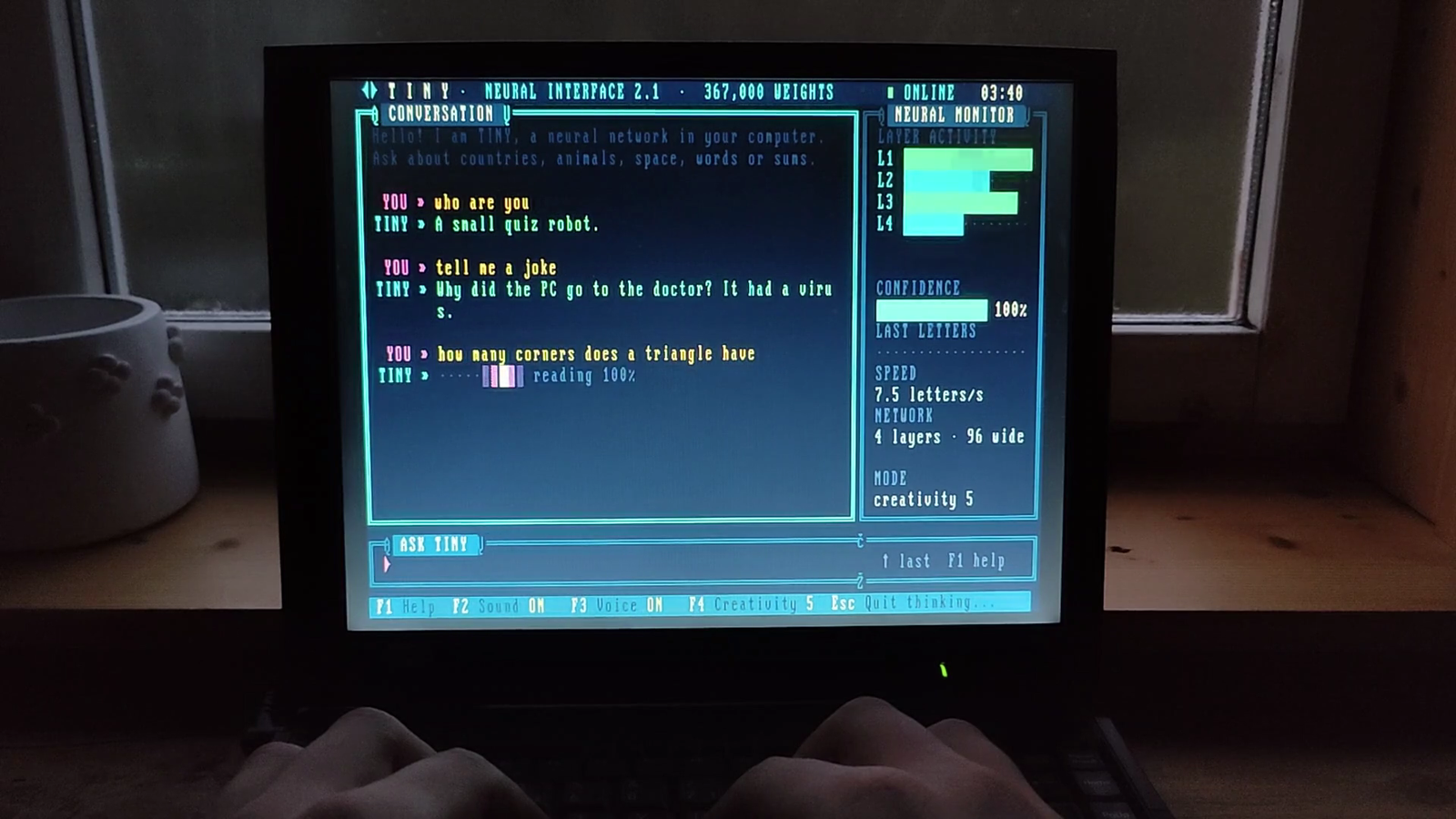
Credit: wollymonjak Published Nov 16, 2026, 2:03 AM EST Simon is a Computer Science BSc graduate who has been writing about technology since 2014, and using Windows machines since 3.1. After working for an indie game studio and acting as the family's go-to technician for all computer issues, he found his passion for writing and decided to use his skill set to write about all things tech. Since beginning his writing career, he has written for many different publications such as WorldStart, Listverse, and MakeTechEasier. However, after finding his home at MakeUseOf in February 2019, he would eventually move on to its sister site, XDA, to bring the latest and greatest in Windows, Linux, and DIY electronics. Sign in to your XDA account Summary This Claude-built transformer runs on DOS from a floppy disk, booting on vintage Pentium hardware. It has tiny specs, with 367K params, 4 layers, 8‑bit weights at ≈380KB, and needs ≈540KB of conventional RAM. It has limited knowledge and hallucinates on complex queries, but a highly impressive feat nonetheless. A little while ago, I mused that people have been getting really good at using AI to make chatbots that run on restrictive hardware never intended for them. I spoke about it when showing off someone running a language model off a 2015 Kindle. Well, it appears someone else has done the seemingly impossible and used Claude as a transformer to make a language model that runs off a floppy disk. And you can stick it on a DOS computer to boot. Getting a language model to run off an Intel Pentium is no easy feat But someone got it working anyway Over on the ClaudeAI subreddit, user wollymonjak showed off this really impressive feat. They used Claude Fable 5.2 to create a transformer, then made Opus 5.5 supply the training data. It fits on a floppy disk and runs at a respectable speed, given that it's running off a CPU that was designed decades before LLMs were even a thing. Here are the specifications: 367,000 parameters: 4 layers, 96 wide, reads and writes letter by letter 8-bit weights (one scale per row), 380 KB in all Needs about 540 KB of free conventional memory Trained on about 3,500 facts, each asked in many wordings. Outside those it makes things up confidently Neon full-screen interface with a live neural monitor and a PC-speaker robot voice So, yes, it's not going to be a particularly powerful AI; in fact, wollymonjak notes that if you ask something too complex or too long, it starts spitting out nonsense. But who cares about that when you're using a language model on DOS? That's worthy of praise alone. You can see how it was made, and even download it yourself, on the project's GitHub page.
Someone used Claude to build an AI chatbot for MS-DOS, and it fits on a floppy
Full Article
Original Source
Read the full article at Xda-developers →KhanList aggregates and links to publicly available news content. We do not host full articles from third-party sources. Always verify important information with original sources.