
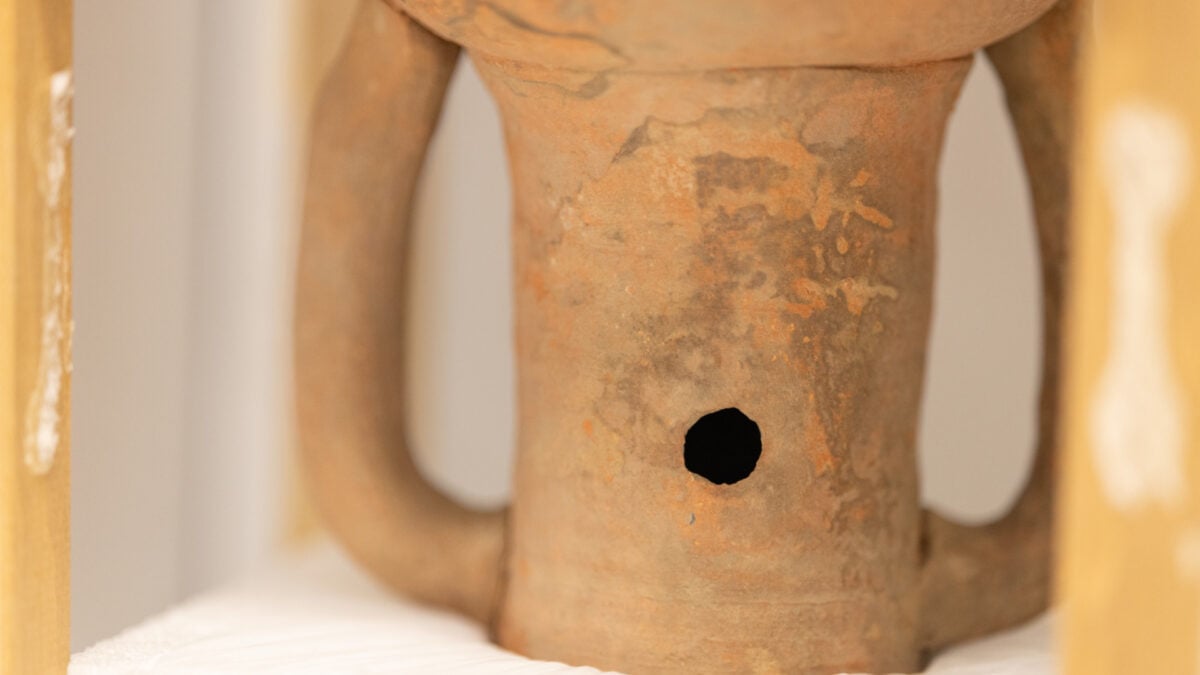
The Simpson collection of Egyptian and Nubian artifacts at Yale’s Peabody Museum reportedly took a “Noah’s Ark” approach. Egyptologist William Kelly Simpson salvaged the artifacts in the 1960s—a variety of objects from a broad range of periods, cultures, and societal levels. Once future scientists with better equipment came along, they’d come with a fresh set of questions to find new information. And come they did. In a recent update, Yale archaeochemist Andrew Koh describes one standout object from his team’s analysis of the collection: a 2,000-year-old Nubian amphora with a small hole that once held an exceptional concoction. An amphora—a two-handled ceramic vase—typically held wine or olive oil in the Greco-Roman world. While Koh’s team found wine, there was also opium and a mixture of possibly dozens of other plants, including members of the nightshade family, which have a history of medicinal or ritualistic uses. The Nubian jar, standing upside down. Credit: Allie Barton/Yale University Although analysis is still ongoing, it’s possible that this concoction used to be some sort of potion with wine as the base. Relatedly, the hole may have had functional use, but it could also be an act of “ritual killing” of the vase to neutralize the spiritual power present in the vase, Koh noted in the university statement. “Rather than simply centering wine with added incidental ‘stuff,’ our analyses suggest that the additives were in fact its raison d’être, and the wine, and its constituent ethanol, was simply the most readily available solvent delivery system of the time,” Koh told Gizmodo. A potion from antiquity A close-up look at the bottom of the jar. Credit: Allie Barton/Yale University Considering what we know of amphorae, this particular jar seemed off for several reasons. It was too big to store perfume or opium, but too small to transport wine. And there was that hole on its neck. Fortunately, the team’s specialty is in extracting millennia-old chemical residue from the bottom of ancient pots. For instance, last year Koh and colleagues had identified opium traces in an Egyptian alabaster vase, rewriting our knowledge of opiate use in ancient Egypt. In the case of the Nubian jar, the uncanny mix of various substances reminded him of two things. One, his earlier research on a Bronze Age wine cellar at Tel Kabri, and two, an ancient recipe for kyphi—an Egyptian religious and medicinal incense—presented by the philosopher Plutarch. “I realized that wine was sometimes not the star of the show, but the ingredients mixed into it were the focus,” Koh told Gizmodo. In the statement, he explained the Nubian jar “quite likely” held a potion with a “deeper cultural purpose we are only beginning to understand.” Movie references, anyone? The combination is also reminiscent of the ancient antidote, theriac—or perhaps even the mythical treatment for sorrow, nepenthe, from Homer’s Odyssey (or The Hunger Games: Sunrise on the Reaping, if you’re a fan). This was rather surprising, Koh explained, as the jar was identified as Nubian and came from a tomb in Arminna, a settlement by the Nile River. An image of the site where the jar was recovered. Credit: Allie Barton/Yale University It would be reasonable to assume, therefore, that the contents—whatever they were—would be closer to ancient Egyptian traditions of potion-making. But despite the artifact’s distance from the Mediterranean, its contents closely resemble Greco-Roman theriac, Koh told Gizmodo. Then again, this may speak to the “cosmopolitan, interconnected world well-documented during this period,” he said. To Gizmodo, Koh shared that the Nubian jar was being studied in parallel with other comparable objects from the Boston Museum of Fine Arts. The team’s first round of findings is slated to be published academically in the near future, with the Nubian jar being a fascinating preview.
Someone Filled This 2,000-Year-Old Nubian Jar With a Magic Potion, Then Possibly ‘Killed’ It
Full Article
Original Source
Read the full article at Gizmodo →KhanList aggregates and links to publicly available news content. We do not host full articles from third-party sources. Always verify important information with original sources.