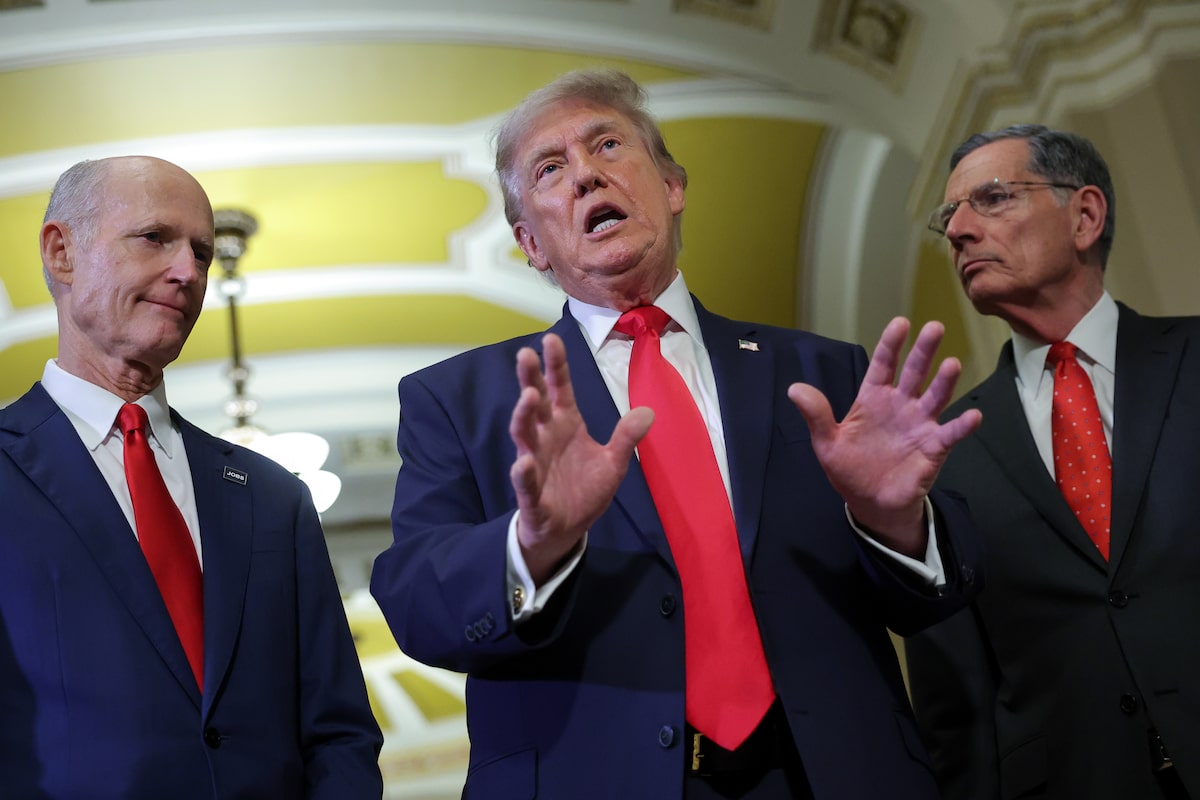
Open this photo in gallery:U.S. President Donald Trump, seen here with U.S. Sen. Rick Scott, left, and U.S. Senate Majority Whip John Barrasso, is trying to push his SAVE Act, which would impose strict voter ID and proof-of-citizenship requirements in federal elections.Kevin Dietsch/Getty ImagesPresident Donald Trump has directed the full powers of his office to changing how elections are held in the United States. He has pressed forward new legislation, the Safeguard American Voter Eligibility Act, better known by its catchy acronym, the SAVE Act. He has cajoled and browbeaten Congress to pass the bill, which would obligate voters to show identification and prove their citizenship, even withholding his signature from other bills until lawmakers pass it. Last week, he devoted a rare primetime address to demanding what he called urgently needed reforms to address a “crisis of election security.” Those reforms, critics say, would amount to the most restrictive voting legislation ever enacted by Congress. It has not yet passed, in part thanks to opposition from a handful of Republican senators. Alaska’s Lisa Murkowski recently wrote that it would create “chaos before the November elections.” Nonetheless, Republicans in Congress are now working to pass elements of it as part of a filibuster-proof budget bill that will almost certainly engender new accusations that the country’s conservative leadership is trying to stifle democracy. Mr. Trump, after all, has said the SAVE Act would “guarantee the midterms” for Republicans.But a number of the bill’s provisions are broadly popular in the U.S. − and some would not look out of place in Canada. Republicans who have sought greater scrutiny of voters say they simply want common-sense checks, no more than a store verifying a beer buyer’s age or an airline verifying a traveller’s identity. “There’s a vast amount of Americans that want to have faith in their election system,” said Brad Farrin, a Republican state senator in Maine who has backed a half-dozen bills demanding voter identification in that state. Without proper checks, he argued, “it disenfranchises some folks from voting, because they think that the system is broken.”Trump uses White House speech to renew claims of election fraud, accusing China of stealing voter filesCanadian experience suggests that greater scrutiny of voter ID is not incompatible with the exercise of elections. It also suggests that at least some of Mr. Trump’s demands − in principle, if not in precise detail − would be uncontroversial north of the border.“Most people think that voting, while a right that’s protected in our Charter, is still something for which we want a great degree of security,” said Andrea Lawlor, an associate professor at McMaster University who specializes in Canadian election law.Canadian voters are generally obliged to show government-issued photo ID before marking a ballot − a driver’s licence or other document with picture and address. A secondary option allows for the presentation of two documents from a list of more than 50, which can include a bank statement, liquor identity card, correspondence from a school or a letter of confirmation from a shelter or soup kitchen. A third option allows for someone without proper identification to be vouched for by someone with it. “The idea of enfranchisement in Canada has long been animated by the principle of being non-restrictive against people who have the legal entitlement to vote, even where their life circumstances may make producing standard ID a little bit more challenging,” Prof. Lawlor said.Attestation of citizenship is also required, although proof is assessed differently. Canadians who register to vote by checking a box on their taxes must attest to being citizens. U.S. federal judge rules against Trump’s order requiring proof of citizenship to voteVoters are not required to provide any proof of citizenship, an honour system that recognizes the difficulty many would have in producing a birth certificate or passport. Instead, Elections Canada compares its national register of electors with information from Immigration, Refugees and Citizenship Canada ”and removes any non-citizens,” said Clare MacDonald, a spokesperson for Elections Canada. Similar checks are done after an election is completed.Even in the U.S., millions of voters must prove both identity and citizenship. Arizona has required voters in state and local elections to show documented proof of citizenship since 2004; those who can’t can only vote in federal elections. But that group amounts to just 0.7 per cent of the electorate, in part because the state has built its architecture of identity around the requirement. Proof of citizenship or residency is a requirement for any driver’s licence issued after 1996. “We didn’t just require proof of citizenship. We also said when you go to the Motor Vehicle Division, we’ll make it easy to provide proof,” said Josh Heywood, who worked as a special projects manager in the Maricopa County Recorder’s Office. That county, which encompasses much of Phoenix, is one of the largest voting districts in the country.“The devil’s kind of in the details,” he said. Those details form the heart of critics’ concerns regarding the requirements in the SAVE Act that Mr. Trump wants to impose nationwide. Its photo identification demands, for example, are stricter than those imposed by every state outside of Ohio. Its requirements for proof of citizenship would create a sudden surge in demand for identity documents that an estimated 12 per cent of registered voters − more than 20 million people − currently do not have.Trump wants voter ID requirements for U.S. midterm elections“Introducing major change to electoral laws months before an election is creating havoc,” said Jean-Pierre Kingsley, a former chief electoral officer of Canada who later served as CEO of the International Foundation for Electoral Systems.Election authorities in the U.S. are already “underfunded,” he noted. (Elections Canada, by contrast, enjoys statutory spending authority, empowering it to spend what is needed. “It’s brilliant. It has given us the best electoral system in the world,” Mr. Kingsley said.)Besides, other states have discovered that demanding proof of citizenship can hurt more than help. In Kansas, such a requirement was struck down by a judge after it barred tens of thousands of people from registering to vote, far in excess of the estimated number of non-citizens on voting rolls. In Utah, authorities spent more than a year scrutinizing the state’s entire voters’ list. They found just 27 non-citizens out of two million registered voters. “Every election safeguard has a cost. The question is whether that cost is proportional to the problem you’re trying to solve,” Mr. Heywood said. And “if you look at the research, it’s pretty clear that non-citizen voting is astonishingly rare.”In Washington, Republican leaders in Congress have continued to press the SAVE Act forward. On Wednesday, they tucked elements of the bill into budget legislation, as Karoline Leavitt, the White House press secretary, said Mr. Trump’s “patience is running out.” Elsewhere in the country, though, even some Republicans say it’s not worth pursuing some of the bill’s measures, such as demanding proof of citizenship.“My personal opinion: I would leave that on the sideline at this stage,” said Mr. Farrin, the Maine state senator. Better simply to confirm the identity of voters, he said. That, at the very least, “would suggest that you are here in the United States legally.”
Some of Trump’s voter ID demands are common in Canada. Critics say the devils are in the details
Full Article
Original Source
Read the full article at Theglobeandmail →KhanList aggregates and links to publicly available news content. We do not host full articles from third-party sources. Always verify important information with original sources.