
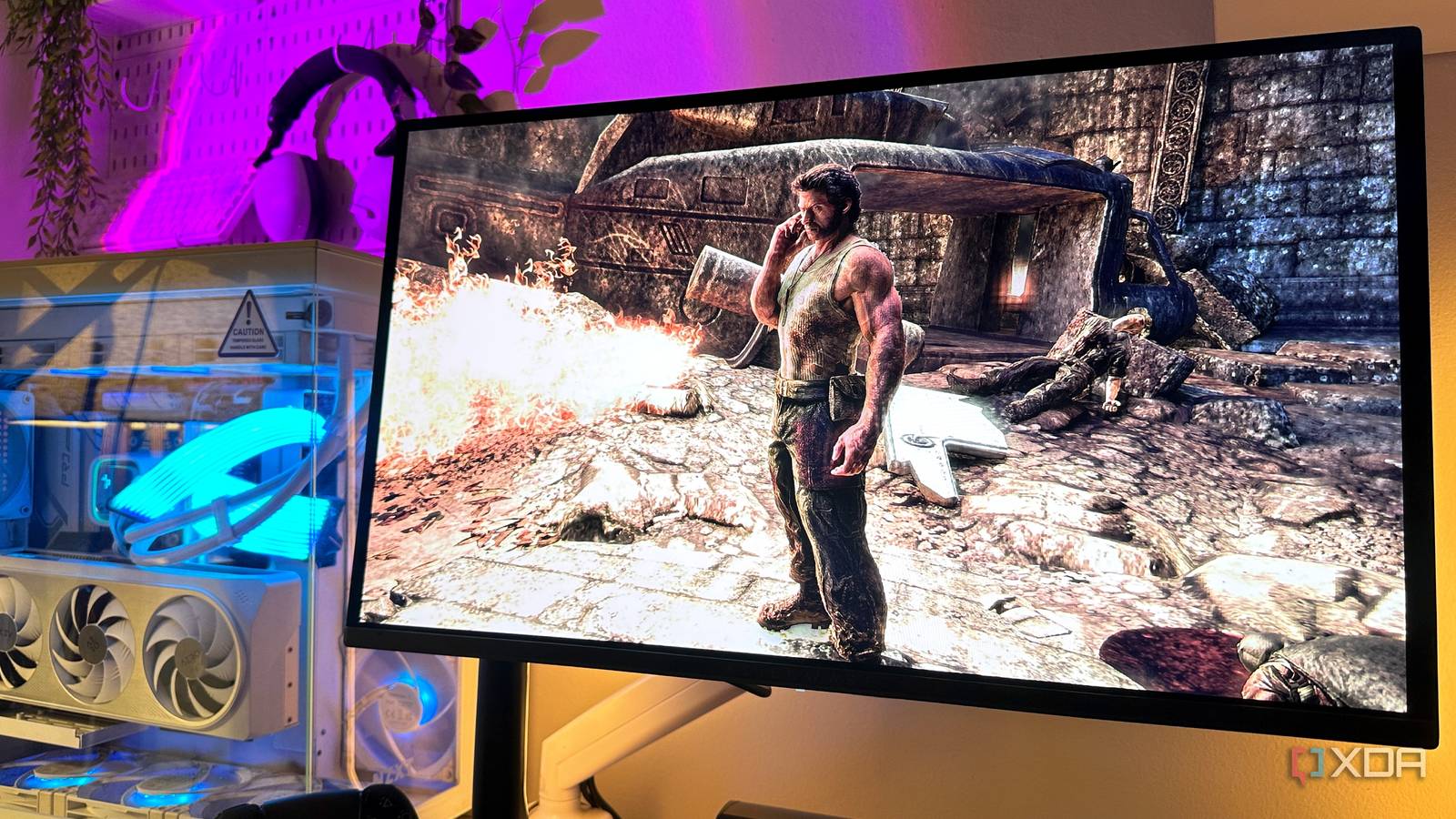
Published Nov 18, 2026, 3:00 PM EST Gaming has been Samarveer’s greatest passion, and the Literature graduate in him takes immense joy in dissecting games for their themes, messages, and impact. Samarveer holds a deep appreciation of gaming, and considers the platform to be the most immersive and impactful across all media. He can be found engaging with gaming communities online, always ready to debate the finer points of ray tracing or itching to write an 8-page collegiate thesis on any game that impacts him emotionally. DLSS 5 has given me an excuse to go digging through the abandonware games of my childhood. A lot of these forgotten PC games survive today thanks to the internet and preservation efforts like the Internet Archive, even when publishers have long since stopped selling or supporting them. It's absolutely an overstatement, but it still feels oddly noble, giving these games another moment in the spotlight and telling them, "Hey, I remember you. You're not completely forgotten." That's exactly what I’ve been doing lately. I dug up games I played on knock-off consoles and cracked flea market DVDs, found their abandonware files, and decided to give them a hilariously excessive upgrade in the form of DLSS 5's neural rendering. The results have been far more interesting than I expected, and they've made me look at some of these games — and DLSS 5's tech — rather differently. I went digging for the PC games I grew up with They deserve better than to be lost to time I started with two games that have become difficult to play legitimately — 007: Blood Stone and X-Men Origins: Wolverine. Both are casualties of licensing, making them the sort of games that vanish from storefronts while remaining playable today. Instead of PS2 games I had to drag through an emulator before throwing neural rendering at them, these are native PC releases built around DirectX. That gives tools like ReShade and OptiScaler a conventional target. I also had Need for Speed: Underground 2 from previous experiments. It's another game that changes once a modern rendering enters the picture, particularly when you've spent years remembering its early-2000s presentation as the default. I wanted games I remembered, titles that survived while their companies moved on. DLSS 5 gave me a ridiculous way to revisit them, but it needed to make them look like my teenage self remembered them—lifelike and impossibly photorealistic. Getting DLSS 5 working in these games took a bit of elbow grease, though. I first had to make OptiScaler think these games were DirectX 11 titles, so I used dgVoodoo2. It's a DirectX 9 wrapper that sits next to a game's executable and tells the PC it's running DirectX 11 software. That's how I could finally inject OptiScaler into the games, tricking them into believing that these were DirectX 11 games instead. DLSS 5 can make old games look shockingly good These games had no idea what was coming X-Men Origins: Wolverine was the first one that made me stop and stare. The game already has sharp environments, but DLSS 5 pulls more definition out of the rocks, grass, character model, and ground without changing the assets. Wolverine's skin and clothing also pick up fine detail. The same thing happens in 007: Blood Stone, although its grounded presentation makes the difference easier to see. Distant scenery is cleaner, surfaces hold together better, and characters look less like they were assembled from textures stretched across polygons. If anything, Blood Stone blew me away even before DLSS 5, and I was taken aback by just how great it looked even sixteen years later. What I find interesting is that DLSS 5 isn't magically remastering either game. It isn't replacing textures or rebuilding geometry. The original assets are still doing the heavy lifting; neural rendering is extracting a more convincing image from what the game gives it. That matters because these games were never designed around reconstruction techniques. They were built for an era when increasing resolution meant asking the GPU to push more pixels. Now I'm taking those pixels and letting an RTX 4070 Ti make an AI interpretation of them. In Need for Speed: Underground 2, DLSS 5 cleans up the road, cars, and distant scenery, but the biggest difference is stability. The image loses that distinctly early-2000s softness without losing the game underneath it. Yes, it looks ridiculous, and that's why I love it. I'm throwing 2026 rendering technology at games from an era when 720p felt luxurious, and somehow, it works. DLSS 5 still couldn't fix everything, though Sometimes, the original art direction wins After going through Wolverine and James Bond, I was genuinely excited about what DLSS 5's neural rendering would do to the characters in The Simpsons: Hit & Run. I expected Homer and Marge to look like their horrific "realistic" versions straight out of uncanny valley, but that never happened. The image changed, sure, but it didn't get any better. Not only did DLSS 5 not change anything in the characters' appearances, but it didn't work on the environments either. The only thing that neural rendering changed was how slick and shiny the roads in Springfield looked, and they weren't necessarily an improvement. That makes sense once you look at what Hit & Run is trying to achieve. Its cel-shaded characters, simple geometry, flat colors, and cartoonish lighting are part of the game's identity. There isn't much detail for neural rendering to reconstruct, and sharpening everything can make the stylization feel less coherent. This definitely served as an important reminder that DLSS 5 just isn't a universal remaster button. Sometimes a game's limitations are inseparable from its identity, and the best upgrade you can give it is knowing when to leave well enough alone. These games deserve to be remembered Abandonware is complicated, but forgetting these games is easy Most of these games aren't readily available anymore. Blood Stone and X-Men Origins: Wolverine are effectively stranded by licensing, while other older games have simply disappeared from storefronts. The internet has become one of the few places where they remain discoverable. That doesn't make "abandonware" a legal free pass. Copyright doesn't disappear because a publisher stopped selling a game, and downloading something from an archive or preservation site doesn't automatically make it legitimate. The legal situation varies from game to game, which is precisely why I don't want to pretend otherwise. Thankfully, all I had to do was use my own copies from my old PC DVD collection. Regardless, preservation matters, and it matters a lot. A game can be commercially unavailable, unsupported, and absent from every modern storefront while still being worth remembering. The files are only part of that preservation; keeping people interested in the games themselves matters too. That's why loading up these games felt like giving them another reason to exist on my screen. An unofficial DLSS 5 mod is ridiculously overkill for games like these, but seeing these forgotten games running again made all the tinkering worthwhile. The old stuff is absolutely worth keeping There's nothing quite like having a game you haven't touched in years surprise you after so long. That feeling is genuinely hard to replicate, no matter how good newer titles get. Perhaps that's why I keep using DLSS 5 to mess with old games instead of simply moving on, or even bothering to do the same with newer titles. Technology keeps giving us better ways to experience the things we thought we'd outgrown, and I'm perfectly happy to indulge it. If that means throwing a cutting-edge neural renderer at a game from the 2000s just to see what happens, well, I've made worse uses of an evening. DLSS 5 Manager
Some of my best childhood games are abandonware now, so I brought them back with DLSS 5
Full Article
Original Source
Read the full article at Xda-developers →KhanList aggregates and links to publicly available news content. We do not host full articles from third-party sources. Always verify important information with original sources.