
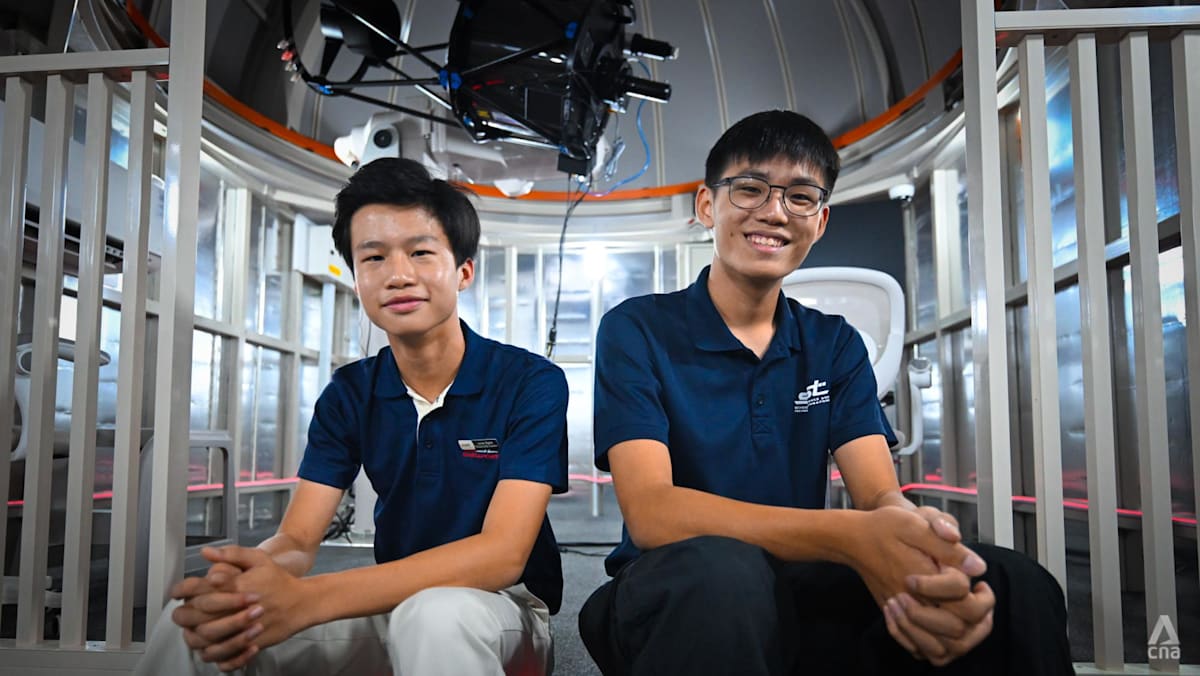
SINGAPORE: A tangle of wires snakes across the walls and ceiling of 14-year-old Edmund Lim's balcony. It may not look like much, but the homemade antenna – assembled with just S$20 worth of wire and paired with a S$50 receiver – allows him to pick up radio broadcasts from as far away as the United States.For Edmund, it is more than a hobby. The setup has deepened his curiosity about how satellites communicate with Earth.His interest began during a lesson at the School of Science and Technology (SST), where he learnt to receive radio signals using a device connected to a computer. "We managed to receive data from radio stations from all around Singapore. That made me interested in radio communications," said the Secondary 2 student, who is now studying how atmospheric conditions and time of day affect radio frequencies. Edmund is among a growing group of young Singaporeans setting their sights on the space industry, with some hoping to turn their passion into a career. And schools are helping them take their first steps, offering hands-on experience through projects ranging from studying solar flares to building satellites destined for orbit. The push comes as Singapore looks to grow its nascent space industry, which currently employs about 2,000 professionals, according to figures shared by Minister for Energy, Trade and Industry (Energy and Industry) Tan See Leng in parliament last month. Beyond astronauts and rocket launches, the sector needs engineers, researchers and data specialists to develop satellites, maintain communications systems and analyse information gathered from space. The National Space Agency of Singapore (NSAS) noted that the industry also needs professionals who can apply space technologies in sectors such as maritime and finance.SPARKING AN INTEREST IN SPACE Educators told CNA that early exposure will be crucial to building a pipeline of local talent. At SST, students now have access to facilities that allow them to pursue space-related projects beyond the classroom. Its space technology centre, which opened in April, houses an observatory and radio room, where students can track satellites and communicate with radio users around the world.SST is one of two secondary schools with an observatory – the other being the NUS High School of Mathematics and Science – and the only one with a dedicated amateur radio station. For alumnus Gavriel Chia, 17, who was the former president of SST's astronomy club, the facilities have made pursuing his interests easier.Previously, he and his peers had to set up antennas in an open field, where strong winds could knock them over and other curious students could disrupt data collection. They also borrowed part of the school's music room for their work. Now studying at National Junior College, Gavriel regularly returns to SST to use its facilities. His projects include studying solar radiation and solar flares – powerful bursts of energy from the sun that can disrupt radio communications and satellite operations."I've also been using the observatory to take deep sky photographs of galaxies and nebulae," said Gavriel, who hopes to work as an astronomy researcher. "This sort of equipment is not easily accessible to amateur astronomers like us because of the price and the space constraints we have."His passion sometimes draws puzzled reactions from his peers. "Some of my friends ask what I'm doing, and if I'm speaking to aliens," he said with a laugh. A photograph of Castor, the second brightest star in the Gemini constellation, taken at the School of Science and Technology's observatory. (Photo: Gavriel Chia) While Gavriel is drawn to understanding space itself, 17-year-old Ngee Ann Polytechnic (NP) engineering science student Teoh Tian Huai is interested in how space technology can solve problems on Earth.His interest was sparked in 2023, when he attended a course by Space Faculty Singapore, a space education and training provider."I learned about the potential use of remote sensing data to do things like, for example, warn communities about the increase in toxic gas around their area or rising sea levels," he said.Remote sensing involves using satellites and other technologies to gather information about Earth, helping scientists monitor environmental changes and assess natural disasters, among other things.Tian Huai is looking forward to NP's new space technology specialisation, which he hopes will give him access to equipment that would otherwise be beyond his reach. Students who enrolled this year in one of seven engineering courses can select the specialisation in the first semester of their third year in 2028. They will learn about the different systems that make up a satellite and the testing required to ensure these systems can function reliably in space. Teoh Tian Huai, a first-year student in the Diploma in Engineering Science at Ngee Ann Polytechnic, on Oct 13, 2026. He plans to join the school's space technology specialisation in 2028. (Photo: CNA/Jeremy Long) As part of their capstone project, students will also build small-scale satellite components and gain experience in the processes involved in developing space systems.While undecided on a career, Tian Huai is considering becoming a space diplomat, working on international relations involving outer space. "When people think of the space industry, they think of astronauts launching rockets into space," he said. "But I prefer something more practical and with a wider range of use cases … Space diplomacy is one area which our government can make strides in, such that we can have a greater stake in the space industry and develop it for our country's economic and national interests."FROM CLASSROOMS TO ORBIT At the National University of Singapore (NUS), students are going a step further by building satellites for launch into space. For third-year undergraduate Pradyumn Vashishtha, the opportunity once seemed out of reach. He was inspired in 2015 after watching television coverage of NUS launching its first satellite, Galassia."Up till that point, I thought the only way to do anything related to space was through NASA in America, and that that'll be unattainable," he said. A decade later, Mr Pradyumn is among 40 students working on Galassia 5, a nanosatellite slated for launch in the first quarter of 2028. The chemical and biomolecular engineering undergraduate, who has a second major in innovation and design, is helping to develop the imaging payload that will capture images of Singapore's waters from space, along with a computer to control it.Besides putting classroom knowledge into practice, the project has opened doors to connect with the wider space industry. (From left) National University of Singapore instructor Eugene Ee Wei Han, second-year undergraduate An Wei Teck and third-year undergraduate Pradyumn Vashishtha with a prototype of their Galassia 5 satellite on Oct 27, 2026. (Photo: CNA/Lim Li Ting) It has linked students with organisations including the Agency for Science, Technology and Research (A*STAR), startups and overseas industry players. Last month, Mr Pradyumn, who hopes to start a business developing a star tracker used for satellite orientation, attended the International Astronautical Congress in Turkiye, where he received feedback on his project from space industry veterans and leaders."I was able to build my confidence, as well as connections that will be useful to me both during the continuation of this project and hopefully beyond university," he said. Mr Eugene Ee, an instructor at NUS' Engineering Design and Innovation Centre, said such opportunities help students understand industry developments and build networks with potential employers and collaborators before graduating.BRIDGING THE SPACE SKILLS GAP Yet educators say challenges remain in preparing students for careers in the space industry. Mr Lau Zirui, deputy course chair at NP's School of Engineering, said one hurdle is helping students understand the range of jobs available and giving them meaningful exposure to specialised technologies."This is why it is important to build on their foundational engineering knowledge and provide opportunities for them to explore how these skills can be applied in a space-related context," he said. To bridge the gap between classroom learning and industry needs, the polytechnic is exploring collaborations with industry partners to co-develop its curriculum and offer industry-linked final-year projects and internships. Universities are also expanding their programmes to meet the sector's evolving needs.Professor Gan Chee Lip, Nanyang Technological University’s (NTU) deputy provost for education, said a strong local talent pool would also help Singapore attract international space companies and startups, strengthening its position as a regional hub.NTU began its satellite engineering programme in 1996. It has since established initiatives including its Satellite Research Centre, where students can design, build and operate satellites in orbit."The global space industry is rapidly expanding from government-led missions into high-value commercial space applications, with exponential growth expected in the near term," said Prof Gan, adding that the sector needs a wide range of expertise such as in satellite systems, telecommunications and data analytics.Meanwhile, NUS launched what it says is Asia's first bachelor's degree programme in geospatial intelligence in August. Students learn satellite data processing, spatial modelling and computational analysis, said Associate Professor Feng Chen-Chieh, the programme's director.He said the skills graduates gain across different disciplines would help them address environmental and societal challenges, while preparing them for careers both within and beyond the space industry. WHAT IT TAKES TO WORK IN SPACEBut industry players say technical training alone is not enough to prepare graduates for space careers. Dr Mark Lim, chief executive of Singapore-based space tech firm Aliena, said developing the expertise needed to build hardware that can operate reliably in space takes years of experience. "Graduates from our universities and polytechnics come equipped with relevant skills that put them on the right track fresh out of school," he said."Fundamentals such as computer-aided design, simulation and circuit design are highly transferable, and they are the bread and butter of our industry."But young engineers must also be adaptable and able to work across disciplines, he stressed."Much of the real engineering happens at the interfaces between subsystems, so young engineers must be ready to work in multidisciplinary, cross-functional teams and to understand disciplines beyond their own," he said."A satellite does not care which faculty you graduated from; it only works when every subsystem does."NSAS told CNA that several institutes of higher learning (IHLs) already offer space-related programmes, with the agency supporting hands-on training through projects. It also runs a technology development programme that supports the training and employment of researchers, scientists and engineers involved in eligible research and development projects at IHLs and research institutions."Singapore's space ambitions are ultimately about creating good jobs and meaningful careers for Singaporeans," its spokesperson said. A replica of the payload imager for the Galassia 5. (Photo: CNA/Lim Li Ting) "We will continue to work with our IHLs, industry partners, and government agencies to ensure Singaporeans are well-positioned to seize the opportunities ahead."For NUS' Mr Ee, who helped build the university's first Galassia satellite as a student in 2015, the expanding opportunities reflect how far Singapore's space sector has come over the past decade."More than 10 years ago, when I was working on a satellite, there was a lot of scepticism around whether a bunch of university students could send a satellite to space," he said. "Today, it's a selling point for students to join our programme."Now, Mr Ee is guiding a new generation of students working towards the launch of Galassia 5.Several former students have gone on to work at the Defence Science and Technology Agency, ST Engineering and space tech startups, he said."It's a full-circle moment that what I worked on then would inspire the next generation of students to join the space industry."
‘Some friends ask if I’m speaking to aliens’: How young Singaporeans are gearing up for space careers
Full Article
Original Source
Read the full article at Channelnewsasia →KhanList aggregates and links to publicly available news content. We do not host full articles from third-party sources. Always verify important information with original sources.