
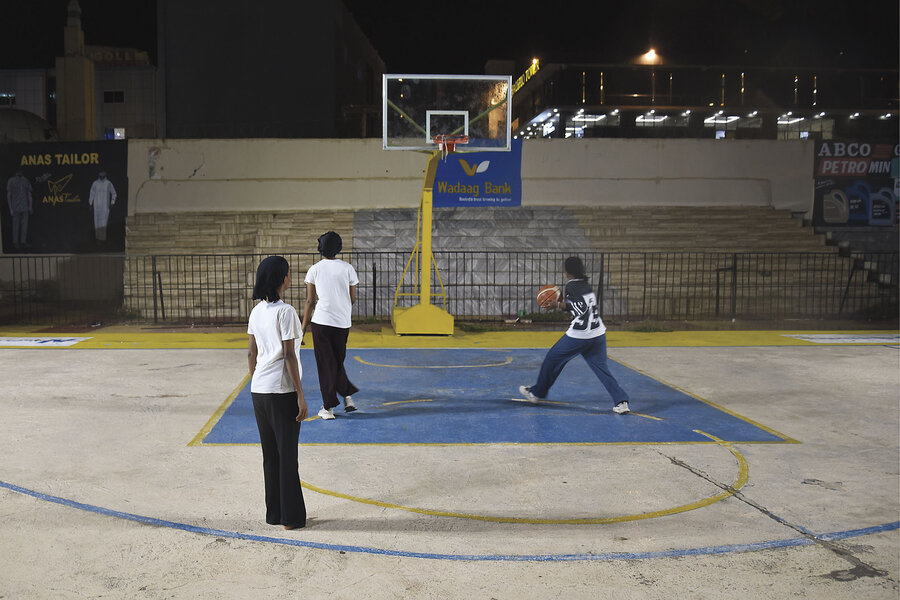
Hargeisa, Somalia | Sept. 18, 2026, 1:53 p.m. ET | 4 min read On a court slick with evening rain and illuminated by the glowing yellow light of a mosque, about a dozen young women practice basketball together. Six nights a week, this government-owned court here in Somaliland’s capital city is reserved for men. But every Thursday, the women take over. Head coverings and long skirts cast aside, they laugh as they dribble up and down the court in sweatpants and oversized shirts.The players here dream of representing their country. Somaliland doesn’t have a national women’s basketball team, however, because Somaliland, in the eyes of most of the world, isn’t a nation at all. Since the breakaway state declared its independence from Somalia in 1991,only one country – Israel – has recognized its sovereignty. Without wider recognition, its athletes cannot represent their country abroad. It means that, for many in Somaliland, participating in sports is not just about recreation. It is an act of defiance, a way to assert their very existence. “It is my role and responsibility to make sure the world sees me,” says Nimo Ahmed, one of the players, “because I am not from Somalia ... I am from Somaliland.”A court of their ownWhen the women show up to play here, they – like other women on the street – are covered head to toe. Boys loitering outside the gates taunt them as they walk inside. It wasn’t always that way. Khadra Mohamed Abdi grew up in Hargeisa in the 1970s and ’80s, when Somaliland was still part of Somalia and young women played sports freely, right alongside the boys. Ms. Abdi was part of a popular regional women’s basketball team, which played in T-shirts and shorts in front of mixed-gender crowds. Sophie NeimanKhadra Mohamed Abdi began teaching young girls to play basketball in the aftermath of the Somali civil war. That was possible because of the progressive policies promoting gender equality championed by former dictator Siad Barre. These initiatives touched on all parts of life – from marriage rights to state-supported women’s basketball teams. But in the late 1980s, civil war erupted between Somalilanders and the regime in Mogadishu. As Mr. Barre’s government punitively slaughtered tens of thousands of civilians and bombed Somaliland’s cities to near-total destruction, Ms. Abdi fled into neighboring Ethiopia, then Djibouti, and finally across the Red Sea to Yemen.A few years after Somaliland declared its independence, Ms. Abdi returned home to a paradox. Somaliland finally had its own government, but unlike Mr. Barre’s regime, it was steeped in religious conservatism. Girls and boys could no longer play sports side by side in the same spaces. “I had always dreamed of training girls,” Ms. Abdi says. She got her wish when she began working for the government as a girls’ basketball coach, but she had to train players at her own house. Her neighbors responded by throwing stones at the participants, and her landlord threatened her with eviction. Eventually, Ms. Abdi got her own court, where women could practice without men seeing them. However, when she went to area schools to recruit players, parents and teachers accused her of immorality for encouraging girls to act like men. Today, there is more acceptance of women in sports. But playing basketball in Somaliland as a woman continues to be a defiant act. “Girls deserve to play and also be independent,” says one young player, who asked to remain anonymous because her family disapproves of her athletic endeavors. The next generation The next generation of female players is not only flouting Somaliland’s conservative social norms, but also its lack of diplomatic recognition. Eight years ago, as a high school student, Hafsa Omer founded a team called Hiil Hableed – meaning “female solidarity.” Now in her mid-20s and working as a digital archivist and art gallery manager, Ms. Omer welcomes any girl who wants to play with her, regardless of skill level. Her team counts among its members university students and working adults. “We have become a family rather than just friends,” says Ms. Omer’s sister Fatima.Still, Ms. Omer is frustrated that there is nowhere for her athletic ambition to go. “If my country was recognized, I would have represented it well,” she says. For now, she and her teammates are using their head-turning athletic feats to draw attention to Somaliland’s fight for sovereignty. “A lot of people know my country because of me,” Ms. Omer says proudly, referring to past international news stories about her and Hiil Hableed – also known as Hargeisa Girls Basketball. The team also counts more than 3,000 followers on Instagram, where its grid is checkered with photos of the players wrapped in Somaliland’s green, red, and white flag. Deepen your worldviewwith Monitor Highlights.Politics with respectGet political stories with respectful analysis.There‘s a world of new ideas in everyBooks newsletter.There‘s more to life, enrich yours withCulture & Learning weekly.Follow humanity‘s discoveries withScience & Nature stories in your inbox.Gain a spiritual perspectivefrom the stories in your inbox.Want to understand the deeper impact of critical events? Learn the Monitor‘s insight.Already a subscriber? Log in to hide ads. At an Independence Day celebration this past May, members of Hiil Hableed marched as a team, draped in the same flags. And they continue to play On the night the Monitor visited the government-run court, a mixed group of Hiil Hableed members and women from other teams scrimmaged on a rain-washed blacktop. Some wore sneakers; others were barefoot. With her tongue between her teeth, one player aimed carefully, sending the ball curving into the basket. Each time they take the court, the young women here know they are proof positive of two things: Somaliland exists, and its women play basketball. ALREADY A SUBSCRIBER? LoginReal news can be honest, hopeful, credible, constructive.The Christian Science Monitor was founded in 1908 to lift the standard of journalism and uplift humanity. We aim to “speak the truth in love.” Our goal is not to tell you what to think, but to give you the essential knowledge and understanding to come to your own intelligent conclusions. Join us in this mission by subscribing.
Somaliland’s women shoot high on and off the court
Full Article
Original Source
Read the full article at Csmonitor →KhanList aggregates and links to publicly available news content. We do not host full articles from third-party sources. Always verify important information with original sources.