
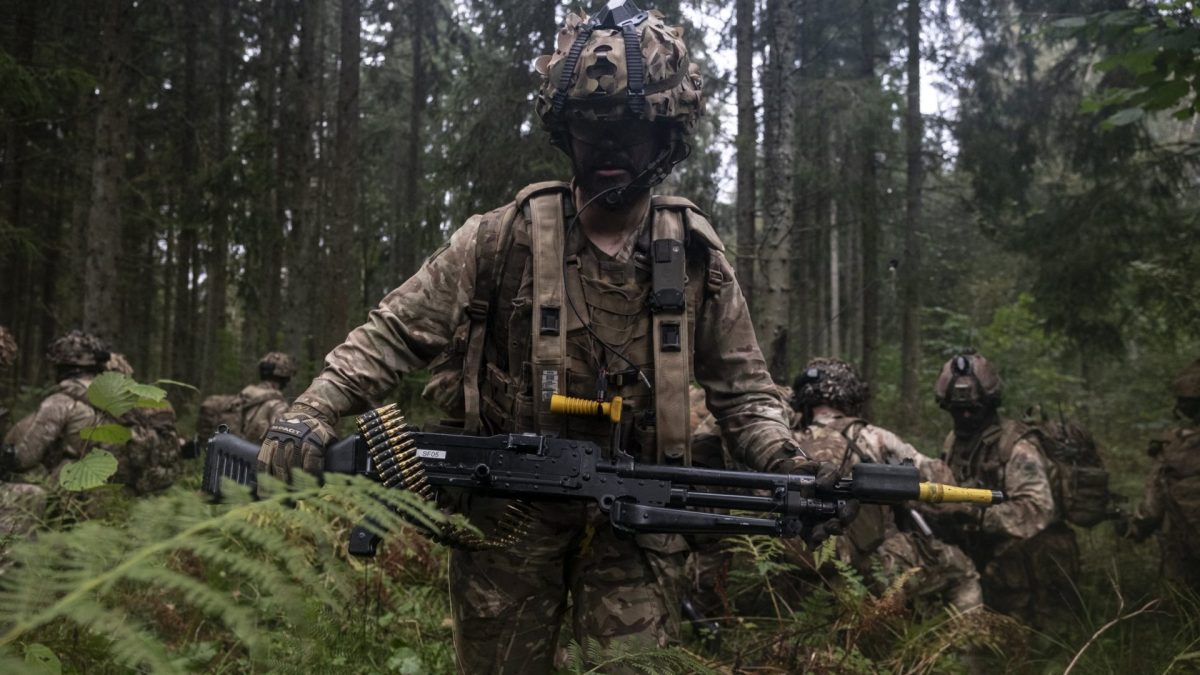
The majority of Britain’s soldiers returning from summer leave this week might just as well be told to go back on holiday, with the shock announcement that all but essential training is to be cancelled immediately. It is all part of an “efficiency saving” – a favourite Treasury weasel phrase – saving a princely £30 million out from an annual budget of something around £74 billion. Apparently, the Ministry of Defence‘s (MoD) till for regular operational expenditure is running near empty. Only “essential” training is to continue to prepare soldiers for service in Estonia, Cyprus, or the Falkland Islands. In a wonderfully crass expression, an anonymous MoD official told the BBC that the Army was giving up on “nice to have training”, such as practising platoon attacks, working with attack helicopters, tanks and artillery, on Salisbury Plain, Sennybridge, Otterburn and Arbroath. The high point of such exercises is the part involving live ammunition – but you can forget about that for a game of soldiers well into next year. Shorts This is one of the worst PR blunders of the Burnham government so far. It shows more than insouciance about defence, but a fundamental ignorance about the services, why they are needed and what they need to prepare for. Soldiers live by training, and die by the lack of it. They need to practise for real how to work together, to use the equipment old and new, more the former rather than the latter in the case of today’s Army, to take orders and learn how to react when things go wrong. Just keep them in barracks and training from desktops and classrooms, and they will get bored. And bored soldiers get up to mischief. Coincidentally, or not, the training cuts were announced within hours of the speech to the Argentine nation by President Javier Milei, declaring that he was pledged to his “sacred mission” of recovering the Falkland Islands, or Malvinas as he calls them. The exploitation of oil around the islands makes the issue urgent. The message about Army training underlines that UK military strength is at the lowest for 90 years – and we may not have the diplomatic nor the military muscle to defend the islands and British interests in the south Atlantic, Antarctica included. During the short campaign to recover the Islands in 1982, the Royal Navy had nearly 60 destroyers and frigates. In the campaign, four were sunk and around 30 were deployed. Today the Royal Navy has only three destroyers and between two and four frigates available for operations. The government spends roughly 2.6 per cent of GDP on defence, around £74 billion. It is pledged to up defence spending to meet the Nato requirement to spend 3 per cent of GDP by 2030, rising to 3.5 per cent by 2035. John Healey resigned as defence secretary from the Starmer government because the 3 per cent target was not likely to be met. As Chancellor, he has admitted it is unlikely to be met by the Burnham government, either. “We cannot max out the credit card” he is alleged to have told one reporter. So what has changed in the last few weeks ? If anything the world has become even more dangerous, with Russian media and ministers singling out the UK for some pretty direct threats. The volume of Russian surface shipping and tankers from the shadow fleet going through the North Sea and the English Channel, has gone up more than 30 per cent on last summer, according to the Royal Navy. Submarine activity through the Faroes-Iceland and Greenland gaps is of a similar scale. Cyber attacks are persistent and increasing, according to the cyber agencies under GCHQ, and run now at something near 100,000 a year. Most, but not all, emanate from Russia, with a fair amount from Iran. The cyber attack on Jaguar Land Rover last year that cost the UK economy something in the region of £1.9 billion came from Russia. Meanwhile in the past few weeks there has been another outbreak of suspicious drone activity, most notably at Leipzig airport, the logistics hub for air freight to Ukraine. One struck a plane on the ground, losing its explosive charge on the way, another was tracked midair. Russia is involved in a cunning game of disinformation and misdirection, and has the initiative in the information war across Europe. One of the most worrying aspects of the latest defence pronouncements from the Burnham government is lack of discussion of homeland defence and resilience. The east coast of England and Scotland do not have adequate air defences – successive governments, including Labour most recently, have turned down an integrated air defence system as too expensive and unaffordable. With a very real threat of covert drone attack now, this may well prove a risk too far. There is another aspect to home defence and resilience almost totally ignored by governments , especially this one. This is the need for support in emergencies from multiple wildfires to cyclones and weird weather events, droughts and floods, disrupted energy and food supplies, and human and animal pandemic. The reserves of the forces can fill the gap, as they did in the fires in Wales – but they need to train and to be equipped. In civil support operations, the forces need to draw on reserves – yet successive governments have failed to build up the reserves, and the cadet forces. Trained personnel are going to be needed with the reasonable prediction that 2027 is going to much hotter and stormier than 2026, with the most extreme El Niño phenomenon in a century now brewing up in the Pacific. A lot of rethinking is needed about our forces and their training – for all kinds of contingencies and threats, some barely on the policy radars of Whitehall right now. The government should forget about their two major policy documents on defence so far, the Strategic Defence Review of 2025, and the Defence Investment Plan from June – both high on aspiration and wishful thinking and far too low on practicality and realistic targets. It is not just a question of more money, but spending it more wisely and to face the world as it is and not as we would wish it. And we cannot rely on old friends and colleagues. Perhaps the most ominous bit of news during a week of threats came from a near neighbour, the Netherlands. The Dutch government has hastily ordered the transfer of 70 tonnes of gold bullion from New York to London, on grounds of security and safety. Quite a judgement on the regime stability of King Donald.
Soldiers live by training, and die without it. This is Burnham’s first big mistake
Full Article
Original Source
Read the full article at Inews →KhanList aggregates and links to publicly available news content. We do not host full articles from third-party sources. Always verify important information with original sources.