
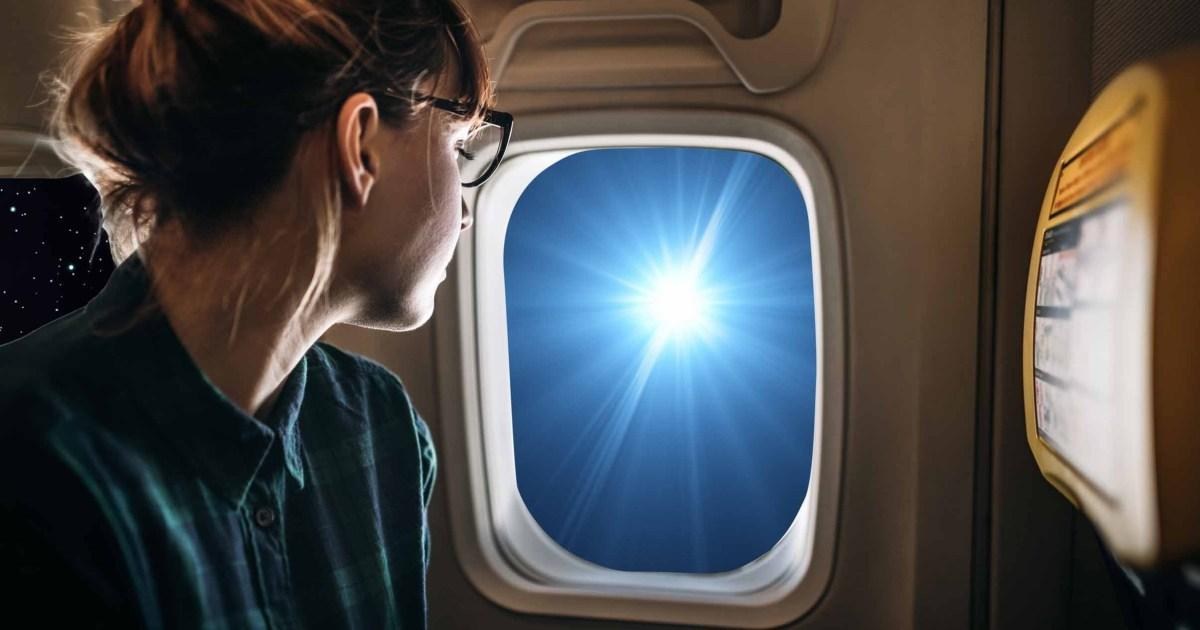
Slightly worse than turbulence (Picture: Getty Images) Most people board planes to get away to somewhere hot and sunny – but they might be exposed to the wrong kind of sunshine. University of Surrey researchers have found that solar storms could expose airline passengers and crew to dangerous amounts of radiation. The team’s study, published in the Journal of Space Weather and Space Climate, found radiation surges at typical flight altitudes. ‘Cosmic radiation at 40,000 feet is around 300 times higher than at sea level, giving a steady radiation drizzle,’ Professor Clive Dyer, a visiting professor at the Surrey Space Centre and co-author of the study, tells Metro. ‘Solar storms, however, can produce sudden downpours, potentially delivering a month’s worth of this normal cosmic radiation in just one hour.’ Wait, what’s space weather? Only during ‘extreme’ space weather would radiation pose a risk (Picture: Cody Froggatt/PA Wire) Space weather doesn’t mean rain clouds drifting through the cosmos and that you’d need an umbrella for a moonwalk. Rather, it describes the angry-looking things the sun does, like blowing chunks of its outer layers at us, called coronal mass ejections. Then there’s solar wind, the million-miles-per-hour stream of particles it’s constantly spewing. If both weren’t bad enough, the Earth is also being splattered with cosmic radiation from exploding stars. ‘These variations, particularly those from the sun, can influence life and technology on Earth and are what we call space weather,’ says Professor Dyer. We don’t need to worry about space weather much, as the Earth’s invisible shield, the magnetic field, keeps us safe. Earth is largely protected from radiation thanks to its magnetic field (Picture: ESO/M. Kornmesser, L. Calçada/Co) The closer to the ground, the less cosmic radiation we’re exposed to. At 40,000 feet, that protection is one-third. ‘Long-haul aircrew typically receive around double the radiation exposure of someone at ground level for every year of flying and some frequent fliers spend even more time in the air,’ says Professor Dyer. Less protection can be bad news when powerful coronal mass ejections hit the Earth, which cause solar storms. Also called geomagnetic storms, they can endanger spacecraft, fry power grids and, more pleasantly, illuminate the skies with the Northern Lights. They won’t cause all the plane cabin lights to switch off or the controls to smoke but will cause minor electronic errors, Single Event Upsets (SEUs). Last year, aircraft-maker Airbus grounded 6,000 A320 planes after intense solar radiation messed with the flight control computer. All that white wispy stuff you might have seen during the eclipse this month is the corona, the sun’s angry outer layer (Picture: Owen Humphreys/PA Wire) The issue was discovered after a JetBlue flight from Cancún, Mexico, to Newark, US, was forced to make an emergency landing in October 2025. The plane ‘experienced an altitude drop’ during the flight, the airline said, injuring several passengers. If that’s minor, what could extreme space weather do? Severe solar storms are rare, happening every few years. Professor Dyer says one of the most extreme was on February 23, 1956. If a plane flew at 40,000 feet that day, crew and passengers would have been blanketed with 1,000 times more radiation than normal. ‘The cancer risk from flying through an event of this scale could be around one in 1,000,’ Professor Dyer says, or about ‘a year’s worth of normal flight-related radiation in a single flight’. ‘For people, the concern is an increased cancer risk, while high radiation levels can also disrupt the electronics controlling aircraft.’ It’s been quiet on the solar front since then, but three CMEs collided with the Earth and caused a six-hour-long geomagnetic storm last November. The SOHO satellite recorded the ejections (Picture: ESA/Nasa) The solar storm caused radiation to jump to almost 10 times normal high-altitude flight conditions, according to calculations by the SSC. Despite being just 2% as strong as the 1956 episode, Professor Dyer says it ‘still produced significant radiation levels and indirectly led to aircraft being grounded and fixes being made’. ‘It is a reminder that rare events will happen.’ Researchers say that this doesn’t mean you should cancel your next holiday, but aviation officials need to account more for space weather. Once a CME happens, we can forecast when it will hit Earth days before. Air travel can be safer by integrating these forecasts into flight planning, akin to pilots watching the weather report for wind and rain. An aviation-specific radiation scale could be introduced, so air traffic control knows if a plane needs to reroute or ground. Polar flights, which shave off travel time by flying over the North Pole, are vulnerable to extreme solar storms because the magnetic field is weaker at the poles. Such a route could be London Heathrow to Vancouver International, Canada. ‘We have been working on this problem for around 40 years, with significant progress made over the last decade as the dangers of space weather have become more widely recognised,’ adds Professor Dyer. ‘For individuals, the chance of being caught in an extreme event is low, but with growing air traffic, the hazard must be addressed.’ Get in touch with our news team by emailing us at webnews@metro.co.uk. For more stories like this, check our news page. Arrow MORE: Inside Elon Musk’s vision for SpaceX’s new $100,000,000,000 spaceport Arrow MORE: Lightning and floods leave holidaymakers stranded at London Luton Airport Arrow MORE: Lunar eclipse coming to UK will turn moon dark red – and you won’t need glasses News Updates Stay on top of the headlines with daily email updates.
Solar storms could expose holiday-makers to ‘a month’s worth of radiation in one hour’
Full Article
Original Source
Read the full article at Metro →KhanList aggregates and links to publicly available news content. We do not host full articles from third-party sources. Always verify important information with original sources.