
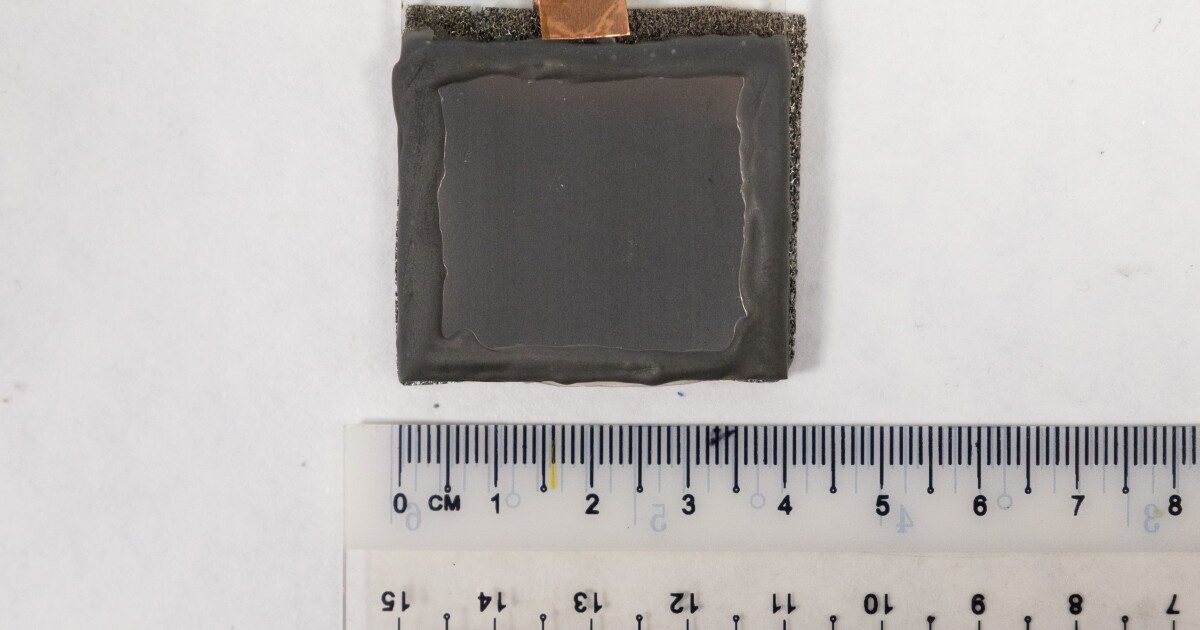
Hydrogen production from electrolysis is typically complex and energy-intensive. So is wastewater treatment. Inspired by leaves, which harness solar power to generate oxygen and carry out other processes, researchers at Nanyang Technological University in Singapore have developed a solar-powered device that generates hydrogen from seawater while simultaneously degrading hydrazine, a highly toxic industrial wastewater pollutant.Their proof-of-concept design essentially combines a miniature solar cell, an electrolyzer, and a wastewater treatment system into one device. In tests, the device maintained stable operation for over 72 hours, producing hydrogen at a rate of 466 μmol per square centimeter per hour. In a separate test, it also reduced the concentration of toxic hydrazine in contaminated water from 0.5 M (about 1.6% by weight) to 0.5 parts per billion (ppb), more than 20 times below the US Environmental Protection Agency’s permissible limit of 10 ppb, within approximately 30 hours.“This dual-function device represents a major leap forward for environmental technology. By efficiently harvesting solar energy to break down a toxic industrial pollutant while simultaneously harvesting clean fuel, we are solving both an energy problem and a pollution problem,” says Prof. Lydia Wong, one of the researchers. The not-very-leafy-looking artificial leafNTU Singapore Hydrogen, widely used as an industrial feedstock and increasingly used as a clean fuel, can be produced through electrolysis, an electrochemical process in which an electrolyzer uses electricity to split water molecules into hydrogen and oxygen gas. In conventional water electrolysis, hydrogen is produced at the cathode (negative electrode), while oxygen is released at the anode (positive electrode).Seawater is an attractive feedstock for this process, as it is abundant, offering a viable alternative to freshwater, which is already scarce in many parts of the world. The problem, however, is its high chloride content, which can corrode electrodes and other electrolyzer components, and also trigger unwanted reactions that produce toxic chlorine compounds. In a separate project, researchers at the University of Hong Kong developed a highly corrosion-resistant stainless steel alloy, dubbed SS-H2, to help overcome this problem.The NTU researchers took a different approach detailed in the journal Nature Communications: one that not only circumvents the corrosion problem but also simultaneously breaks down any hydrazine present in the seawater, while making the entire hydrogen production process more energy-efficient.You see, in conventional electrolysis, the supplied electricity drives two reactions simultaneously. At the cathode, water molecules gain electrons and produce hydrogen gas, while at the anode, they lose electrons to produce oxygen. The resulting oxygen is often released into the atmosphere, meaning a considerable amount of energy goes into producing a “waste” by-product.As an alternative, the researchers developed an anode that, instead of producing oxygen, breaks down hydrazine, a highly toxic industrial pollutant. To achieve this, they equipped the anode with a special catalyst that stimulates the breakdown of hydrazine into nitrogen gas, while also generating additional hydrogen through a secondary reaction. Interestingly, breaking down hydrazine requires significantly less energy than producing oxygen through conventional electrolysis.Therefore, the researchers' anode not only removes a toxic contaminant but also reduces the energy needed to produce hydrogen at the cathode, increasing the system's overall hydrogen-production efficiency. Furthermore, the catalyst itself contains iron, cobalt, and chromium. This combination also makes it corrosion-resistant and helps suppress the production of toxic chlorine compounds that would otherwise damage the electrodes.Now, the cathode wasn’t left out of the innovation either. Conventional electrolyzers rely on electricity supplied from an external source to drive the reaction that produces hydrogen. The researchers built the cathode from lead-halide perovskites, a semiconductor material that absorbs light and converts it into electrical energy. As a result, in addition to producing hydrogen, the perovskite photocathode also generates the electricity that powers the entire system, allowing the device to operate without an external power supply.However, perovskites are notoriously vulnerable to moisture and harsh chemical environments, posing a clear problem in seawater. To address this problem, the researchers protected the perovskite with a layer of conductive epoxy containing silver and copper particles, along with titanium foil that prevents water from reaching the sensitive semiconductor while allowing electrical charge to pass through. They also coated the titanium with a thin layer of platinum to facilitate hydrogen production.To test the device, the researchers placed it in alkaline solutions containing simulated seawater and actual seawater, with hydrazine added, and exposed it to artificial light equivalent to the intensity of sunlight on a clear day. In both cases, the device generated a photocurrent density of approximately 25 milliamps per square centimeter, among the highest reported for lead-based perovskite photocathodes, without requiring any external electricity. Artificial leaf device It also produced hydrogen at a rate of 466 micromoles per square centimeter per hour and maintained stable operation for over 72 hours without any significant drop in performance. The researchers then built a larger version, increasing the photocathode area from 0.56 to 6.25 square centimeters, to test its ability to remove hydrazine from water. After about 30 hours, the device reduced the hydrazine concentration from 0.5 molar (about 1.6% by weight) to 0.5 parts per billion, well below the 10 parts per billion limit the researchers cited.They also tested the artificial leaf outdoors under natural sunlight, where they observed hydrogen and nitrogen bubbles forming, proving the system could operate outside laboratory lighting conditions. The work is very similar to an earlier “artificial leaf” project by Rice University researchers that turned water and sunlight into hydrogen fuel, but with the added advantage of contamination removal.“The breakthrough here lies not simply in producing solar hydrogen but in demonstrating a practical route towards multifunctional photoelectrochemical systems. Such dual-purpose approaches are likely to play an increasingly important role in the future deployment of solar fuels technologies, where economic value and environmental impact must go hand in hand,” says Professor of Photochemistry and Sustainable Energy at the University of Oxford, James Durrant, who was not involved in the research.So, is the device about to “revolutionize” global hydrogen production from seawater electrolysis? Not quite. One of the device's benefits is, interestingly, a limitation in another sense. Remember that anode that can degrade hydrazine? It turns out that it cannot function without said hydrazine present. The system needs the pollutant to function chemically. This means that it is suited to hydrogen production from and the treatment of hydrazine-contaminated wastewater, not general-purpose electrolysis.There's also some concern about the device's lead content. Lead-halide perovskites absorb light well, but they degrade in water. The researchers addressed this limitation using protective layers containing conductive epoxy and titanium foil. However, keeping the materials stable and preventing contaminant leakage over years of operation remains a challenge.Perhaps most importantly, the system is still in the proof-of-concept stage. Full-scale, industrial applications require significant scaling and viability beyond 72 hours. The researchers acknowledge the need to improve the system's long-term durability, hydrogen collection, scalability, and integration with existing systems, while also ensuring it can handle the varying chemical compositions and pH levels of real seawater and industrial wastewater. They are also developing catalysts that degrade other pollutants and convert waste materials into useful products such as fuels and industrial chemicals.Source: Nanyang Technological University
Solar-powered 'leaf' generates hydrogen while purifying seawater
Full Article
Original Source
Read the full article at Newatlas →KhanList aggregates and links to publicly available news content. We do not host full articles from third-party sources. Always verify important information with original sources.