
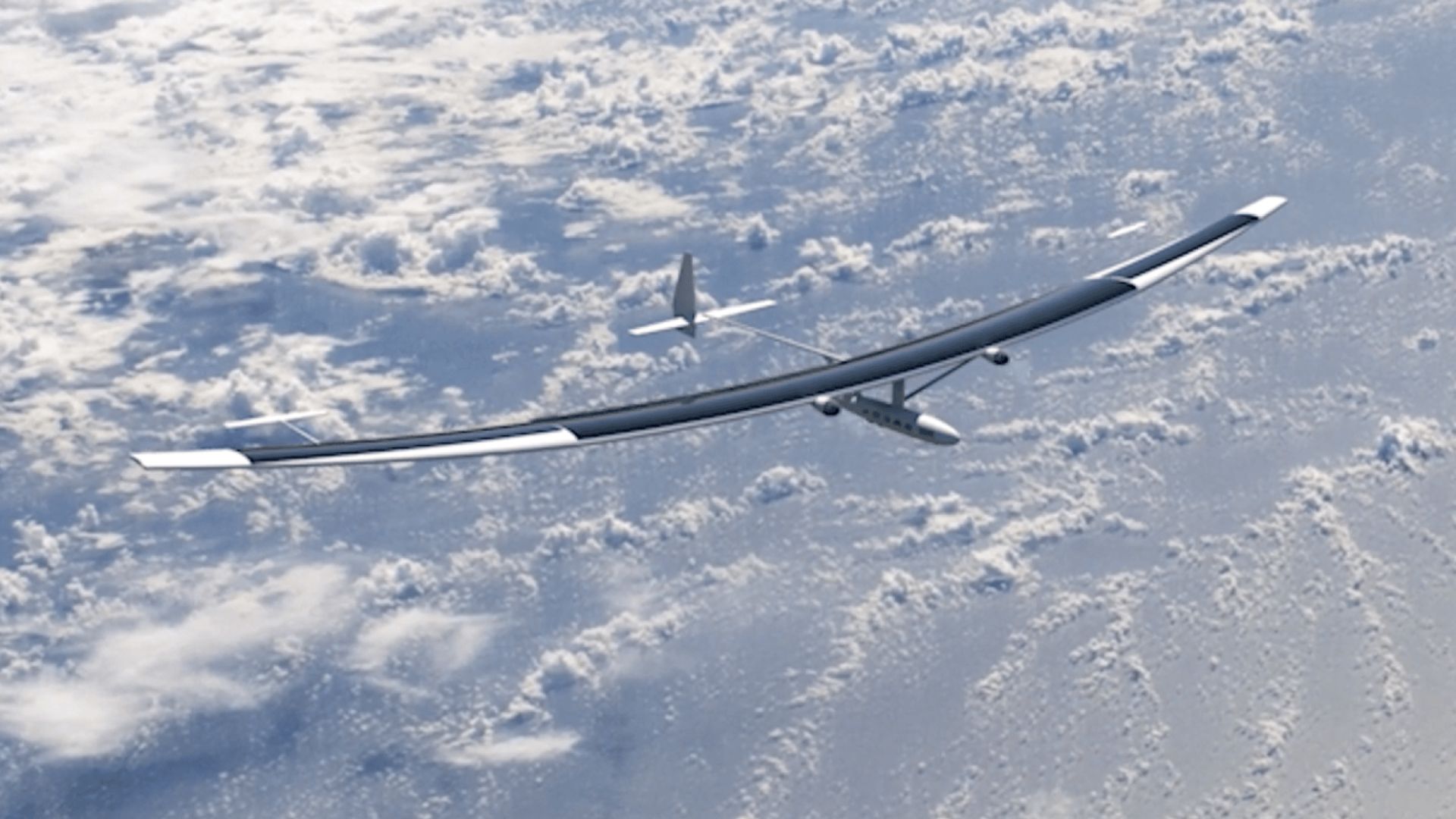
Keeping a solar-powered aircraft in the sky after sunset requires a difficult trade-off: larger batteries store more energy, but their weight makes the airplane consume more power. A new US-led study identifies a battery performance target that could help pilotless aircraft stay airborne for weeks or months. Their analysis identifies an energy density of 500 watt-hours per kilogram (Wh/kg) as an important threshold for persistent solar flight across regions where atmospheric conditions permit. Such aircraft would operate in the stratosphere, around 60,000 feet above Earth, collecting observations for climate research, hurricane tracking, and wildfire monitoring. Solar panels would power daytime operations and charge batteries to sustain flight through the night. Solving the battery weight problem Craig Mascarenhas, who spearheaded the study through Harvard atmospheric scientist Jim Anderson’s laboratory, described the engineering challenge. “It’s this circular mathematical relationship where you need more energy storage, but the batteries become heavier, so now you need more power to push it through the air to get more lift,” he explained. The researchers argue that battery development for these aircraft should prioritize energy density, which measures how much energy a battery stores relative to its weight. Power density, which describes how quickly that energy can be delivered, is less critical here. These aircraft require relatively little power, but must carry enough stored energy to keep flying throughout the night. A 500 Wh/kg performance target The proposed threshold is roughly double the approximately 250 Wh/kg figure cited for commercial electric-vehicle batteries. Experimental and specialty cells already reach around 400 Wh/kg, bringing the target closer, although cost remains a barrier. “We’re almost there. Those cells are very expensive right now, but they’re getting cheaper very quickly,” Mascarenhas said. The findings set a development target rather than demonstrating a new battery or a months-long aircraft mission. Achieving persistent flight would also depend on local atmospheric conditions. Battery researchers Venkatasubramanian Viswanathan and Shashank Sripad contributed to the analysis. Aerospace entrepreneur John Langford, whose companies have built and flown experimental solar aircraft, also co-authored the paper. Longer observation windows for wildfire research Anderson has worked on solar aircraft concepts for three decades and leads Harvard’s involvement in the Stratospheric Airborne Climate Observing System, or SACOS. The potential advantage is sustained observation. NASA’s piloted ER-2 research aircraft typically conducts missions lasting six to eight hours, with flight costs reaching tens of thousands of dollars per hour, according to the supplied research account. Solar aircraft could eventually revisit the same area repeatedly over months, potentially reducing staffing needs and operating costs while providing longer observation windows. Anderson and Mascarenhas are also guiding research intended to support deep-learning and radiative transfer models for wildfire mapping and environmental sensing. “I’m passionate about reducing the damage and destruction from wildfires across the world. I think the capabilities that this project uniquely unlocks are very exciting,” Mascarenhas said. Researchers at Harvard’s John A. Paulson School of Engineering and Applied Sciences, working with the University of Michigan and industry collaborators, outlined the pathway in ACS Energy Letters.Get the latest in engineering, tech, space & science - delivered daily to your inbox.Atharva is a full-time content writer with a post-graduate degree in media & amp; entertainment and a graduate degree in electronics & telecommunications. He has written in the sports and technology domains respectively. In his leisure time, Atharva loves learning about digital marketing and watching soccer matches. His main goal behind joining Interesting Engineering is to learn more about how the recent technological advancements are helping human beings on both societal and individual levels in their daily lives.
Solar planes at 60,000 feet could fly for months with 500 Wh/kg batteries: US study
Full Article
Original Source
Read the full article at Interestingengineering →KhanList aggregates and links to publicly available news content. We do not host full articles from third-party sources. Always verify important information with original sources.