
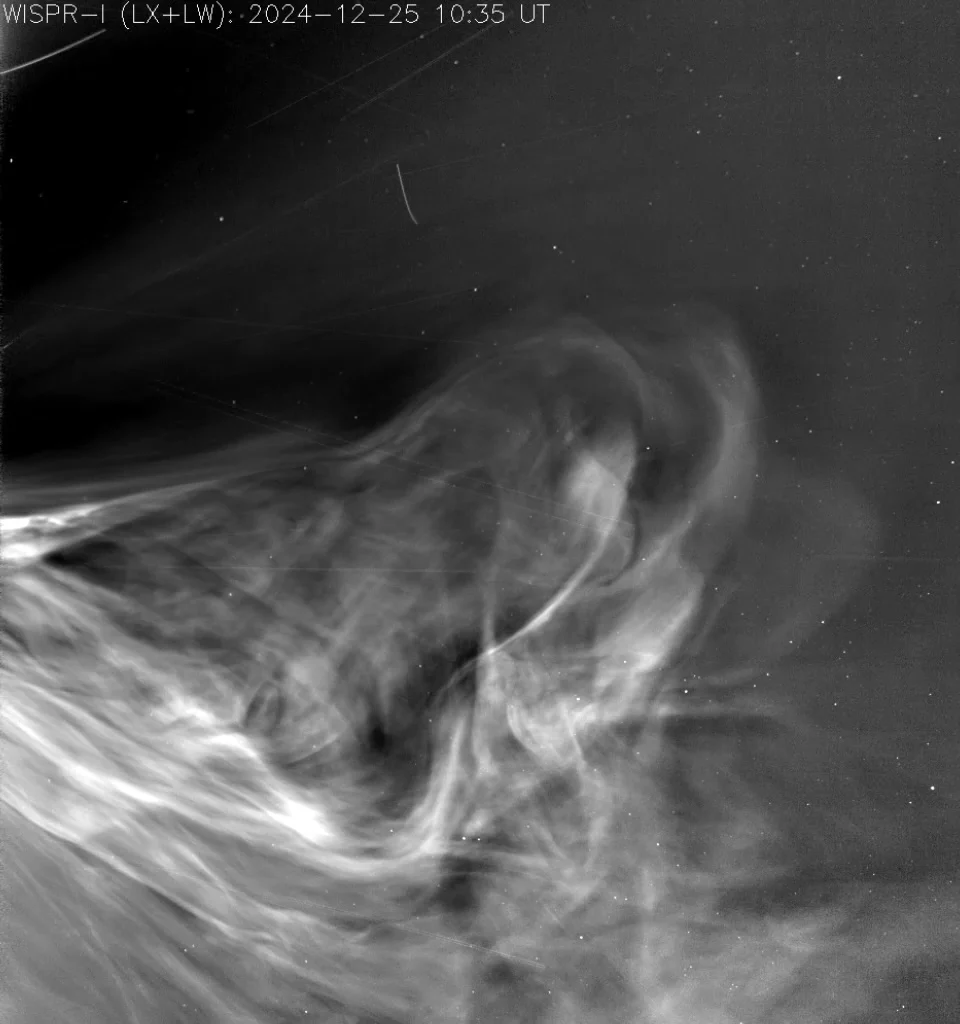
There has been a torrent of solar physics data lately, largely thanks to new spacecraft that have begun actively observing the Sun. One of those spacecraft, Solar Orbiter, happened to have a serendipitous encounter with a type of solar physics phenomenon known as a “switchback”. A new paper, available in Nature Astronomy from researcher Jesse T. Coburn and their co-authors, describes how that serendipitous encounter allowed them to track the switchback back to its birthplace in the solar corona for the first time. Switchbacks are important in our understanding of solar physics because of how they tie into the solar wind - the supersonic stream of charged particles that consistently blows from the surface of the Sun out into space. Modern spacecraft have shown that violent kinks in the Sun’s magnetic field, which they called “switchbacks”, directly affect the flow of these particles, and therefore, the exposure the wider solar system gets to the solar wind more generally. We’ve known switchbacks have existed for a while. NASA’s Parker Solar Probe has spotted massive amounts of them. But scientists have been debating where exactly they form, which would help inform how exactly they affect the wind. The two leading theories are that they were either formed in deep space due to turbulence inside the wind itself, or in the Sun’s extraordinarily hot corona. Fraser and Pamela discuss the Parker Solar Probe. The breakthrough that helped answer this question began as a serendipitous encounter on March 2, 2022, when Solar Orbiter was cruising through the solar system at roughly half the distance between Earth and the Sun. Its onboard magnetometers and particle sensors began to pick up data that indicated it was diving through a major switchback, with elevated readings lasting around an hour and a half. Given the speed the craft was going (around 30-40 km/s) and the speed the switchback was passing it (around 450-460 km/s), that would put the radial size of the switchback itself at around 2.75 million kilometers - about 6 times the distance from the Earth to the Moon, and even 3.5 times the radii of the Sun itself. During that hour and a half of serendipity, Solar Orbiter collected data via its Heavy Ion sensor. From that data, the researchers noticed an increase in oxygen and carbon ions that had been stripped of their electrons, as well as a decrease in helium when compared to expected levels. In the hot lower reaches of the atmosphere, heavy ions are stripped of their electrons, but once they move out toward open space, the temperature drops so they no longer lose them, but they also don’t gain them back. Essentially, this preserves the heavy ions at the same state they were in when the plasma was formed. According to the data from Solar Orbiter, it seemed pretty clear that the plasma it encountered in the switchback had been baked at over one million degrees Celsius - most likely in the Sun’s extremely hot corona. To confirm their suspicion, they cross referenced data from the Solar Dynamics Observatory that happened at the same time Solar Orbiter had crossed the switchback, and mapped the plasma back to a closed magnetic loop near a feature called a coronal hole on the Sun. Fraser talks about how we are now able to see the Sun's poles with Solar Orbiter. Coronal holes are darker, cooler regions where the magnetic fields from the Sun stretch out into interplanetary space. They contrast to coronal loops which are hot arcs of plasma that are anchored on both ends to the solar surface. Since the plasma was clearly formed in a closed loop, the researchers concluded that the switchback itself was launched by a process known as an interchange reconnection. An interchange reconnection happens when the arc that makes up part of the loop, encounters an open magnetic field line. This causes the line to “snap”, temporarily breaking the arc, and then reconfigure in a different position. During this process, some of the superheated gases that make up the arc are slingshotted into interplanetary space, creating the "switchback" feature that Solar Orbiter soared through. Seems simple enough. But the team noticed there was a discrepancy with the motion of the particles within the switchback. If they were simply slingshotted out of the broken arc, they would simply travel straight. Instead, they seem to behave in sync with magnetic field lines, creating a feature that looks similar to an Alfven wave, a type of magnetic wave that travels along field lines in a similar pattern to how mechanical waves travel down a guitar string. So the creation of the switchback wasn’t as simple as just being shot out into space from a broken magnetic arc - once launched it is also governed by the wave dynamics of its constituent plasma. Understanding this hybrid behavior is a big step forward in our understanding of heliophysics. There’s still a lot we don’t know about the Sun’s corona. But keep the data and discoveries coming from all these new instruments, please. Right now must be a great time to be a solar physicist. Learn More: ESA - Solar Orbiter tracks origin of mysterious magnetic switchbacks J. T. Coburn et al - On the coronal origin of magnetic switchbacks in the solar wind UT - Solar Orbiter Captures the First Ever Image of a Magnetic Solar Switchback on the Sun UT - Why is the Sun's Corona So Hot? One Hypothesis Down, Many to Go
Solar Orbiter Traces Giant Magnetic Switchbacks Directly Back to the Sun
Full Article
Original Source
Read the full article at Universetoday →KhanList aggregates and links to publicly available news content. We do not host full articles from third-party sources. Always verify important information with original sources.