
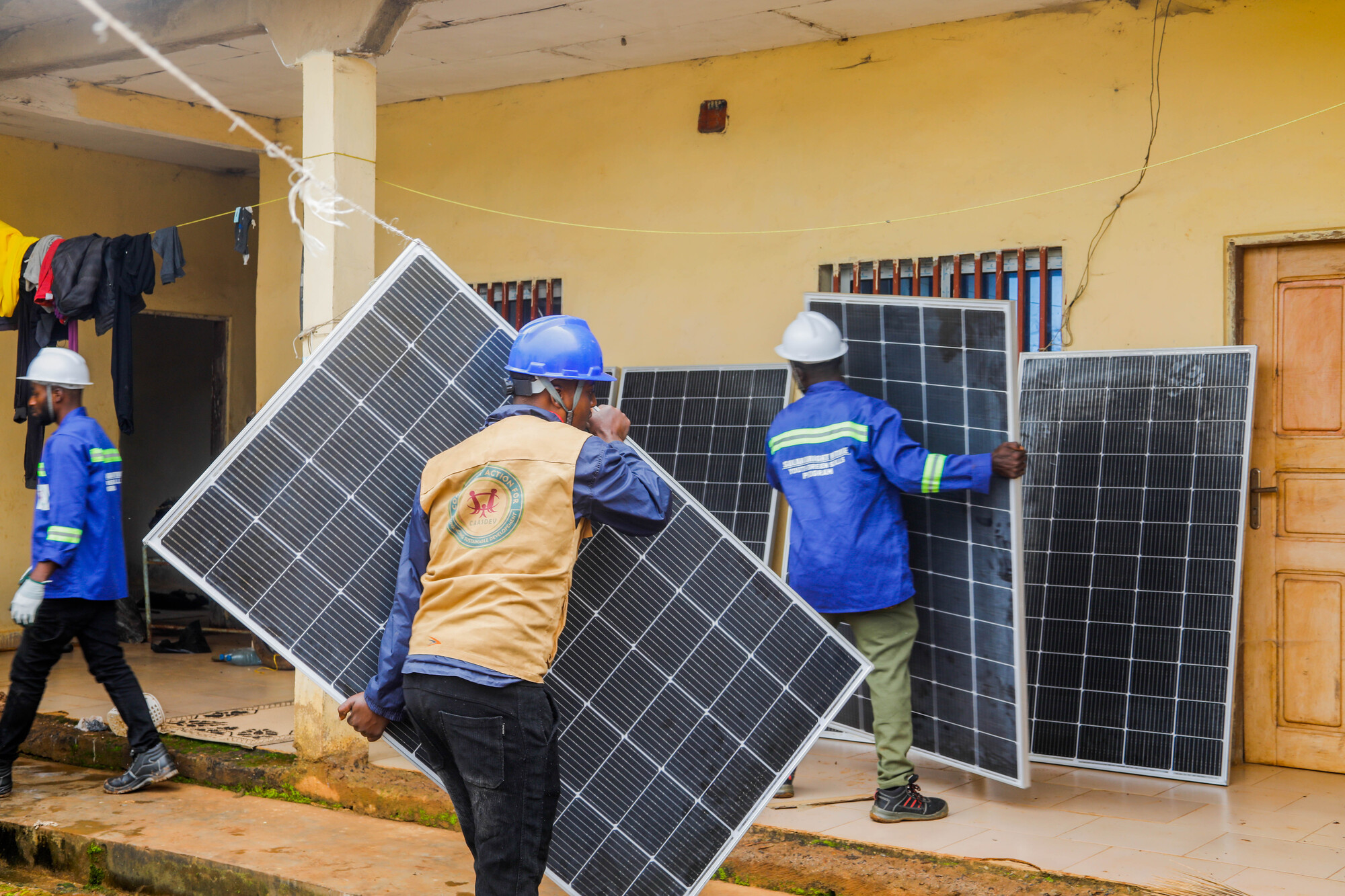
At least 300 young people affected by a civil war in Cameroon’s Northwest and Southwest regions are helping protect newborns in maternity wards they’ve equipped with solar energy.More than 100 maternity wards now benefit from solar power thanks to youths trained over the past three years by the Cameroonian company Solar Bright Future, a subsidiary of local NGO Action for Advancing Sustainable Development.The initiative, which creates an opportunity for young people displaced by the war, is a finalist for the “Heroes of Tomorrow: U.N. SDG Action Awards,” with the winners to be announced on Oct. 29. In Cameroon’s Northwest and Southwest regions, where a civil war has dragged on for 10 years, abundant sunshine has become a source of hope and opportunity for hundreds of young internally displaced people, and a lifeline for the next generation. The fighting has choked off job opportunities for youth and worsened the collapse of basic public services. Rural communities here face acute electricity shortages and have very limited access to quality health care. Mothers often give birth in the dark, and their children risk missing vital vaccines because clinics lack reliable power to provide lighting or appropriate cold storage for vaccines. To address these threats to newborn survival across local health centers, Cameroonian clean-energy company Solar Bright Future, a subsidiary of local NGO Action for Advancing Sustainable Development (CAASDEV), set out to equip maternity wards with solar power in crisis-affected facilities through a program that trains young people displaced by the conflict. The company installs solar power systems for maternity lighting and solar-powered vaccine cold-chain systems for safe vaccine preservation, with temperature monitoring. Their systems can also support equipment such as echography or ultrasound machines and sterilization devices, depending on system capacity. Equipment that runs on solar power at the Tugi integrated health centre in the Northwest region of Cameroon. Image courtesy of Ndze Noel Lifogha/Solar Bright Future. The tragedy of the twins Ndze Noel Lifogha, chief executive of Solar Bright Future, said in an interview with Mongabay that the initiative grew out of a tragedy at a clinic without electricity in Northwest several years ago. A woman displaced by the war reportedly lost her newborn twins after a kerosene lamp in the clinic sparked a fire that killed one of the infants on the spot. The second baby survived the flames but died days later, after being discharged from the clinic, according to Lifogha. The baby was especially vulnerable because it had not been vaccinated, as the health facility lacked electricity to refrigerate vaccines. “Based on that experience, we had to think about how to address this challenge of energy poverty,” he said. “So we came up with the idea of solar energy, which would allow us to train young people in solar skills in order to provide essential services in maternity wards.” Lifogha added: “Our approach is therefore an integrated solution that responds to the challenges of energy poverty, youth unemployment, climate change and maternal healthcare in conflict-affected communities in Cameroon’s Northwest region.” Over the past three years, the company has trained at least 300 internally displaced men and women between 18 and 35 years old from Northwest to install and maintain solar power systems. Solar Bright Future has already brought solar power to 164 health facilities. That comprises 41 clinics equipped with lighting systems and 123 fitted with solar units dedicated to powering vaccine cold chains. According to the United Nations Development Programme (UNDP), which supports solar initiatives in crisis-affected Cameroonian communities, more than 1,200 health facilities in the areas served by the project still face severe electricity shortages. Many operate without dependable power or still rely on fuel generators and kerosene lamps. The UNDP is working closely with the Cameroonian government to provide sustainable solutions to the energy deficit facing health centers across the conflict-affected regions. Mathieu Ciowela, resident representative of the UNDP in Cameroon said, “We prioritize facilities that are not connected to the electrical grid or whose power supply is very unstable, that serve rural and remote communities, that provide essential maternal and child health services, and that have critical needs for reliable lighting or power supply for the vaccine cold chain.” Internally displaced persons installing solar panels at a health center in northwestern Cameroon as part of the “Solar Bright Future” program. Image courtesy of the United Nations Sustainable Development Goals Action Campaign, an initiative of the UNDP. ‘I have found purpose’ Youths who complete Solar Bright’s three-month training program, during which they support the health care facilities, receive certificates recognized by Cameroon’s Ministry of Vocational Training. In addition to helping improve health care for children in conflict zones, they gain direct access to the job market and earn an income to support themselves. “At least 60% of our graduates have already found a job, whether formal or informal,” Lifogha said. “The solar sector is an area where, as soon as you acquire the necessary knowledge, you jump right in. People need energy; then it is just a matter of negotiating, landing contracts, and starting to earn money right after graduating.” Kudus Sony Kangimi, a 31-year-old former security guard who took part in the program, told Mongabay that being part of this initiative transformed his life. “From guarding gates to leading green solutions that bring light and cleanliness to my community, I have found purpose,” he said. “It proves that despite the war, we youth can move from vulnerability to leadership and bring real hope, care, and sustainable change to our community,” Kangimi said. Lifogha said 20% of graduates have started their own businesses, providing energy services to their communities. For its work strengthening infant health care in maternity wards across Northwest through solar power, Solar Bright Future was selected as a finalist for the “Heroes of Tomorrow: U.N. SDG Action Awards” in the “Resilience” category. The competition is a special initiative of the U.N. secretary-general hosted by the UNDP. Winners will be announced Oct. 29. Banner image: Internally displaced persons installing solar panels at a health center in northwestern Cameroon as part of the “Solar Bright Future” program. Image courtesy of the United Nations Sustainable Development Goals Action Campaign, an initiative of the UNDP. Feedback: Use this form to send a message to the author of this post. If you want to post a public comment, you can do that at the bottom of the page. Cite this articleYannick Kenné (2026). Solar initiative brings power to clinics and jobs to displaced youths in Cameroon. Mongabay Conservation news. DOI: https://doi.org/10.66709/news-333877 Credits Topics
Solar initiative brings power to clinics and jobs to displaced youths in Cameroon
Full Article
Original Source
Read the full article at News →KhanList aggregates and links to publicly available news content. We do not host full articles from third-party sources. Always verify important information with original sources.