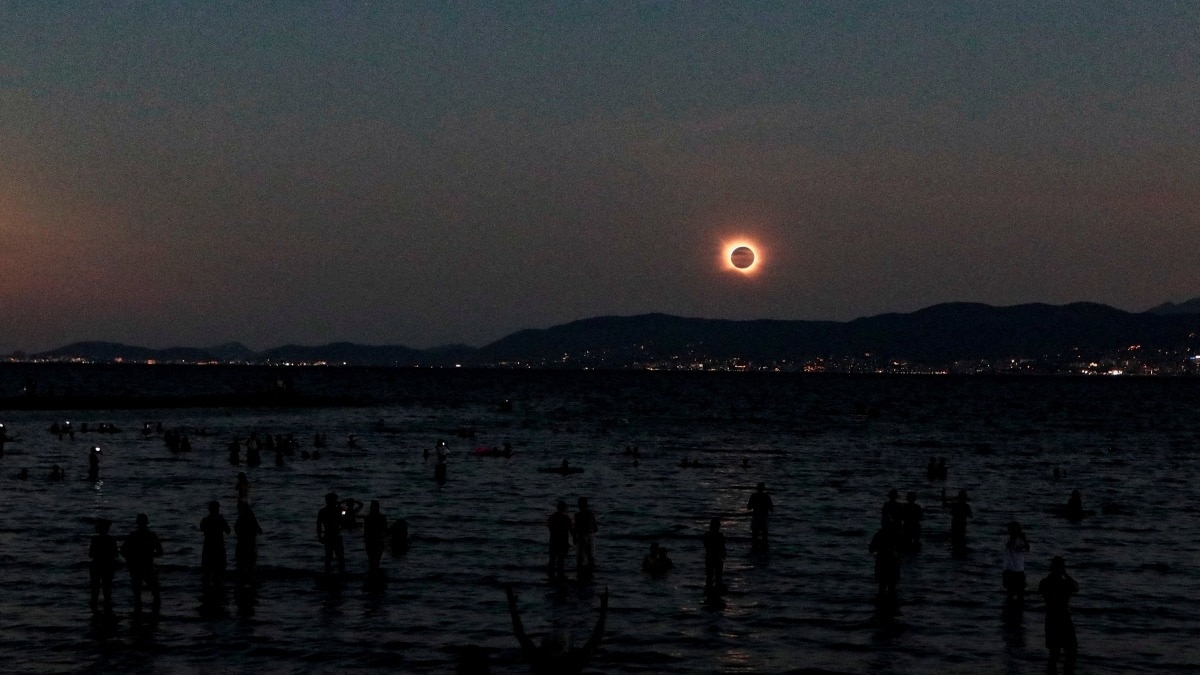
Millions across Europe, Greenland and the Atlantic watched the total solar eclipse of 12 August 2026. For India, the next chance to see totality will come on 20 March 2034.The "diamond ring" effect appears as the moon moves across the sun during a total solar eclipse, as seen from El Arenal beach in Mallorca, Spain. (Photo: Reuters)Millions of skywatchers across Europe, Greenland and parts of the Atlantic witnessed the spectacular total solar eclipse of August 12, 2026, as the Moon completely blocked the Sun and plunged parts of the daytime world into darkness.A total solar eclipse occurs when the Moon passes directly between Earth and the Sun, completely covering the Sun's bright disk.For a few precious minutes, observers within the narrow path of totality can see the Sun's faint outer atmosphere, known as the corona, while the sky darkens dramatically. The moon partially covers the sun during a solar eclipse over mountains near the northern Spanish town of Reinosa. (Photo: Reuters) But for India, the celestial event remained out of sight. If you missed the eclipse and are wondering when India will get its next chance to witness totality, the wait will be a long one. The next total solar eclipse visible from India will occur on March 20, 2034, nearly eight years from now.The 2034 eclipse is expected to be one of the most significant astronomical events of the decade for India. The path of totality will sweep across a vast region stretching from North Africa and the Middle East into South Asia. ICYMI: Spanish Skateboarder Pulls Off 'Move of Life' During Total ExcipseDanny León pulled off a jump timed to the exact moment the Moon passed in front of the Sun during the partial solar eclipse.He called it “the move of his life.”Danny_leon / Social Media https://t.co/qSoVfpQRSr pic.twitter.com/ArAMaoy19D— RT_India (@RT_India_news) August 13, 2026According to eclipse projections, the shadow of the Moon will cross India, Pakistan, Afghanistan, Iran, Saudi Arabia, Egypt and several African nations before continuing eastward across Asia.Unlike the 2026 eclipse, which was visible mainly across parts of Europe and the North Atlantic, the 2034 event will offer millions of people in South Asia an opportunity to experience totality without travelling overseas. The moon completely covers the sun during a solar eclipse near the silhouette of an Osborne Bull, in Navarrete, northern Spain. (Photo: Reuters) For astronomy enthusiasts, the long wait may be worth it. Total solar eclipses are among the rarest and most dramatic natural phenomena visible from Earth. During totality, temperatures can drop, birds may fall silent and bright stars and planets can briefly appear in the daytime sky.Until then, Indian skywatchers will still have several celestial events to look forward to, including meteor showers, lunar eclipses and partial solar eclipses. The moon partially covers the sun during a solar eclipse over the Prague Castle, as seen from Prague, Czech Republic. (Photo: Reuters) But for those dreaming of seeing the Sun disappear entirely behind the Moon, March 20, 2034, is the date to circle on the calendar. It will be India's next rendezvous with one of nature's most breathtaking spectacles.- EndsPublished By: Sibu Kumar TripathiPublished On: Aug 13, 2026 11:09 IST
Solar eclipse pics are stunning. It will be visible over India on this date
Full Article
Original Source
Read the full article at Indiatoday →KhanList aggregates and links to publicly available news content. We do not host full articles from third-party sources. Always verify important information with original sources.