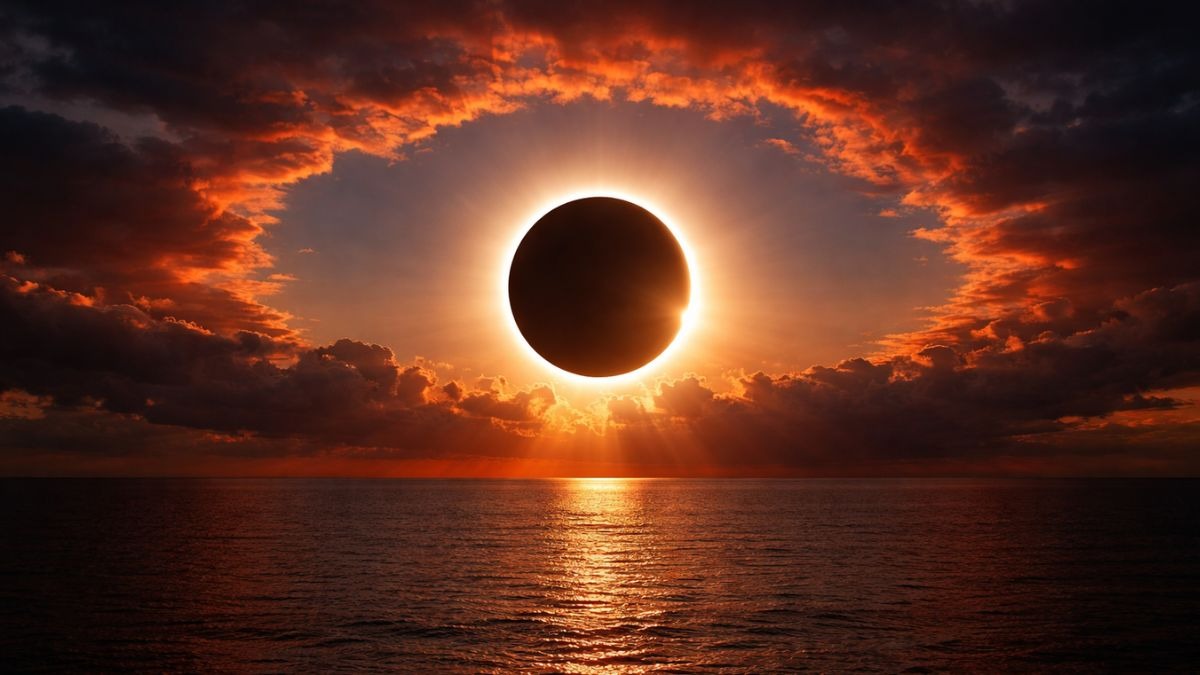
One of the biggest astronomical events of 2026 is just around the corner.On August 12, a total solar eclipse will sweep across parts of the Northern Hemisphere, briefly turning day into twilight for millions of people along its path.The rare celestial event will give scientists and skywatchers a unique opportunity to observe the Sun's outer atmosphere, or corona, which is normally hidden by the Sun's bright glare.The eclipse will begin at around 2:30 pm IST on August 12, reach its maximum at around 5:15 pm IST, and end close to 8 pm IST. A total solar eclipse in 2024 is pictured. (Photo: Unsplash) WHY IS THE SOLAR ECLIPSE A MAJOR EVENT?A total solar eclipse occurs when the Moon passes directly between the Earth and the Sun, completely blocking the Sun's bright disc for observers located along a narrow corridor known as the path of totality.For a few minutes, the sky darkens enough for the Sun's faint corona to become visible, creating one of nature's most spectacular sights. The August 12 event is particularly significant because it will be the only total solar eclipse anywhere in the world in 2026.The path of totality will cross Greenland, Iceland, the Atlantic Ocean, northern Spain, a small part of northeastern Portugal and northern Russia.Many surrounding regions, including parts of Europe, North America and northwestern Africa, will witness a partial solar eclipse.On Aug. 12, a total solar eclipse will cross Greenland, Iceland, and Spain — and NASA science will be there!We're flying high-altitude jets and launching scientific balloons to study the Sun and the eclipse's effects on us: https://t.co/zPn8UavJ3m: NASA/Ernie Wright pic.twitter.com/wVJzVGJ3Ao— NASA Solar System (@NASASolarSystem) July 27, 2026For scientists, total solar eclipses are rare opportunities to study the Sun's corona, solar magnetic activity and how Earth's atmosphere responds to the sudden loss of sunlight.Nasa is expected to support the event with aircraft observations and high-altitude balloon missions to gather valuable scientific data.WILL THE ECLIPSE BE VISIBLE IN INDIA?The total solar eclipse, however, is not going to be witnessed directly in India.In fact, no phase of the August 12 eclipse will be visible as the Moon's shadow will pass over parts of the North Atlantic and Europe rather than South Asia.Although Indians will miss the spectacle in person, the eclipse is expected to draw global attention, with space agencies, observatories and science organisations likely to livestream the event for viewers around the world. A woman uses special protective glasses to observe a total solar eclipse. (Photo: Reuters) Experts also remind people that the Sun should never be viewed directly without certified eclipse glasses or approved solar filters, except during the brief period of totality for observers located exactly within the Moon's shadow.- EndsPublished On: Aug 1, 2026 16:57 IST
Solar eclipse incoming: When is it and will India be able to watch?
Full Article
Original Source
Read the full article at Indiatoday →KhanList aggregates and links to publicly available news content. We do not host full articles from third-party sources. Always verify important information with original sources.