
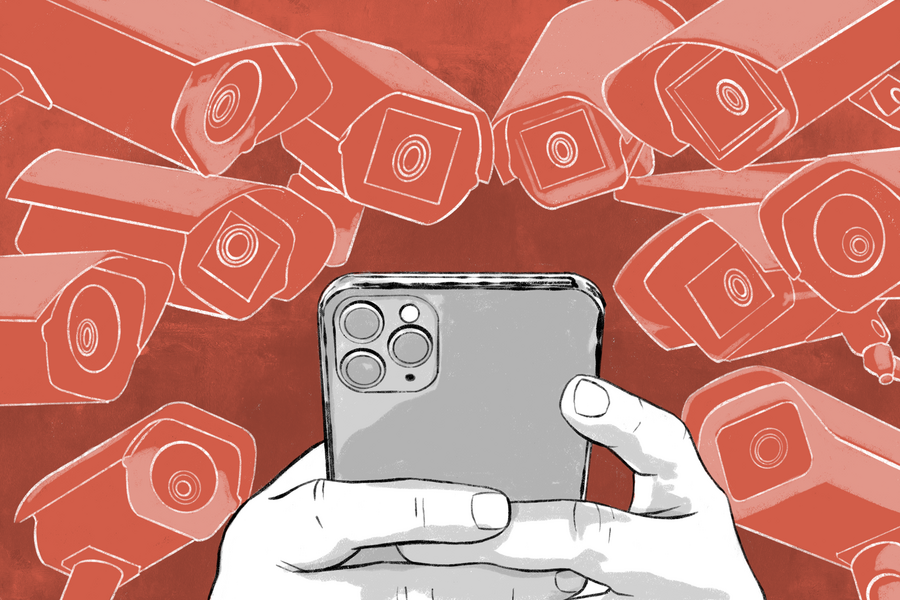
The future of a lawsuit challenging the Trump administration’s right to surveil immigrants’ social media posts using artificial intelligence was thrown into doubt Wednesday following the sudden death of a federal judge who only weeks ago ruled the case could move forward.“Plaintiffs’ allegations are of an ongoing surveillance program that is actively chilling the speech of their members and otherwise causing harm. ... I agree,” U.S. District Court Judge Alvin K. Hellerstein wrote on Oct. 1.In the wake of Judge Hellerstein’s death, a new judge will be “randomly” assigned to his cases, according to the district executive for the Southern District of New York. The surveillance suit, brought by three of the nation’s major labor unions, argues that the government’s monitoring of millions of visa and green card holders’ online activity is a form of “viewpoint discrimination” that violates the First Amendment. The unions say that’s already resulted in “adverse immigration action” based on the beliefs those immigrants profess.The groups, which include the United Auto Workers, Communications Workers of America and American Federation of Teachers, also allege the State Department and Department of Homeland Security failed to follow federal rules when they implemented the program, violating the Administrative Procedure Act.The government had sought to quash the suit, arguing the unions lacked standing. In its filing, the government acknowledged the practice of reading some immigrants’ social media posts, but described it as a targeted effort. “There is no monolithic government surveillance program,” Assistant U.S. Attorney Jennifer Jude wrote in a motion to dismiss the lawsuit, arguing that the plaintiffs collected unrelated instances to craft their complaint.No injunction to block social media reviewJudge Hellerstein’s death would appear to be a setback to plaintiffs, which might now have to proceed before a less favorable jurist or face delays as the judge’s cases are reassigned. Judge Hellerstein, who was in his 90s, was a senior federal judge in the U.S. District Court in Manhattan. Appointed by President Bill Clinton in 1998, he handled litigation that stemmed from the Sept. 11, 2001, terrorist attacks, and was presiding over the prosecution of former Venezuelan President Nicolás Maduro. Last year, he blocked the Trump administration from using the Alien Enemies Act of 1798 for deportation from his district.For now, the Trump administration’s surveillance programs will be allowed to continue.That’s because, while Judge Hellerstein allowed the case to proceed, he did not impose an injunction that immediately ordered the Trump administration to stop reviewing immigrants’ social media posts. Amanda Swinhart/AP/FileMohsen Mahdawi speaks outside the courthouse after a judge released the Palestinian student activist, in Burlington, Vermont, April 30, 2025. Margaret Hu, a law professor at William & Mary Law School, says the case is in early stages and is moving slowly. “We are still far away even from an injunction being granted to shut down the challenged surveillance program,” she says.A case management conference, where the judge is expected to set rules for discovery, is scheduled for Nov. 12.A State Department spokesperson said the agency doesn’t comment on ongoing litigation. A DHS spokesperson declined to comment on investigative methods or ongoing investigations, but in an email offered this on the department’s general use of technology: “Like other law enforcement agencies, ICE employs various forms of technology while respecting civil liberties and privacy interests.” The plaintiffs argue the government could not surveil at scale by manually scouring the internet, since there are about 55 million visa holders in the country. But, by using “automated and Al systems,” it alleges that the government “can review and process large volumes of social media and online activity at a scale previously difficult or impossible to analyze with human review alone.”Citing federal contracts, the complaint shows that the State Department and the DHS have bought access to a range of AI-powered online activity monitoring tools: including Fivecast ONYX, which its maker says can “track shifts in sentiment and emotion” in a person’s posted data; and Penlink’s Tangles, which the complaint says is a “social media monitoring product” that can perform facial recognition on images, sentiment analysis on posts, and add specific social media accounts to a “watch list.” Rodrique Ngowi/AP/FileRümeysa Öztürk, a Tufts University student and visa holder from Turkey who was detained by immigration agents in March 2025, speaks to reporters at a news conference in Boston, May 10, 2025. Ms. Öztürk had been held for six weeks in a Louisiana immigration detention center. The complaint also refers to a 2025 report about the State Department’s “Catch and Revoke” program that surveils student visa holders, saying that when they “find those who have supported terrorists or otherwise abused our hospitality, their visas are instantly revoked.”Saira Hussain, a senior staff attorney at the Electronic Frontier Foundation, and one of the lawyers representing the plaintiffs said the surveillance represented a form of retaliation, “designed to stop people from speaking in ways that the government doesn’t want them to be speaking.”What makes this lawsuit unique, legal experts say, is that it’s targeting the system of surveillance.It’s “an interesting attempt to attack the government repression of immigrants’ free speech rights at a systemic level by addressing the surveillance policies rather than the individual deportation cases,” says Michael Kagan, a law professor at the University of Nevada, Las Vegas.Case hinges on issue of free speech for noncitizensTwo main questions tug at the core of this lawsuit, Mr. Kagan adds: “Do noncitizens have the right to free speech? And if yes, what is the remedy when the government represses that speech?” This isn’t the first time courts are debating these questions. Last year, U.S. District Judge William Young, an appointee of Republican President Ronald Reagan, ruled that lawful noncitizens have the same free speech rights as citizens. That case was filed by a group of university associations that cited early arrests like that of green-card holder and Columbia University graduate Mahmoud Khalil, a leader in campus protests against Israel’s military campaign in Gaza.But earlier this year, Judge Young limited the protection his ruling provided to the members of the group that brought on this case. Seth Wenig/APMahmoud Khalil speaks during a news conference in New York, July 14, 2026. The current lawsuit also cites such similar examples, and explains the role of social media surveillance. The lawsuit alleges that Homeland Security Investigations analysts compiled online information and social media posts by Mr. Khalil – an Algerian citizen – where he expressed support for Palestinians, following which he was arrested in March 2025. During the same month, the complaint says the administration “made a very public example” by arresting Rümeysa Öztürk, a Tufts University graduate student and F-1 visa holder. They alleged that Ms. Öztürk was surveilled online and her online op-ed in the Tufts student newspaper was obtained by HSI analysts as evidence that eventually contributed to her visa to be revoked.A month later, the complaint alleges, Mohsen Mahdawi, at the time a student at Columbia University, was arrested right after his naturalization interview, in part because screenshots of his social media posts showed support of Palestinians.The surveillance program, the complaint says, has made several noncitizens reluctant to share union posts online or join union-related group chats. In some cases, members have deleted online posts or disabled their social media accounts.“They’re seeing their members disengaging both online, but also in person in real life,” says Ms. Hussain. “Because of concerns that if they’re associated with the union, if they speak too loudly on behalf of the union, or if they speak at all, that could be something that the government uses against them and terminates their student visa or whatever other status they have.” Rachel Levinson-Waldman, director of the Brennan Center’s Liberty and National Security Program, says this case is “a really strong endorsement of First Amendment protections for speech of non-citizens in the U.S.” while also showing the significant impact of the administration’s threats to punish dissenting viewpoints.While the plaintiff’s claims are compelling, according to Ms. Levinson-Waldman, the more important detail in the case moving ahead is that the court iterated how the government does not have total discretion as soon as anything immigration-related comes into the picture. “Instead, where a case does not specifically involve an individual’s removal proceeding, courts can consider the issues and ensure that constitutional protections, democratic rights, and the rule of law are upheld,” she says. ALREADY A SUBSCRIBER? LoginReal news can be honest, hopeful, credible, constructive.The Christian Science Monitor was founded in 1908 to lift the standard of journalism and uplift humanity. We aim to “speak the truth in love.” Our goal is not to tell you what to think, but to give you the essential knowledge and understanding to come to your own intelligent conclusions. Join us in this mission by subscribing.
Social media surveillance case faces uncertainty after judge’s death
Full Article
Original Source
Read the full article at Csmonitor →KhanList aggregates and links to publicly available news content. We do not host full articles from third-party sources. Always verify important information with original sources.